



The outer part of the wishbone is bolted to the cross beam.
It should be taken into account that the suspension of cars with 2.1-liter diesel engines has a modified wishbone. In addition, the engine subframe of these engines has been reinforced.
An anti-roll bar is installed between both wishbones. Its ends are secured with the help of struts on the transverse levers. The stabilizer bar itself is attached to the lower part of the frame cross member using silent blocks and mounting clamps (see illustration 1.0). The diameter of the anti-roll bar is not the same for all car models. In most cases, the diameter is 25 mm. Some car models do not have a front suspension with an anti-roll bar, such as the Jumpy cars produced since 1997.
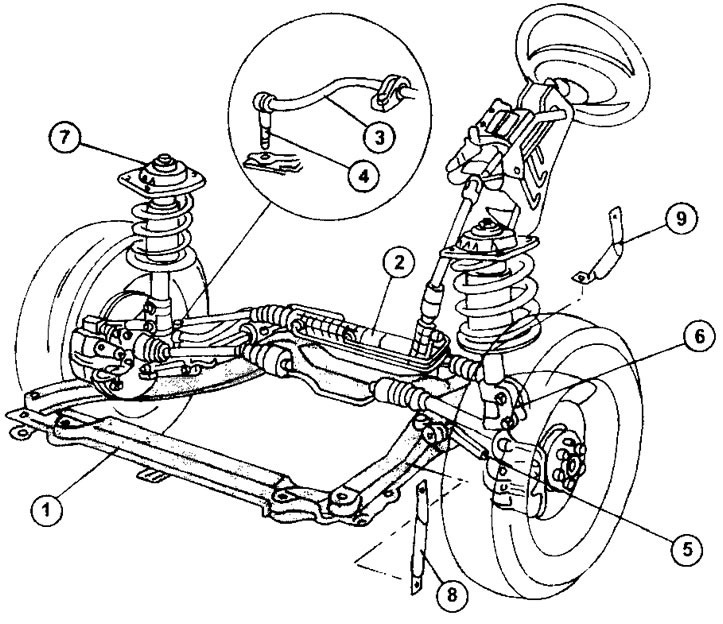
1.0 Front suspension
1 - sub-engine frame
2 - steering rack and power steering
3 - anti-roll bar
4 - the anti-roll bar is connected to the wishbone
5 - transverse suspension arm
6 - steering knuckle
7 - shock absorber strut with coil spring
8 - front stretch (not available on all models)
9 - rear stretch (not available on all models)
The outer ends of the drive shafts are secured in hub bearings. Shock absorber springs are not the same for all vehicles. Therefore, when replacing a spring, it is necessary to indicate the model and year of manufacture.
Please note: The ball joint pin diameter on CITROEN vehicles has been increased during production. Since this entailed a change in the hole on the knuckle for the ball joint pin, the steering knuckles themselves were correspondingly changed. If during the operation of the vehicle it becomes necessary to replace the steering knuckle, then it will be necessary to install a wishbone with a modified ball joint. To avoid purchasing a knowingly inappropriate part, it is imperative to indicate the vehicle identification number or year of manufacture.