
English Русский
Български
Беларускі
Український
Српски
Hrvatski
Română
Polski
Slovenský
Magyar
Bookmark Articles Sitemap Contacts
Company Hyundai Company Opel Company Skoda Company Kia Company Mitsubishi Company LADA Company Audi
PeugeotBook.ru


Series 100   Series 200   Series 300   400-500   Series 600   Crossovers   Others
 
Partner I (1996-2008) Peugeot 807 (2002-2014) Peugeot 806 (1994-2002) Peugeot J5 (1981-1993)

Front wheel hub and hub bearing — removal (Peugeot Eurovans 806)

  • Main
  • Пежо
  • Peugeot 806 (1994-2002)
  • Chassis, running gear
  • Car suspension
  • Front wheel hub and hub bearing — removal
0
The hub bearing is sealed, adjusted and lubricated to ensure its flawless operation throughout the entire life of the vehicle, without the need for maintenance or adjustment. The hub nuts are tightened to a specific torque. For this reason, you should not attempt to adjust the bearing position by tightening the hub nut.

However, it also happens that the bearing fails and has to be replaced. Workshops have enough necessary tools and equipment to replace the wheel bearing. The most useful tool is the puller, which is used to extract the inner bearing ring that remains on the flange after removing the hub. If you have such a puller, there is no reason to refuse to perform work on replacing the hub bearing. The hub bearing is pressed in and therefore a hydraulic press is required to press the bearing in and out. When purchasing a new wheel bearing, please specify the vehicle model, as the bearings, although identical, are not the same for all models.

The order of execution of works is as follows.

1. Remove the shock absorber strut and clamp it in a vice. Be careful not to deform the strut when clamping it in the vice.

2. Remove both brake disc bolts and remove the brake disc from the hub.

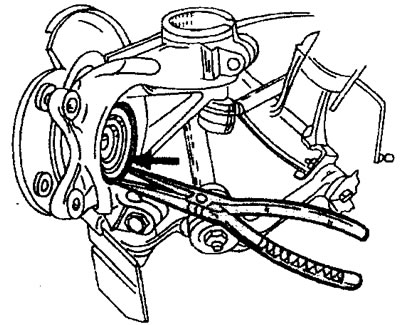
3. Wipe the steering knuckle on the side where the hub bearing is located with a clean rag so that you can see the retaining ring that holds the bearing in the steering knuckle. Remove this retaining ring with needle-nose pliers (see illustrations).
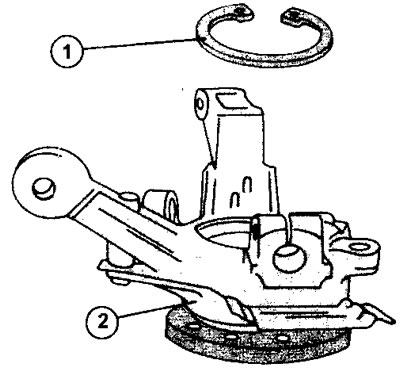
3.3a Retaining ring 1, which holds the hub bearing in the steering knuckle 2
3.3a Retaining ring 1, which holds the hub bearing in the steering knuckle 2


Z.Zb Remove the retaining ring from the steering knuckle using needle-nose pliers

Z.Zb Remove the retaining ring from the steering knuckle using needle-nose pliers


To remove the hub or bearing, you will need the appropriate pullers. The most convenient is the so-called hammer puller. The hammer puller rod is inserted into the hub hole and rests against the bearing. The rod is driven into the hole with a hammer and pushes out the hub flange together with the bearing (see illustration 3.0a).
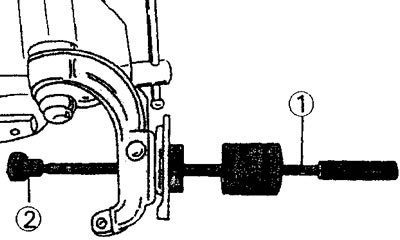
3.0a Pressing out the hub bearing using a hammer puller.

3.0a Pressing out the hub bearing using a hammer puller.
1 - hammer
2 - pressing nozzle of the puller rod


If you don't have a hammer puller, the hub bearing can be pressed out or even knocked out using a suitable punch.

The inner ring of the hub bearing remains in the hub and must be removed from there. To do this, use a puller, as shown in Illustration 3.0b. If necessary, the ring can be loosened with a chisel.
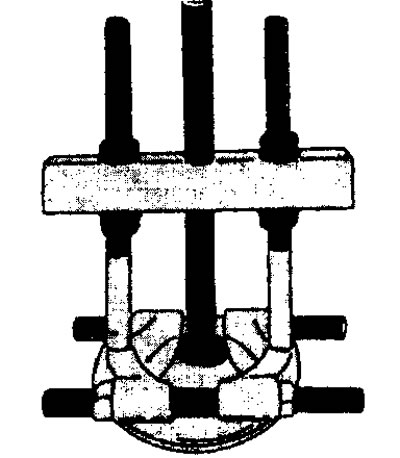


3.0b Removing the inner ring of the hub bearing using a puller

3.0b Removing the inner ring of the hub bearing using a puller


4. Clean all parts thoroughly and check their condition. The bearing must be replaced in any case.

5. Make sure the bearing retaining ring is in good condition.

6. Lubricate the new bearing with a generous amount of multi-purpose grease.

The procedure for installing a new hub bearing is as follows.

7. Press the new bearing into place using a piece of pipe of the same diameter as the outer ring of the bearing.

8. Make sure the bearing race is properly seated in the steering knuckle bore and install the snap ring. If the bearing retaining ring was deformed during removal, it should be replaced with a new one. Make sure the snap ring is properly and securely seated.

9. Press the hub onto the steering knuckle. In this case, place the hub so that the steering knuckle with the hub bearing installed can be placed on it. After this, press the assembly together so that the hub fits onto the bearing. Place the pressing rod onto the inner ring of the bearing. The protective plastic ring on the hub bearing is destroyed during the pressing process and can be removed after installation is complete (see illustration).


Source available here www.PEUGEOTBOOK.ru
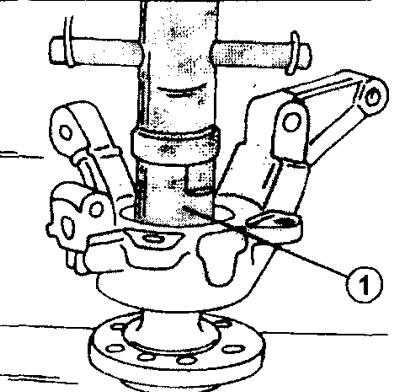
3.9 Pressing in the hub bearing. Pressing rod 1 must stand on the inner ring of the bearing.

3.9 Pressing in the hub bearing. Pressing rod 1 must stand on the inner ring of the bearing.


10. Remove any excess grease pressed in during pressing and recheck the position of the retaining ring in the bearing bore on the steering knuckle.
This article is available at russian, bulgarian, belarusian, ukrainian, serbian, croatian, romanian, polish, slovak, hungarian
Article reviewed by editor: Shirokov Arseny
Share information:
Previous
Peugeot 806: Car suspension
Next

Shock absorber strut — removal, installation and overhaul
Front suspension
Suspension specifications
Lower wishbone — removal and installation
Rear suspension — removal and installation
Rear wheel hubs and hub bearings — removal and installation
Drive shafts — removal
Drive shafts — installation
See similar information for other Peugeot models

➨ Front brake pad check Peugeot 106 (1991-2003)
➨ Removal and installation the front wheel hub bearing Peugeot 206 (1998-2012)
➨ Replacing the front wheel hub bearing Peugeot 307 (2001-2008)
➨ Front wheel drive with 4x4 powertrain Peugeot 405 (1987-1997)
➨ Steering wheel Peugeot 605 (1989-2000)
Link to this article in different formats
Comments and feedback from visitors
No comments yet


Add two numbers 10 + 10


Partner I (1996-2008) 
  • General information
  • Introduction to the guide
  • Faults en route
  • Weekly checks
  • User manual
  • Maintenance (petrol)
  • Maintenance (diesel)
  • Power unit
  • Petrol engines
  • Diesel engines «XUD»
  • Diesel engines «DW»
  • Overhaul of petrol engines
  • Overhaul of diesel engines
  • Cooling and heating
  • Power and exhaust (petrol)
  • Power and exhaust (XUD diesels)
  • Power and exhaust (DW diesels)
  • Emission reduction
  • Starting and charging system
  • Transmission
  • Clutch
  • Mechanical gearbox
  • Drive shafts
  • Chassis, running gear
  • Brake system
  • Car suspension
  • Steering
  • Body and interior
  • Exterior (external elements)
  • Interior (internal elements)
  • Doors, locks and windows
  • Electrical equipment
  • Equipment and devices
  • Electrical circuits
Peugeot 807 (2002-2014) 
  • General information
  • Operating instructions
  • Maintenance
  • Troubleshooting
  • Power unit
  • Gasoline engines
  • Diesel engines
  • Cooling and heating
  • Fuel injection (petrol)
  • Fuel system (diesel)
  • Fuel system
  • Exhaust system
  • Ignition system
  • Transmission
  • Clutch
  • Manual gearbox
  • Automatic gearbox
  • Chassis, running gear
  • Brake system
  • Car suspension
  • Steering system
  • Body and interior
  • Exterior (external elements)
  • Interior (internal elements)
  • Electrical equipment
  • Power devices
  • Electrical circuits
Peugeot 806 (1994-2002) 
  • General information
  • User manual
  • Maintenance
  • Power unit
  • Petrol engines
  • Diesel engines
  • Lubrication system
  • Cooling system
  • Fuel injection (petrol)
  • Fuel system (diesel)
  • Ignition and exhaust systems
  • ECM Bosch Motronic MP 3.2
  • ECM Magneti-Marelli (MM)
  • Transmission
  • Clutch
  • Mechanical gearbox
  • Chassis, running gear
  • Brake system
  • Car suspension
  • Steering
  • Electrical equipment
  • Equipment and devices
  • Electrical circuits
Peugeot J5 (1981-1993) 
  • General information
  • Introduction to manual
  • Specifications
  • Gasoline engine
  • Engine repair
  • Lubrication system
  • Cooling system
  • Fuel system
  • Ignition system
  • Diesel engine
  • Engine repair (DB9)
  • Lubrication system (DB9)
  • Cooling system (DB9)
  • Fuel injection (DB9)
  • Engine repair (U25)
  • Lubrication system (U25)
  • Cooling system (U25)
  • Fuel injection (U25)
  • Transmission
  • Clutch
  • Gearbox
  • Drive shafts
  • Chassis, running gear
  • Steering system
  • Car suspension
  • Brake system
  • Electrical equipment
  • Power devices
  • Electrical circuits
PeugeotBook.ru © 2018–2026 | Mobile version | Sitemap: EN BG BY UA RS HR RO PL SK HU | Write message | Site search | Add to bookmarks | Peugeot owners
106 (1991-2003) | 206 (1998-2012) | 207 (2006-2014) | 305 (1977-1989) | 306 (1993-2002) | 307 (2001-2008) | 405 (1987-1997) | 406 (1995-2004) | 605 (1989-2000) | Partner-I (1996-2008) | Eurovans-807 (2002-2014) | Eurovans-806 (1994-2002) | J5 (1981-1993) |
Cookies are used to ensure the correct display of pages on the site.