



Table of contents: General information 🠇 Precautions 🠇
General information
An air conditioning system is available on certain models (see illustration). It enables the temperature of incoming air to be lowered and also dehumidifies the air, which makes for rapid demisting and increased comfort.
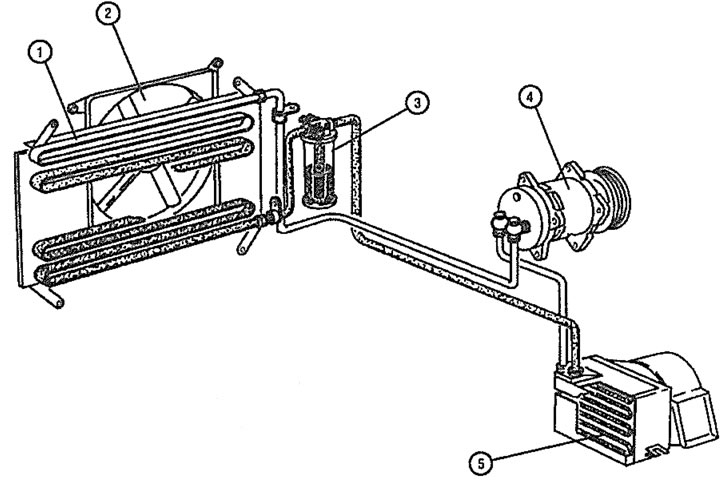
10.1. Air conditioning system components 1. Condenser; 2. Electric cooling fan; 3. Dehydrator reservoir; 4. Compressor; 5. Evaporator
The cooling side of the system works in the same way as a domestic refrigerator. Refrigerant gas is drawn into a belt-driven compressor and passes into a condenser mounted on the front of the radiator, where it loses heat and becomes liquid. The liquid passes through an expansion valve to an evaporator, where it changes from liquid under high pressure to gas under low pressure. This change is accompanied by a drop in temperature, which cools the evaporator. The refrigerant returns to the compressor and the cycle begins again.
Air blown through the evaporator passes to the air distribution unit, where it is mixed with hot air blown through the heater matrix, to achieve the desired temperature in the passenger compartment.
The heating side of the system works in the same way as on models without air conditioning (see Section 8).
The operation of the system is controlled by an electronic control unit, which controls the electric cooling fan, the compressor and the facia-mounted warning light. Any problems with the system should be referred to a Peugeot dealer.
Precautions
When an air conditioning system is fitted, it is necessary to observe special precautions whenever dealing with any part of the system, or its associated components. If for any reason the system must be disconnected, entrust this task to your Peugeot dealer or a refrigeration engineer.
Warning: The refrigeration circuit contains a liquid refrigerant and it is therefore dangerous to disconnect any part of the system without specialised knowledge and equipment.
Warning: The refrigerant is potentially dangerous and should only be handled by qualified persons. If it is splashed onto the skin, it can cause frostbite. It is not itself poisonous, but in the presence of a naked flame (including a cigarette) it forms a poisonous gas. Uncontrolled discharging of the refrigerant is dangerous and potentially damaging to the environment.
Caution: Do not operate the air conditioning system if it is known to be short of refrigerant, as this may damage the compressor.