



Installing an auxiliary valve for opening the starting diaphragm
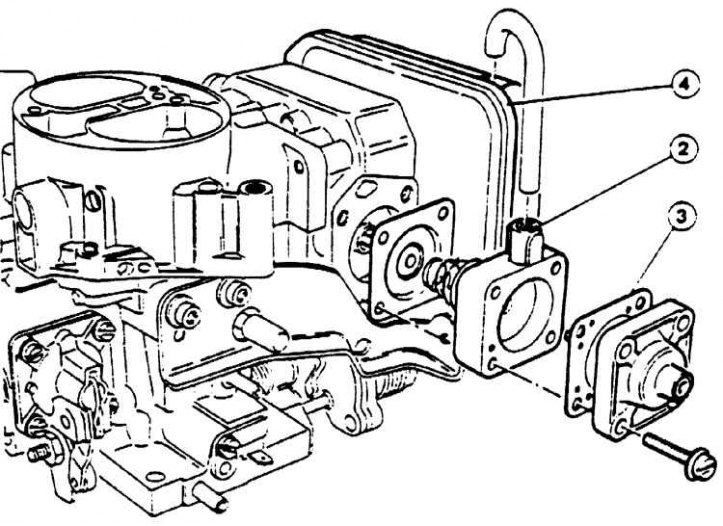
2 – connector, 3 – second membrane, 4 – tank
Auxiliary valve for opening the starting diaphragm (scheme of work)
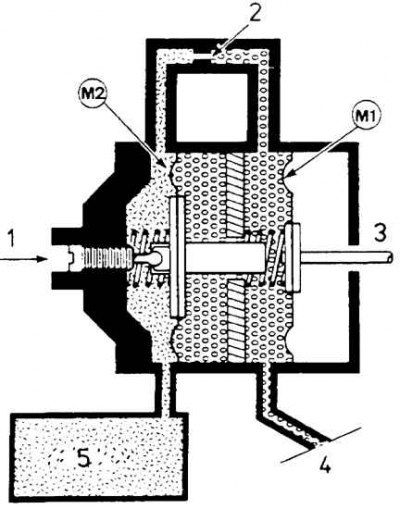
1 – adjusting screw, 2 – calibrated jet, 3 – starting diaphragm control tail, 4 – vacuum pipeline, 5 – receiver, M1, M2 – membranes
The mechanism has a dual-membrane vacuum opening control system, as well as a vacuum receiver and connector.
Job
The engine is cold, the starting device is on, the springs push the membranes towards the carburetor body and act on the control tailpiece, the starting diaphragm is closed. During engine starting, the vacuum in the intake pipe acts on the membrane M1, which rests on the membrane M2. The vacuum does not act on the membrane M2 immediately due to the use of a calibrated jet in the passage between the chamber and the receiver. The starting diaphragm opens slightly, but to such an extent that enrichment immediately increases. The vacuum reaches the second chamber and the receiver is triggered, the spring is compressed by the membrane, the control tailpiece of the starting diaphragm can move to the end of its stroke, and the starting diaphragm opens completely.
Connection of the second chamber and the vacuum line in cars with automatic transmission
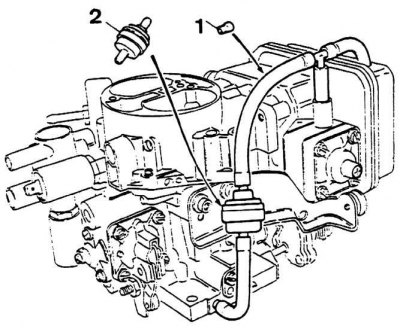
1 – calibrated jet, 2 – check valve
In cars with automatic transmission, the outer chamber is connected to the carburetor support via a retard valve and a calibrated jet.