
English Русский
Български
Беларускі
Український
Српски
Hrvatski
Română
Polski
Slovenský
Magyar
Bookmark Articles Sitemap Contacts
Company Hyundai Company Opel Company Skoda Company Kia Company Mitsubishi Company LADA Company Audi
PeugeotBook.ru


Series 100   Series 200   Series 300   400-500   Series 600   Crossovers   Others
 
Peugeot 405 (1987-1997) Peugeot 406 (1995-2004)

Clutch — design description (Peugeot 405)

  • Main
  • 40X
  • Peugeot 405 (1987-1997)
  • Transmission
  • Clutch
  • Clutch — design description
0

Clutch


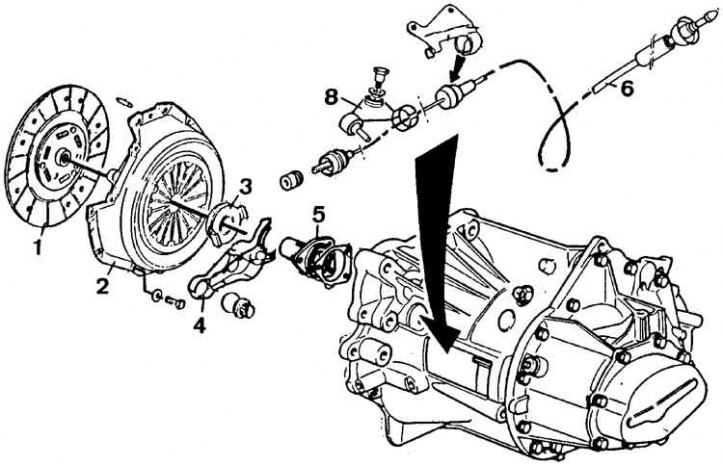
1 – disc, 2 – drive part, 3 – release bearing, 4 – clutch release lever, 5 – release bearing…

1 – disc, 2 – drive part, 3 – release bearing, 4 – clutch release lever, 5 – release bearing sleeve, 6 – control cable, 8 – support element of the casing


Clutch (since January 1988)
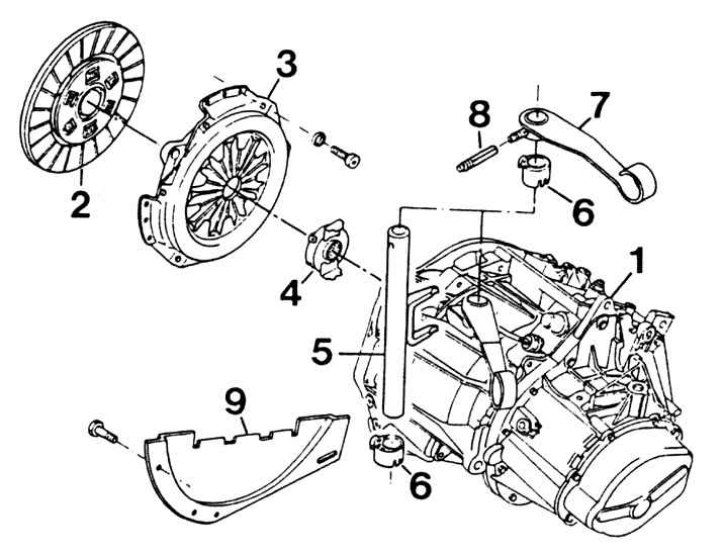


1 – gearbox, 2 – clutch disc, 3 – clutch leading part, 4 – release bearing, 5 – axle, 6 – bushings,…

1 – gearbox, 2 – clutch disc, 3 – clutch leading part, 4 – release bearing, 5 – axle, 6 – bushings, 7 – lever, 8 – pin, 9 – casing


The clutch consists of a clutch disc, a clutch drive with a pressure plate, and a release mechanism. The release mechanism is mechanical and is controlled by a self-adjusting cable. The clutch disc is installed between the flywheel and the pressure plate and moves along the splines of the primary shaft of the gearbox.

The clutch master assembly is bolted to the flywheel. Torque during engine operation is transmitted from the crankshaft through the flywheel and clutch disc, which is clamped between the flywheel and the pressure plate, to the primary shaft of the gearbox. The clutch disc has a torsional vibration damper and asbestos-free linings.


To disengage the engine from the gearbox, it is necessary to move the pressure plate away from the clutch disc. Peugeot cars use two different clutch release mechanisms. The first is the conventional type, where the release bearing is mounted on the primary shaft of the gearbox. The second type is where the release bearing is an integral part of the leading clutch assembly.

A unified clutch housing is supplied as a spare part, allowing both solutions to be used. In the first case, (with release lever) it is mandatory to use a ball joint corresponding to the disk diameter. The characteristic values of the clutch adjustment dimensions have remained unchanged.

When the clutch pedal is pressed, the cable moves and rotates the clutch release fork by the upper end of the fork. The fork, turning, compresses the pressure springs and moves the pressure plate away from the clutch disc.

Since January 1988, the clutch release lever has been replaced by a special axle passing through the clutch housing and controlled directly by a cable (without intermediate lever).

As the clutch disc friction linings wear, the clutch pedal height increases, so the clutch cable needs to be adjusted to ensure proper clutch action. However, since mid-1994, an automatic adjustment clutch cable has been installed (it can be installed on earlier models as well). The automatic regulator is included in the central part of the clutch cable.
This article is available at russian, bulgarian, belarusian, ukrainian, serbian, croatian, romanian, polish, slovak, hungarian
Article reviewed by editor: Shirokov Arseny
Share information:
Previous
Peugeot 405: Clutch
Next

 
Clutch specifications
Replacing the clutch disc or leading part
Adjusting the clutch control unit
Replacing the clutch cable
Clutch release mechanism — removal, inspection and installation
See similar information for other Peugeot models

➨ Clutch adjustment check and control mechanism lubrication Peugeot 106 (1991-2003)
➨ Brake and Clutch Hydraulic Fluid Peugeot 207 (2006-2014)
➨ Clutch — installation Peugeot 305 (1977-1989)
➨ General information about the clutch Peugeot 605 (1989-2000)
➨ Clutch specifications Peugeot 806 (1994-2002)
Link to this article in different formats
Comments and feedback from visitors
No comments yet


Add two numbers 29 + 18


Peugeot 406 (1995-2004) 
  • General information
  • User manual
  • Maintenance (gasoline)
  • Maintenance (diesel)
  • Power unit
  • Gasoline engines
  • Diesel engines
  • Engine overhaul
  • Cooling and heating
  • Fuel system (gasoline)
  • Fuel system (diesel)
  • Engine electrical equipment
  • Transmission
  • Clutch and drive shafts
  • Mechanical gearbox
  • Automatic gearbox
  • Chassis, running gear
  • Brake system
  • Car suspension
  • Steering
  • Body and interior
  • Exterior (external elements)
  • Interior (internal elements)
  • Doors, locks and windows
  • Electrical equipment
  • Equipment and devices
  • Electrical circuits
Peugeot 405 (1987-1997) 
  • General information
  • User manual
  • Maintenance
  • Power unit
  • Petrol engines 1.4 l
  • Petrol engines 1.6-2.0 l
  • Diesel engines
  • Ignition system
  • Fuel system (carburetor)
  • Single point fuel injection
  • Multipoint fuel injection
  • Cooling and lubrication system
  • Exhaust system
  • Transmission
  • Clutch
  • Manual gearbox MA
  • Manual gearbox BE
  • Automatic gearbox
  • Drive shafts
  • Chassis, running gear
  • Steering
  • Front suspension
  • Rear suspension
  • Brake system
  • Body and interior
  • Exterior (external elements)
  • Interior (internal elements)
  • Doors, locks and windows
  • Electrical equipment
  • Equipment and devices
  • Electrical circuits
PeugeotBook.ru © 2018–2026 | Mobile version | Sitemap: EN BG BY UA RS HR RO PL SK HU | Write message | Site search | Add to bookmarks | Peugeot owners
106 (1991-2003) | 206 (1998-2012) | 207 (2006-2014) | 305 (1977-1989) | 306 (1993-2002) | 307 (2001-2008) | 405 (1987-1997) | 406 (1995-2004) | 605 (1989-2000) | Partner-I (1996-2008) | Eurovans-807 (2002-2014) | Eurovans-806 (1994-2002) | J5 (1981-1993) |
Cookies are used to ensure the correct display of pages on the site.