
English Русский
Български
Беларускі
Український
Српски
Hrvatski
Română
Polski
Slovenský
Magyar
Bookmark Articles Sitemap Contacts
Company Hyundai Company Opel Company Skoda Company Kia Company Mitsubishi Company LADA Company Audi
PeugeotBook.ru


Series 100   Series 200   Series 300   400-500   Series 600   Crossovers   Others
 
Peugeot 405 (1987-1997) Peugeot 406 (1995-2004)

Wheel alignment angles (Peugeot 406)

  • Main
  • 40X
  • Peugeot 406 (1995-2004)
  • Chassis, running gear
  • Car suspension
  • Wheel alignment angles
0
Table of contents: Collapse 🠇 Convergence 🠇 Transverse tilt of the pivot axis 🠇 Angle of longitudinal inclination of…🠇

Adjusting the wheel by loosening and turning the inner pivot bolt
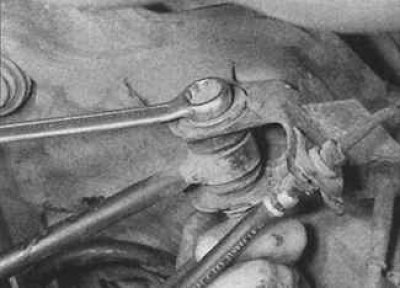


Wheel alignment angles have a significant impact on vehicle stability, tire wear, and fuel…


Wheel alignment angles have a significant impact on vehicle stability, tire wear, and fuel consumption. The following wheel alignment angles are distinguished.

Collapse


Camber is the tilt of the wheel in a vertical plane relative to the centerline of the car. It can be positive if the wheels are tilted outward, or negative if the wheels are tilted inward. The camber angle mainly affects the uniformity of wear on the front tires. If one wheel has positive camber and the other has negative camber, the car will pull to one side when driving straight.

Convergence


Toe-in is the lateral distance between the wheels. Positive toe-in means the front wheels are closer together than the rear wheels, measured at the height of the wheel's midpoint. Negative toe-in means the front wheels are further apart than the rear wheels.

Source available here: peugeotbook.ru

Transverse tilt of the pivot axis


The transverse inclination of the steering axis of the wheel is the angle between the inclination axis of the steering knuckle and the vertical drawn through the wheel mounting point, looking in the longitudinal direction of the vehicle.


Due to the camber angles and the transverse tilt of the steering axis, the points of contact of the wheels with the road are located closer to the axis of the steering knuckle. This maintains the so-called "rolling shoulder". The smaller the "rolling shoulder", the easier the car is to control. Also, impacts from uneven surfaces are less transmitted to the steering.

Angle of longitudinal inclination of the axis of rotation


Angle of longitudinal tilt of the turning axis - the axis relative to which the wheel turns is placed in space so that its lower part is tilted forward. Such an angle of longitudinal tilt is called positive. With a positive value of the angle, the self-return of the wheel to the middle position after turning is improved.

Checking and adjusting the wheel alignment angles must be done at a maintenance station due to the complexity of the equipment used.

Conditions for checking wheel alignment angles:
  • the tire pressure must be correct;
  • the car must be parked on a flat horizontal surface;
  • the car must be empty, with the fuel tank half full;
  • before checking the wheel alignment angles, rock the car body;
  • the steering must be in good working order and properly adjusted;
  • there should be no play in the steering rods;
  • there should be no play in the wheel suspension.
This article is available at russian, bulgarian, belarusian, ukrainian, serbian, croatian, romanian, polish, slovak, hungarian
Article reviewed by editor: Vinogradov Robert
Share information:
Previous
Peugeot 406: Car suspension
Next

Rear suspension stabilizer link
Rear suspension anti-roll bar
Rear suspension rod — removal and installation
Rear Suspension Guide Arm — Removal and Installation
Upper Rear Suspension Arm — Removal and Installation
Basic faults of suspension and steering
See similar information for other Peugeot models

➨ Wheel alignment and steering angles — general information Peugeot 106 (1991-2003)
➨ Wheel alignment angles Peugeot 206 (1998-2012)
➨ Front wheel alignment angles Peugeot 305 (1977-1989)
➨ Wheel alignment angles Peugeot 605 (1989-2000)
➨ Wheel alignment angles Peugeot 806 (1994-2002)
Link to this article in different formats
Comments and feedback from visitors
No comments yet


Add two numbers 12 + 18


Peugeot 406 (1995-2004) 
  • General information
  • User manual
  • Maintenance (gasoline)
  • Maintenance (diesel)
  • Power unit
  • Gasoline engines
  • Diesel engines
  • Engine overhaul
  • Cooling and heating
  • Fuel system (gasoline)
  • Fuel system (diesel)
  • Engine electrical equipment
  • Transmission
  • Clutch and drive shafts
  • Mechanical gearbox
  • Automatic gearbox
  • Chassis, running gear
  • Brake system
  • Car suspension
  • Steering
  • Body and interior
  • Exterior (external elements)
  • Interior (internal elements)
  • Doors, locks and windows
  • Electrical equipment
  • Equipment and devices
  • Electrical circuits
Peugeot 405 (1987-1997) 
  • General information
  • User manual
  • Maintenance
  • Power unit
  • Petrol engines 1.4 l
  • Petrol engines 1.6-2.0 l
  • Diesel engines
  • Ignition system
  • Fuel system (carburetor)
  • Single point fuel injection
  • Multipoint fuel injection
  • Cooling and lubrication system
  • Exhaust system
  • Transmission
  • Clutch
  • Manual gearbox MA
  • Manual gearbox BE
  • Automatic gearbox
  • Drive shafts
  • Chassis, running gear
  • Steering
  • Front suspension
  • Rear suspension
  • Brake system
  • Body and interior
  • Exterior (external elements)
  • Interior (internal elements)
  • Doors, locks and windows
  • Electrical equipment
  • Equipment and devices
  • Electrical circuits
PeugeotBook.ru © 2018–2026 | Mobile version | Sitemap: EN BG BY UA RS HR RO PL SK HU | Write message | Site search | Add to bookmarks | Peugeot owners
106 (1991-2003) | 206 (1998-2012) | 207 (2006-2014) | 305 (1977-1989) | 306 (1993-2002) | 307 (2001-2008) | 405 (1987-1997) | 406 (1995-2004) | 605 (1989-2000) | Partner-I (1996-2008) | Eurovans-807 (2002-2014) | Eurovans-806 (1994-2002) | J5 (1981-1993) |
Cookies are used to ensure the correct display of pages on the site.