



Table of contents: General 🠇 Front wheel toe setting - checking…🠇
General
1. A car's steering and suspension geometry is defined in four basic settings - all angles are expressed in degrees (toe settings are also expressed as a measurement); the relevant settings are camber, castor, steering axis inclination and toe-setting (see illustration overleaf). With the exception of front wheel toe-setting, none of these settings are adjustable.
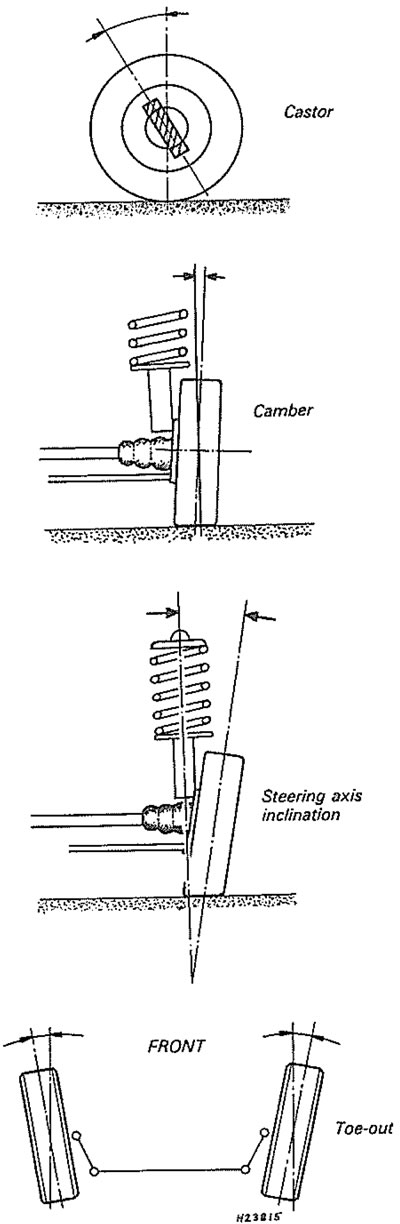
19.1. Wheel alignment and steering angles
Front wheel toe setting - checking and adjusting
Original is located at [peugeotbook.ru]
2. Due to the special measuring equipment necessary to check the wheel alignment and the skill required to use it properly, the checking and adjustment of these settings is best left to a Peugeot dealer or similar expert. Note that most tyre-fitting centres now possess sophisticated checking equipment. The following is provided as a guide, should the owner decide to carry out a DIY check.
3. The front wheel toe setting is checked by measuring the distance between the front and rear inside edges of the roadwheel rims. Proprietary toe measurement gauges are available from motor accessory shops.
4. For accurate checking, the vehicle must be at the kerb weight, ie unladen and with a full tank of fuel and the ride height must be correct (see Section 9).
5. Before starting work, check first that the tyre sizes and types are as specified, then check the tyre pressures and tread wear, the roadwheel run-out, the condition of the hub bearings, the steering wheel free play and the condition of the front suspension components (see "Weekly checks" and Chapter 1A or 1B). Correct any faults found.
6. Park the vehicle on level ground, check that the front roadwheels are in the straight-ahead position, then rock the rear and front ends to settle the suspension. Release the handbrake and roll the vehicle backwards approximately 1 metre, then forwards again, to relieve any stresses in the steering and suspension components.
7. Measure the distance between the front edges of the wheel rims and the rear edges of the rims. Subtract the rear measurement from the front measurement and check that the result is within the specified range.
8. Make sure that the steering is in the straight-ahead position when taking measurements.
9. If adjustment is found to be necessary, clean the ends of the track-rods in the areas of the adjustment pin locknuts.
10. Slacken the locknuts (one at the inner and outer end of each adjustment pin) and turn the adjustment pin on each track-rod by equal amounts in the same direction (see illustration). Only turn each pin by a quarter of a turn at a time before rechecking.
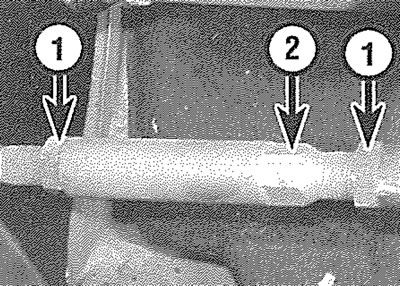
19.10. Track-rod adjuster pin locknuts (1) and adjuster pin flats (2)
11. Check that the track-rod end balljoints are centralised and not forced to the limit of movement in any direction.
12. When adjustment Is correct, tighten the locknuts.
13. Check that the track-rod lengths are equal and that the steering wheel spokes are in the straight-ahead position.