



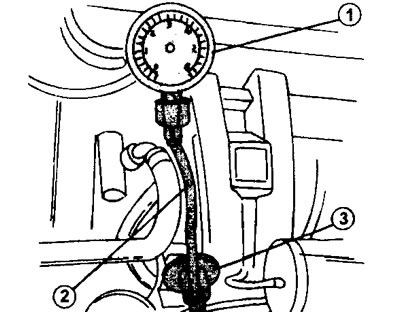
29.0 Checking engine oil pressure on a twin overhead cam engine (16 valves).
1 - pressure gauge
2 - pressure gauge connecting hose
3 - pressure gauge connection point (instead of an oil pressure sensor or oil filter)
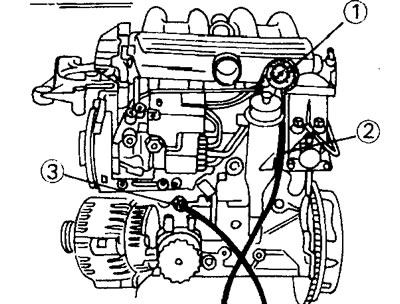
29.0a Checking engine oil pressure.
1 - pressure gauge
2 - pressure gauge connecting hose
3 - pressure gauge connection point (instead of an oil pressure sensor or oil filter)
To check the engine oil pressure on 16-valve engines, you need to remove the oil filter to connect a special pressure gauge adapter.
As for other engines, the pressure gauge adapter is screwed in place of the oil pressure sensor. On diesel engines, the pressure sensor is located above the oil cooler or above the oil filter.
1. Start the engine and warm it up to a temperature of 80°C.
2. Check the engine oil level and top up if necessary.
3. Let the engine idle for 5 minutes to allow the radiator fan to come on.
4. Turn off the engine and unscrew the oil pressure sensor, disconnecting the wire from it, or the oil filter.
5. Screw in the adapter and connect the pressure gauge.
6. Start the engine and let it idle. The pressure gauge readings should be as follows:
XU engine (8/16 valves) - 4.4 bar
Engine - XUD9 - 2.1 bar
XUD11 engine - 2.25 bar
7. Increase engine speed to 4000 rpm and check that the oil pressure has also increased.
XU engine (8/16 valves) - 5.3 bar
XUD9 engine - 5.0 bar
XUD11 engine - 5.0 bar
The data provided applies to new engines. If the engine has been in operation for a long time, it is possible that the oil pressure at idle will be correspondingly lower.
(Source available on the website: PEUGEOTBOOK.ru)
8. Disconnect the pressure gauge and screw the oil pressure sensor back in place. A copper sealing ring is installed on the sensor. The sensor tightening torque is 34 Nm (1.9-liter engine) or 25 Nm (2.1 liter engine). If the oil pressure measurement was performed on a 16-valve engine, reinstall the oil filter.