



Table of contents: Fuel injector 🠇 Injector voltage values 🠇 Injector resistance values 🠇 Injector Duty Cycle Table 🠇 Frequency 🠇 Nozzle type 🠇 Influence of external factors 🠇 Checking injectors (general check) 🠇 Checking the injector's performance…🠇 Checks with the engine off 🠇 Unclear or missing waveform or no…🠇 A Pulse duration that is too long or…🠇 Checks on a running engine 🠇 A Pulse duration that is too long or…🠇 Resistance tests 🠇 Injector circuit 🠇 Fuel system 🠇 Fuel capacity 🠇 Fuel pressure 🠇 Fuel pump 🠇 Fuel pump mounted inside the fuel…🠇 Fuel pump voltage values 🠇 Influence of external factors 🠇 Ignition switch 🠇 Fuel pump relay 🠇 Main relay 🠇
The electronic control unit MM determines the moment and duration of opening of the injectors depending on the engine speed and engine load. This information is received by the electronic control unit from various sensors, such as the manifold absolute pressure sensor, crankshaft angle sensor, coolant temperature sensor, intake air temperature sensor, and throttle position sensor. Based on this information, the electronic control unit will calculate the duration and correct moment of opening of the injectors for fuel injection depending on the engine speed, engine load and temperature range.
The MM 8P system is a multi-point fuel injection system, in which all injectors inject fuel simultaneously - i.e. at one time and twice per engine cycle.
Fuel injector
Fuel injector (see illustration 12.21 or 12.22) has electromagnetic control. The electronic control unit operates the injectors. Voltage to the injectors comes from the main relay. The injector opening time is between 1.5 and 10 milliseconds. The fuel injection duration depends on engine temperature, engine load, engine speed and operating conditions.
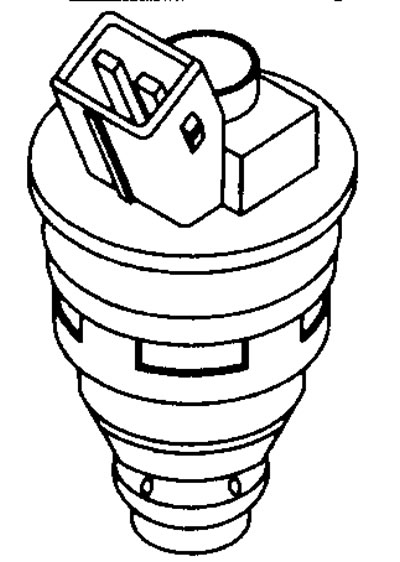
12.21 Fuel injector (XU7JP)
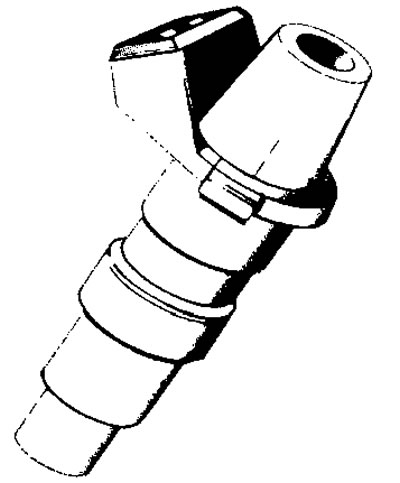
12.22 Fuel injector (XU10J2C)
When the solenoid valve closes, a reverse electromagnetic field voltage of up to 60 volts is created.
Because the injectors inject fuel simultaneously, the fuel briefly flows back to the valve before entering the cylinder.
When the engine starts, the injectors inject fuel twice per engine cycle.
Injector voltage values
Terminal numbers
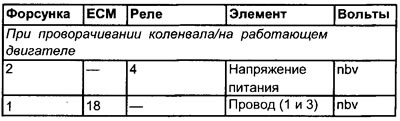
See illustration 12.23
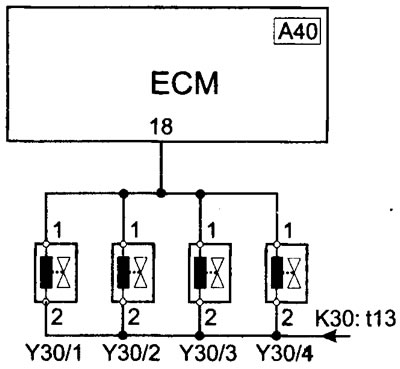
12.23 Fuel injector wiring diagram
Injector resistance values
Note: Voltage is supplied by the fuel injection relay and is only available for approximately one second after the ignition is turned on - either when cranking or with the engine running. Bypassing the relay provides the voltage required for testing.
Terminal numbers

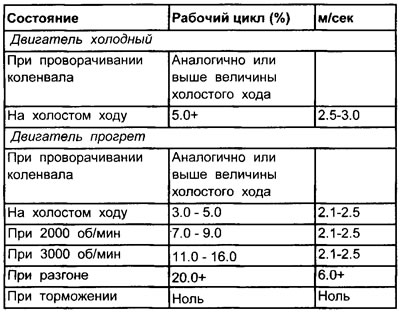
Injector Duty Cycle Table
Frequency
When starting the engine: twice per revolution.
When the engine is running: once per revolution.
Nozzle type
Multi-point fuel injection.
Influence of external factors
- Vacuum leaks
- Ignition system malfunction
- The air filter is clogged
- The engine oil is contaminated
- Fuel tank ventilation malfunction
Checking injectors (general check)
1. Inspect the injector multi-pin connectors for signs of corrosion or damage.
2. Make sure the multi-pin connector terminal pins are properly installed and have good contact with the injectors.
3. Check for corrosion on the relay and injector terminals, as well as on the ECU and injector terminals. Corrosion on the terminals is the cause of poor injector performance.
Checking the injector's performance using an oscilloscope or a contact duration meter
1. Two wires are routed to the injector multi-pin connector: a power wire and a signal wire.
2. Bend back the rubber insulation (where possible) to the injector multi-pin connector or connect the output block (OB) between the ECU multi-pin connector and the ECU.
3. Connect the negative probe of the oscilloscope or breaker duration meter to ground on the engine.
4. Connect the positive probe of an oscilloscope or a contact duration meter to terminal #1 of the injector signal wire. Since the injectors inject fuel in pairs, one injector from each pair is suitable for testing. Note: The injector signal will only be received on the wire connecting the injector to the ECU. If it is not possible to obtain a reading, connect the probe to a different terminal and repeat the test.
Checks with the engine off
1. Turn the crankshaft.
2. The device will display either a waveform or a duty cycle reading. If the device can measure readings in milliseconds, then this is the most successful measurement (see illustration 12.24)
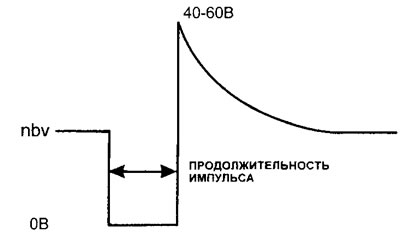
12.24 Typical waveform of the input signal to the injectors
3. Clear waveform or sufficient signal. Key points to consider:
- Does the signal waveform match the sample?
- Is the pulse signal length suitable for temperature?
4. If the answer to these two questions is "yes", then the reason for the engine not starting is unlikely to be related to the fuel injection system. However, a fuel pressure check should be performed.
5. If the primary winding signal of the ignition coil is sufficient, then the fault is unlikely to be related to the electronic control unit.
Unclear or missing waveform or no signal
1. Check for sufficient signal from the crankshaft angle sensor.
2. Check the voltage supply to the injector multi-pin connector.
3. If there is no voltage, check the injector resistance and the voltage supply to the injector.
Note: If the oscilloscope shows a voltage at the battery's nominal voltage level, but there is no waveform, then voltage is reaching the injector, but the circuit is not turning on.
4. Check the opening time of other injectors
5. Disconnect the ECU multi-pin connector (see warning #3).
6. Turn on the ignition.
7. Using a jumper wire, very quickly touch the injector contact pin in the ECU multi-pin connector to ground.
8. If the injector fires, check the voltage supply to the electronic control unit and its grounding. If the power supply and ground are OK, then the electronic control unit may be faulty.
8. If the injector fires, check the voltage supply to the electronic control unit and its grounding. If the power supply and ground are OK, then the electronic control unit may be faulty.
9. If the injector does not fire, check for battery voltage at the contact pin of the electronic control unit.
10. If there is voltage, the injector may be faulty.
11. If there is no voltage, check the continuity of the wiring between the injector multi-pin connectors and the electronic control unit multi-pin connector.
A Pulse duration that is too long or too short
1. Check the coolant temperature sensor (CTS).
2. Check the manifold absolute pressure (MAP) sensor.
Note: If the ECU used LOS mode due to a failed sensor, the engine may run properly while it is warm. However, starting the engine from a cold state may be difficult.
Checks on a running engine
1. Run the engine at different speeds. Record the values obtained at the following engine speeds.
- Idle speed
- At 2000 rpm
- At 3000 rpm
- When opening the throttle valve slowly
- When opening the throttle valve quickly
- When braking: Increase engine speed to approximately 3000 rpm and release the throttle.
2. Compare the results with the values stated in the specifications, both on a cold and on a warm running engine.
3. The pulse duration as a percentage (%) should increase as the engine speed increases.
4. The pulse duration in ms should not change significantly with a gradual increase in engine speed.
5. During acceleration, the pulse duration should increase.
6. When braking, when the engine is warm, the oscilloscope should not display the pulse duration, or it should drop to zero (digital measuring instrument) and reappear when the engine speed decreases.
7. If the gauge reading does not drop to zero, check the throttle valve adjustment and the throttle position sensor (TPS) for proper operation. The injector noise should also temporarily disappear as the fuel shutoff valve is activated.
A Pulse duration that is too long or too short
1. Check the coolant temperature sensor (CTS).
2. Check the manifold absolute pressure (MAP) sensor.
Note: If the ECU used LOS mode due to a failed sensor, the engine may run properly while it is warm. However, starting the engine from a cold state may be difficult.
Resistance tests
Nozzle
Remove the injector multi-pin connectors and measure the injector resistance between the two terminals.
Injector circuit
1. Disconnect the fuel injection relay. All injectors are connected.
2. Measure the resistance at the specified terminals of the electronic control unit. The injector circuit resistance must be within specification values.
3. If the resistance does not correspond to the nominal value, this may be caused by:
- Injector malfunction.
- Electrical wiring fault.
Fuel system
When the ignition is turned on, the ECU supplies power to the fuel pump relay for approximately one second, creating pressure in the fuel system. The fuel pump relay is then turned off. Once the engine starts running, fuel is supplied through the non-return valve and fuel filter to the fuel line.
To prevent pressure loss in the fuel supply system, a non-return valve is located in the outlet pipe of the fuel pump. When the ignition is turned off and the fuel pump stops operating, the pressure is thus maintained for some time.
Fuel capacity
From 2.0 to 2.4 l per minute.
Fuel pressure
| State | State |
| In idle mode | 2.0 bar |
| The engine is off | 2.5 bar |
| Maximum allowable pressure | Not specified |
Fuel pump
Fuel pump installed inside the fuel tank (Citroen)
Two-stage fuel pump (see illustration 12.25) installed horizontally on the bottom of the fuel tank.
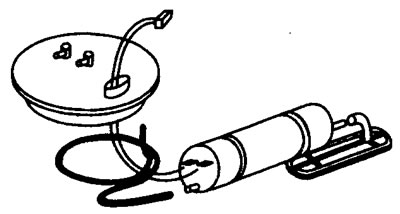
12.25 Fuel pump installed horizontally in the fuel tank
Fuel pump mounted inside the fuel tank (Peugeot)
The fuel pump is mounted vertically in the fuel tank and includes an external and internal gear block.
Fuel pump voltage values
Note: Power is only available when the crankshaft is cranking or the engine is running. Starting the fuel pump when the ignition is on (the engine is turned off), necessary to bypass the relay.
Terminal numbers
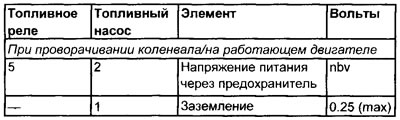
See Figure 12.2
Influence of external factors
- The battery contacts are damaged
Ignition switch
- Wiring
- Relay
- Inertia switch or fuse
- Low battery voltage
- The fuel filter in the fuel tank is clogged
- The fuel lines are damaged
- Fuel pressure regulator
The fuel pressure regulator constantly maintains fuel pressure in the fuel line at 2.5 bar. The fuel pump typically delivers much more fuel than required, so the excess fuel returns to the fuel tank through the return line. Fuel recirculation cools the fuel. In fact, the maximum allowable fuel pressure within 5 bar is possible in this system. To prevent pressure loss in the fuel supply system, a non-return valve is located in the outlet pipe of the fuel pump. When the ignition is turned off and the fuel pump stops operating, the pressure is thus maintained for some time.
The fuel pressure regulator is installed on the fuel line and maintains a pressure of 2.5 bar in the fuel line. The fuel pressure regulator consists of two chambers separated by a diaphragm. The upper chamber has a spring that forces pressure into the lower chamber and closes the outlet diaphragm. The pressurized fuel stream flows into the lower chamber, which forces pressure onto the diaphragm. When the pressure begins to exceed 2.5 bar, the outlet diaphragm opens and excess fuel returns to the fuel tank through the return line.
A vacuum hose connects the upper chamber to the intake manifold so that changes in intake manifold pressure do not affect the amount of fuel injected. This means that the pressure in the fuel line is always a constant pressure, which is higher than the pressure in the intake manifold. The amount of fuel injected thus depends solely on the injector opening time, which is determined by the electronic control unit, and not on changes in fuel pressure.
At idle, with the vacuum line disconnected or the engine stopped and the pump running, or the throttle wide open, the fuel pressure in the system will be approximately 2.5 bar. At idle (the vacuum tube is connected) the fuel pressure will be approximately 0.5 bar when the system is pressurized.
Fuel pump relay
The MM 8P electrical system is controlled by a single 15-pin double contact relay (see illustration 12.47). The supply of direct voltage to terminals No. 2, No. 8, No. 11 and No. 15 of the relay is carried out from the positive pole of the battery.
When the ignition is off, voltage from terminal No. 2 is constantly supplied to contact pin No. 4 of the electronic control unit. When the ignition is on, supply voltage is supplied to terminal No. 14 of the relay.
The ECU grounds terminal #10 through ECU pin #4, which supplies power to the relay primary winding.
When power is supplied to the relay coil, terminal No. 11 is connected to terminal No. 1 of the output circuit. Thus, voltage is supplied to terminals No. 1 and No. 9.
From terminal No. 1, voltage is supplied to contact pin No. 35 of the electronic control unit, and from terminal No. 9 - to the solenoid valve of the carbon filter and the vehicle speed sensor. When the ignition is on, voltage is supplied from pin #35 to the electronic control unit.
When the ignition is switched on, the electronic control unit grounds contact No. 7 of the relay on contact pin No. 23 of the electronic control unit. This supplies power to the secondary winding of the relay, which closes the second contact of the relay and supplies voltage from terminal #8 to terminal #13, thus providing voltage to the fuel pump circuit. After approximately one second, the electronic control unit opens the circuit and the pump stops. Short-term operation of the fuel pump increases the pressure in the fuel lines and ensures a quick start. Additionally, voltage is supplied to the injectors, ignition coils, throttle body heater and oxygen sensor heater from terminals #4, #5 and #6.
Once the ECU receives a signal from the crankshaft angle sensor, the ECU will re-energize the secondary winding and the fuel pump, ignition system, and fuel injection system will operate until the engine stops.
Main relay
| Terminal | State | Relay | Volts |
| 2, 8, 11, 15 | The ignition is off | Connected/disconnected | nbv |
| 14 | The ignition is on | Connected/disconnected | nbv |
| 10 | The ignition is off | Connected | nbv |
| 10 | The ignition is on | Connected | 1.25 (max) |
| 7 | The ignition is on | Connected | nbv |
| 7 | When turning the crankshaft/with the engine running | Connected | 1.25 (max) |
| 1, 9 | The ignition is on | Connected | nbv |
| 4, 5, 6 | When turning the crankshaft/with the engine running | Connected | nbv |
| Terminal | Source/Destination |
| 1 | Relay output voltage to the electronic control unit: t35 |
| 2 | Power supply from battery to relay: t30 |
| 3 | Not used |
| 4 | Relay output voltage to the injector: t2 |
| 5 | Relay output voltage to ignition coil: t3 |
| 6 | Relay output voltage to the oxygen sensor: t2 (through the fuse), fuel pump: t2 (through the fuse), intake manifold heater: t2 (through the fuse) |
| 7 | Control relay, ECM: t23 |
| 8 | Power supply from battery to relay: t30 |
| 9 | Relay output voltage to the carbon filter solenoid valve: t2, vehicle speed sensor: t2 |
| 10 | Control relay, ECM: t4 |
| 11 | Power supply from battery to relay: t30 |
| 12 | Not used |
| 13 | Not used |
| 14 | Power supply from the ignition switch to the relay: I5 |
| 15 | Power from battery to relay: 130 |
See Figure 12.2