



Table of contents: Carbon Filter Solenoid Valve (CFSV) 🠇 Values of voltage of the solenoid…🠇 The resistance value of the carbon…🠇 Duty cycle of carbon filter solenoid…🠇 Influence of external factors 🠇 Checking the Carbon Filter Solenoid…🠇 Checking the operation of the carbon…🠇 Checking the solenoid valve of the…🠇 There is no voltage 🠇 Oxygen sensor (OS) 🠇 Oxygen sensor (OS) voltage values 🠇 Switching frequency 🠇 Influence of external factors 🠇 Checking the signal from the oxygen…🠇 Oxygen sensor switching 🠇 Oxygen sensor heater tests 🠇
The MM 8P fuel injection systems installed on vehicles equipped with a catalytic converter have a closed-loop system, thanks to which harmful exhaust emissions can be minimized. Closed loop systems are equipped with an oxygen sensor that monitors the oxygen content in the exhaust gases. Low exhaust oxygen levels indicate a rich mixture, while high exhaust oxygen levels indicate a lean mixture.
The carbon canister solenoid valve (CFSV) and charcoal canister are used to reduce fuel vapor emissions into the atmosphere. The charcoal canister collects and absorbs fuel vapors, which under certain operating conditions are transferred to the intake manifold for further combustion.
Carbon Filter Solenoid Valve (CFSV)
When the engine stalls, the solenoid valve of the carbon filter will close (see illustration 12.29). When the ignition is on, the charcoal canister solenoid valve remains closed until the engine warms up to normal operating temperature and the throttle valve is partially opened. Once the electronic control unit activates the solenoid valve of the carbon canister, fuel vapors enter the intake manifold for further combustion.
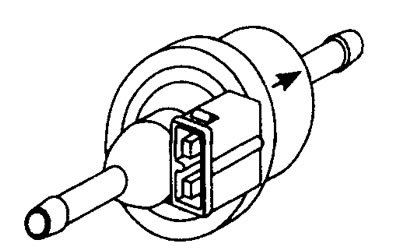
12.29 Carbon Filter Solenoid Valve (CFSV)
The carbon canister solenoid valve remains closed when the engine is cold and also while idling. Once the coolant temperature reaches normal operating temperature and the throttle valve is partially open (in the range of 10.4° and 84°), the electronic control unit will switch (turn on and off) solenoid valve of carbon filter with 54% duty cycle.
After the engine is turned off, the closed valve prevents the engine from starting spontaneously while it is idle.
Values of voltage of the solenoid valve of the carbon filter
Terminal numbers
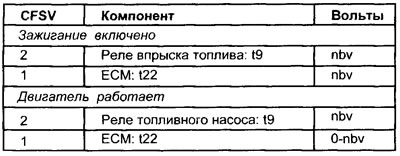
See Figure 12.2
The resistance value of the carbon filter solenoid valve

Duty cycle of carbon filter solenoid valve
54% at normal operating temperature with the throttle valve half open.
Influence of external factors
- Damaged or leaking vacuum hoses and joints
Checking the Carbon Filter Solenoid Valve (CFSV) (general check)
1. Inspect the carbon canister solenoid valve multi-pin connector for signs of corrosion or damage.
2. Make sure the connector terminal pins are properly installed and have good contact with the carbon canister solenoid valve multi-pin connector.
3. The test is quite simple. Two wires are connected to the carbon filter solenoid valve connector: a power wire and a ground wire.
4. Bend back the rubber insulation (where possible) to the multi-pin connector of the carbon canister solenoid valve or connect the output block (OB) between the multi-pin connector of the electronic control unit and the electronic control unit.
5. Connect the negative probe of the oscilloscope or voltmeter to ground on the engine.
6. Connect the positive probe of an oscilloscope or voltmeter to terminal No. 1 of the carbon canister solenoid valve signal wire.
7. Oscilloscope is a useful tool to check the switching waveform (see illustration 12.30). If an oscilloscope is not available, continue checking for voltage.
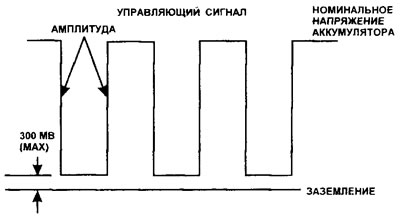
12.30 Typical waveform of the input signal to the solenoid valve of the carbon filter from the electronic control unit
Checking the operation of the carbon filter electromagnetic valve in pulse mode
1. Warm up the engine to normal operating temperature.
2. Increase the engine speed to approximately 2000 rpm and let the engine run at this speed.
3. Check the switching pulse.
4. If there is no pulse, perform the following electrical tests.
Checking the solenoid valve of the carbon filter (electrical checks)
1. Turn on the ignition, check for battery voltage at the power terminal No. 2 of the carbon filter solenoid valve.
2. If there is no voltage, trace the wiring back to the relay output terminal.
3. Check for voltage at terminal No. 1 of the carbon filter solenoid valve, which should be approximately at the level of the nominal battery voltage.
4. If there is no voltage, check the resistance of the carbon filter solenoid valve.
5. Disconnect the multi-pin connector of the electronic control unit.
6. Turn on the ignition so that voltage is supplied to the carbon filter solenoid valve.
7. Using a jumper wire, very briefly connect the switch terminal (pin No. 22) in the multi-pin connector of the electronic unit to ground.
8. If the carbon filter solenoid valve operates, the electronic control unit may be faulty.
9. If the carbon filter solenoid valve does not operate, check for battery voltage at terminal No. 22.
10. If there is voltage, the electronic control unit may be faulty.
There is no voltage
11. Disconnect the multi-pin connector from the carbon filter solenoid valve.
12. Connect a voltmeter between terminals No. 1 and No. 2 on the multi-pin connector.
13. Using a jumper wire, very briefly connect the switch terminal (pin No. 22) in the multi-pin connector of the electronic unit to ground.
14. If the voltmeter indicates the nominal battery voltage, then the wiring of the carbon filter solenoid valve is OK. Most likely, the solenoid valve of the carbon filter is faulty.
15. If the voltmeter does not indicate the nominal voltage of the battery, check the continuity of the wiring between the multi-pin connector of the carbon filter solenoid valve and the switching terminal of the electronic control unit.
Oxygen sensor (OS)
The signal from the oxygen sensor, operating in a closed loop, causes the electronic control unit to change the injector timing in such a way that the composition of the air-fuel mixture remains as close as possible to the stoichiometric ratio. By controlling the fuel injection stroke, under most operating conditions, so that the air-fuel mixture composition is always in a small window around the Lambda point (i.e. Lambda = 0.981.04), at which almost complete combustion is achieved.
The oxygen sensor operates in closed loop when the coolant temperature is above 45°C. If the coolant temperature is below 45°C or the engine load is at or above the limit, the electronic control unit will operate in open loop. When operating in open loop, the ECU regulates the air-fuel mixture, making it richer or leaner than required for the stoichiometric ratio. This prevents the engine from running rough, for example when accelerating with the throttle wide open.
To ensure that the oxygen sensor reaches its maximum operating temperature as quickly as possible after the engine is started, it contains a heating element.
The supply voltage to the oxygen sensor heater comes from terminal No. 6 of the fuel pump relay. Therefore, the oxygen sensor heater will only function when the engine is running.
Oxygen sensor (OS) voltage values
Terminal numbers
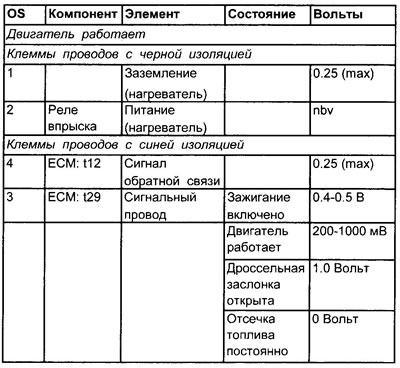
See Figure 12.2
Switching frequency
Intervals are approximately 1 second apart
Influence of external factors
- Poor grounding of the oxygen sensor
- The oxygen sensor is dirty
- Vacuum leaks
- Malfunction of the ignition system or fuel system
- Oil liquefaction
- The air filter is clogged
- Leaded gasoline
- Low fuel pressure
- Exhaust leaks (main oxygen sensor)
Checking the signal from the oxygen sensor
1. Connect the negative probe of the oscilloscope or voltmeter to ground on the engine.
2. Connect the positive probe of an oscilloscope or voltmeter to terminal #3 of the oxygen sensor signal wire.
3. If possible, connect a gas analyzer to the exhaust system that determines the content of 4 gases and the lambda parameter.
4. The gas analyzer should show the following values: CO: as specified in the specifications
- NS: less than 50 ppm
- CO₂: more than 15.0
- From₂: less than 2.0
- Lambda: 1.0±0.04
Oxygen sensor switching
See Appendix 1.
Oxygen sensor heater tests
See Appendix 1.