
English Русский
Български
Беларускі
Український
Српски
Hrvatski
Română
Polski
Slovenský
Magyar
Bookmark Articles Sitemap Contacts
Company Hyundai Company Opel Company Skoda Company Kia Company Mitsubishi Company LADA Company Audi
PeugeotBook.ru


Series 100   Series 200   Series 300   400-500   Series 600   Crossovers   Others
 
Peugeot 305 (1977-1989) Peugeot 306 (1993-2002) Peugeot 307 (2001-2008)

Cruise control system (Peugeot 307)

  • Main
  • 30X
  • Peugeot 307 (2001-2008)
  • User manual
  • Driving and operation
  • Cruise control system
0
Table of contents: Turning on the cruise control system 🠇 Memorizing speed 🠇 Disabling the stored speed 🠇 Changing the speed entered into the…🠇 Cancel the speed entered into memory 🠇
The cruise control system ensures that the set speed is maintained if the engine can provide it, and relieves the driver from having to press the accelerator pedal to maintain it.

The system can remember the vehicle speed if it exceeds 40 km/h, and 4th or 5th gear must be engaged.

Caution! Cruise control should not be engaged in heavy traffic or adverse road conditions (icy or wet road, gravel surface).


Turning on the cruise control system
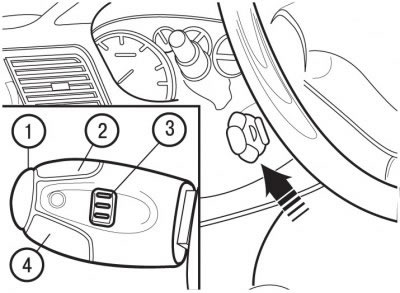


Figure 1.38. Location of the cruise control handle: 1 - switch for disabling the stored speed; 2 -…

Figure 1.38. Location of the cruise control handle: 1 - switch for disabling the stored speed; 2 - memory and speed increase switch; 3 - cruise control system switch; 4 - memory and speed reduction switch


Turn the ring switch of lever 3 (figure 1.38) to the "ON" position.

To turn off the system, set ring switch 1 to the "OFF" position.

Memorizing speed


Once the vehicle reaches the desired speed, press switches 1 or 4. The speed will be entered into the system memory and will be maintained automatically from that moment on.


(Source of the article is posted at peugeotbook)

Note: You can briefly press the accelerator pedal; this will not disable the stored speed.


Disabling the stored speed


If you want to temporarily disable the speed stored in the system memory, press switch 1, the brake pedal or the clutch pedal.

After temporarily disabling the speed, press switch 4 again. The car will again move at the speed entered into memory.

Changing the speed entered into the system memory


The set speed can be increased without pressing the accelerator pedal by pressing and holding switch 2. Once the desired speed is reached, release the switch.

Reduce the set speed by pressing switch 4. Once the required speed is reached, release the switch.

Cancel the speed entered into memory


Set switch 3 to the "OFF" position or turn off the ignition.
This article is available at russian, bulgarian, belarusian, ukrainian, serbian, croatian, romanian, polish, slovak, hungarian
Article reviewed by editor: Sidorov Timofey
Share information:
Previous
Peugeot 307: Driving and operation
Next

Traction control system (ASR) and electronic stability program…
Anti-lock braking system (ABS)
Parking brake
Automatic transmission «Tiptronic-system Porsche»
Parking assistance system for station wagons
Front seats — adjustable
Folding the rear seats
Seat belts — adjustment and inspection
Airbags — general information
See similar information for other Peugeot models

➨ Air cleaner air temperature control system — information and… Peugeot 106 (1991-2003)
➨ Speed control (cruise control) Peugeot 207 (2006-2014)
➨ Cruise control system — removal and installation Peugeot 406 (1995-2004)
➨ Cruise control Peugeot 605 (1989-2000)
➨ Cruise control system Peugeot Partner I (1996-2008)
Link to this article in different formats
Comments and feedback from visitors
No comments yet


Add two numbers 50 + 36


Peugeot 307 (2001-2008) 
  • User manual
  • Keys, doors and alarm
  • Controls and instruments
  • Driving and operation
  • Maintenance
  • Power unit
  • Petrol engines TU3 and TU5
  • Petrol engines EW10
  • Diesel engines DV10
  • Diesel engines DW10
  • Transmission
  • Clutch and drive shafts
  • Mechanical gearbox
  • Automatic gearbox
  • Chassis, running gear
  • Front suspension
  • Rear suspension
  • Steering
  • Brake system
  • Body and interior
  • Exterior (external elements)
  • Interior (internal elements)
  • Doors, locks and windows
  • Heating and air conditioning
  • Electrical equipment
  • Equipment and devices
  • Power devices
  • Airbags
  • Electrical circuits
Peugeot 306 (1993-2002) 
  • General information
  • Introduction to manual
  • Specifications
  • Gasoline engine
  • Engine repair
  • Lubrication system
  • Cooling system
  • Fuel injection
  • Ignition system
  • Diesel engine
  • Engine repair
  • Lubrication system
  • Cooling system
  • Fuel injection
  • Transmission
  • Clutch
  • Gearbox
  • Drive shafts
  • Chassis, running gear
  • Steering system
  • Front suspension
  • Rear suspension
  • Brake system
  • Electrical equipment
  • Power devices
  • Electrical circuits
Peugeot 305 (1977-1989) 
  • General information
  • Maintenance
  • Power unit
  • Gasoline engines
  • Diesel engines
  • Cooling system (gasoline)
  • Cooling system (diesel)
  • Fuel system (gasoline)
  • Fuel system (diesel)
  • Ignition system
  • Transmission
  • Clutch
  • Mechanical gearbox BB8
  • Mechanical gearbox BE1
  • Automatic gearbox ZF4
  • Shafts, hubs and wheels
  • Chassis, running gear
  • Brake system
  • Car suspension
  • Steering
  • Body and interior
  • Exterior (external elements)
  • Interior (internal elements)
  • Electrical equipment
  • Equipment and devices
  • Headlights and lighting
  • Power devices
  • Electrical circuits
  • Wiring diagrams (diesel)
PeugeotBook.ru © 2018–2026 | Mobile version | Sitemap: EN BG BY UA RS HR RO PL SK HU | Write message | Site search | Add to bookmarks | Peugeot owners
106 (1991-2003) | 206 (1998-2012) | 207 (2006-2014) | 305 (1977-1989) | 306 (1993-2002) | 307 (2001-2008) | 405 (1987-1997) | 406 (1995-2004) | 605 (1989-2000) | Partner-I (1996-2008) | Eurovans-807 (2002-2014) | Eurovans-806 (1994-2002) | J5 (1981-1993) |
Cookies are used to ensure the correct display of pages on the site.