
English Русский
Български
Беларускі
Український
Српски
Hrvatski
Română
Polski
Slovenský
Magyar
Bookmark Articles Sitemap Contacts
Company Hyundai Company Opel Company Skoda Company Kia Company Mitsubishi Company LADA Company Audi
PeugeotBook.ru


Series 100   Series 200   Series 300   400-500   Series 600   Crossovers   Others
 
Peugeot 305 (1977-1989) Peugeot 306 (1993-2002) Peugeot 307 (2001-2008)

Front seats — adjustable (Peugeot 307)

  • Main
  • 30X
  • Peugeot 307 (2001-2008)
  • User manual
  • Driving and operation
  • Front seats — adjustable
0
Table of contents: Driver's seat 🠇 Front passenger seat 🠇 Adjusting the longitudinal position…🠇 Access to the rear seats (3-door…🠇 Backrest tilt adjustment 🠇 Adjusting the height of the driver's…🠇 Seat heater switch 🠇 Armrest 🠇 Headrest height and tilt adjustment 🠇 Drawers for storing things 🠇
Correct installation of seats is necessary to ensure:
  • access to controls;
  • travel comfort;
  • maximum effectiveness of seat belts and airbags.

Driver's seat


Caution! For safety, adjust the seats only when the vehicle is stationary.


Install the driver's seat as follows:
  • adjust the longitudinal position of the seat so that the pedals can be fully depressed with slightly bent knees;

Caution! Do not place any objects on the floor in front of the driver's seat, as they could end up under the pedal in the event of emergency braking or even a minor impact, making it difficult to control the vehicle.

  • adjust the position of the seat back so that the back is completely against your back, and the top of the steering wheel can be reached with your arms slightly bent at the elbows.

Front passenger seat


Install the front passenger seat as follows:
  • adjust the position of the seat back so that it is close to vertical;
  • your feet should be comfortably on the floor, with the seat moved back as far as possible.

Adjusting the longitudinal position of the seat
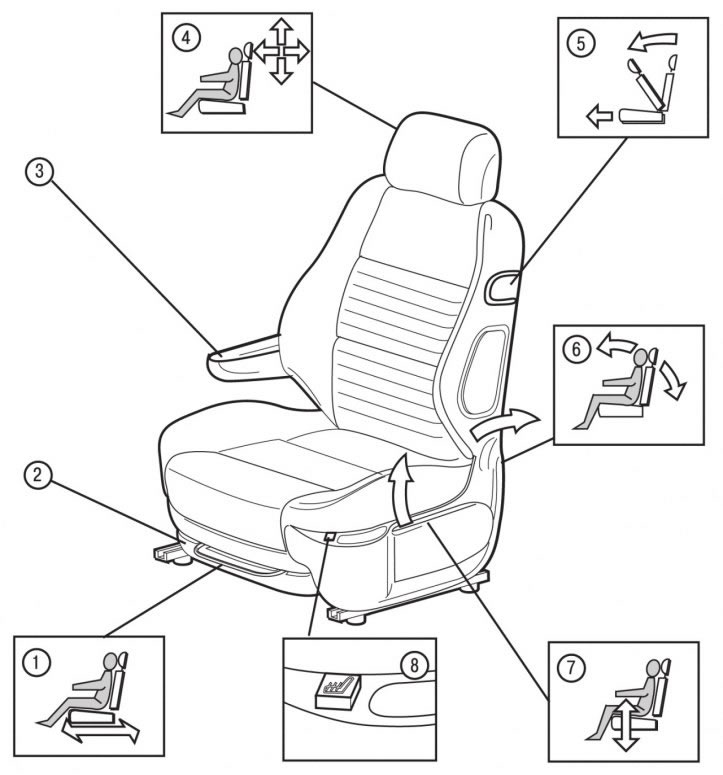


Figure 1.40. Front seat: 1 - fixing bracket for adjusting the longitudinal position of the seat; 2…

Figure 1.40. Front seat: 1 - fixing bracket for adjusting the longitudinal position of the seat; 2 - pull-out drawer for storing things; 3 - armrest; 4 - headrest; 5 - backrest locking lever (3-door cars); 6 - backrest tilt adjustment lever; 7 - seat height adjustment handle; 8 - seat heater switch


Lift the retaining clip 1 (figure 1.40) and move the seat forward or backward. Then release the clamp and move the seat a little further until the lock engages.

Access to the rear seats (3-door cars)


Press lever 5 to tilt the backrest and move the seat forward. The selected seat adjustments are retained after the seat is returned to its original position.

Important! Nothing should prevent the seat from returning to its original position; it must snap into place so that its longitudinal adjustment is locked.


Backrest tilt adjustment


Pull lever 6 back, set the desired backrest tilt position and release the lever.

Caution! Do not tilt the seat back too far back while driving, as this significantly reduces the effectiveness of the seat belts.


Adjusting the height of the driver's or passenger's seat


Pull handle 7 up or press down as many times as necessary to bring the seat to a comfortable position.

Seat heater switch


Press switch button 8.

The seat temperature is adjusted automatically.

Pressing the button again will turn off the electric heater.

Note: The seat heating continues for another 2 minutes after the ignition is turned off.


Armrest


Armrest 3 can be removed and put away by pressing the button located between the armrest and the side of the seat and pulling it out.

Headrest height and tilt adjustment


To raise or lower the headrest, pull it forward and at the same time slide it in the guide bushings.

The headrest adjustment is considered correct if its upper edge is level with the back of the head.


To remove the headrest, first move it to the upper position, then, using a coin to release the latch, pull it forward and upward.

To reinstall the headrest, insert the headrest guides into the bushings strictly along the axis of the backrest.

A special mechanism built into the backrest protects the cervical vertebrae from injury.

The source is located on the website www.PEUGEOTBOOK.ru

In the event of a rear-end collision, the body will press on the seat back, and the headrest will automatically move forward and upward, preventing the head from being thrown back sharply.

Drawers for storing things


There are storage compartments under both front seats for various items.

To open the drawer, lift it and pull it forward.

To remove the drawer, pull it out as far as it will go, press on the ends of the slides and lift it up to remove it.

To return the drawer to its place, push it all the way in and then press until it locks into place.
This article is available at russian, bulgarian, belarusian, ukrainian, serbian, croatian, romanian, polish, slovak, hungarian
Article reviewed by editor: Sidorov Timofey
Share information:
Previous
Peugeot 307: Driving and operation
Next

Parking assistance system for station wagons
Cruise control system
Traction control system (ASR) and electronic stability program…
Anti-lock braking system (ABS)
Parking brake
Folding the rear seats
Seat belts — adjustment and inspection
Airbags — general information
Front airbags
Disabling the front passenger airbag
See similar information for other Peugeot models

➨ Front brake pad check Peugeot 106 (1991-2003)
➨ Manually adjustable front seats Peugeot 207 (2006-2014)
➨ Adjusting the front seats and headrests Peugeot 405 (1987-1997)
➨ Front crankshaft oil seal (timing belt side) — replacement Peugeot 605 (1989-2000)
➨ Front seats — removal and installation Peugeot 807 (2002-2014)
Link to this article in different formats
Comments and feedback from visitors
No comments yet


Add two numbers 50 + 22


Peugeot 307 (2001-2008) 
  • User manual
  • Keys, doors and alarm
  • Controls and instruments
  • Driving and operation
  • Maintenance
  • Power unit
  • Petrol engines TU3 and TU5
  • Petrol engines EW10
  • Diesel engines DV10
  • Diesel engines DW10
  • Transmission
  • Clutch and drive shafts
  • Mechanical gearbox
  • Automatic gearbox
  • Chassis, running gear
  • Front suspension
  • Rear suspension
  • Steering
  • Brake system
  • Body and interior
  • Exterior (external elements)
  • Interior (internal elements)
  • Doors, locks and windows
  • Heating and air conditioning
  • Electrical equipment
  • Equipment and devices
  • Power devices
  • Airbags
  • Electrical circuits
Peugeot 306 (1993-2002) 
  • General information
  • Introduction to manual
  • Specifications
  • Gasoline engine
  • Engine repair
  • Lubrication system
  • Cooling system
  • Fuel injection
  • Ignition system
  • Diesel engine
  • Engine repair
  • Lubrication system
  • Cooling system
  • Fuel injection
  • Transmission
  • Clutch
  • Gearbox
  • Drive shafts
  • Chassis, running gear
  • Steering system
  • Front suspension
  • Rear suspension
  • Brake system
  • Electrical equipment
  • Power devices
  • Electrical circuits
Peugeot 305 (1977-1989) 
  • General information
  • Maintenance
  • Power unit
  • Gasoline engines
  • Diesel engines
  • Cooling system (gasoline)
  • Cooling system (diesel)
  • Fuel system (gasoline)
  • Fuel system (diesel)
  • Ignition system
  • Transmission
  • Clutch
  • Mechanical gearbox BB8
  • Mechanical gearbox BE1
  • Automatic gearbox ZF4
  • Shafts, hubs and wheels
  • Chassis, running gear
  • Brake system
  • Car suspension
  • Steering
  • Body and interior
  • Exterior (external elements)
  • Interior (internal elements)
  • Electrical equipment
  • Equipment and devices
  • Headlights and lighting
  • Power devices
  • Electrical circuits
  • Wiring diagrams (diesel)
PeugeotBook.ru © 2018–2026 | Mobile version | Sitemap: EN BG BY UA RS HR RO PL SK HU | Write message | Site search | Add to bookmarks | Peugeot owners
106 (1991-2003) | 206 (1998-2012) | 207 (2006-2014) | 305 (1977-1989) | 306 (1993-2002) | 307 (2001-2008) | 405 (1987-1997) | 406 (1995-2004) | 605 (1989-2000) | Partner-I (1996-2008) | Eurovans-807 (2002-2014) | Eurovans-806 (1994-2002) | J5 (1981-1993) |
Cookies are used to ensure the correct display of pages on the site.