



Table of contents: Height adjustment of front seat belts 🠇 Seat belt tensioners 🠇 Rear seat belts 🠇 Checking the condition of seat belts 🠇
Properly adjusted seat belts keep the driver and passengers in place while driving and are an effective means of protecting against serious injury in an accident.
The car is equipped with three-point seat belts.
By adjusting the height of the front seat belt anchor points, you can achieve the best possible positioning of the shoulder belt.
Height adjustment of front seat belts
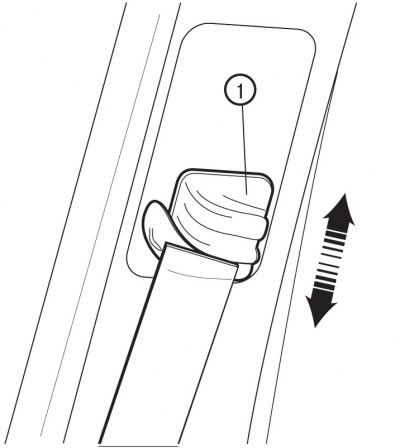
Figure 1.47. Location of the upper seat belt support retainer (1)
Press the latch 1 (figure 1.47) and move the upper support of the belt up or down so that the shoulder branch passes through the middle of the shoulder and in no case through the throat, then release the lock.
After adjustment, pull the belt to make sure the upper belt support is securely locked.
Seat belt tensioners
The safety level of the driver and passengers wearing seat belts will be increased by installing tensioners and pressure limiters.
In moderate to severe frontal collisions, pyrotechnic pretensioners instantly press the driver and passenger's bodies against the seatbacks.
The pyrotechnic seat belt tensioner system is activated only when the ignition is on. Pressure limiters reduce the force of the seat belts on the driver and front passenger's bodies in the event of a collision.
Caution! Depending on the force and nature of the impact, seat belt tensioners may tighten before or independently of airbag deployment. In any case, when the system is triggered, the airbag malfunction indicator in the instrument cluster lights up. After any collision, it is necessary to check the functionality of the entire system at a Peugeot service station.
Please note: All components of the seat belt tensioner system are designed for use for 10 years from the vehicle's production date. At the end of the specified period, the system must be replaced.
Rear seat belts
The rear seats are equipped with three seat belts, each of which is secured at three points and has an inertia reel. The outboard seat belts are equipped with force limiters.
Checking the condition of seat belts
Make sure the belts are not twisted due to improper installation. If the belts are twisted or stick when retracted, pull the belt out as far as it will go to straighten it. Then return the belt to its original position.
Pull the belt out fully and release it so that it also retracts fully. If the belt sticks when moving in both directions, check that it is clean and that there is no dirt, grease or other foreign matter on the belt. The belt should be washed only with a mild soap and water solution. If the belt cannot be washed with this solution, it should be replaced.
Check the condition of all belt attachment points. The mounting bolts must be securely tightened. Remove any traces of corrosion where the belt attaches to the body. Replace any corroded fastening parts.
Replace the belt also if you find the following damage:
- thread breaks or fraying of the belt;
- cuts in the loops on the edges of the belt;
- curvature of the braid;
- the presence of chipped areas or cuts.
Replace the belt assembly if the following damage is detected:
- if the belt buckle is not securely fastened;
- if the belt release button has become loose;
- if the buckle does not release the belt;
- if the force required to release the belt has increased;
- if there are cracks on the surface of the buckle.
[Original text is located at: peugeotbook.ru]
Caution! Periodically inspect belts, buckles, and fastenings to ensure they are in good working order. If the belts are removed for any reason, ensure they are installed correctly. To ensure proper operation of the tensioning mechanism, keep the seat belts clean. If the buckles or tensioning mechanism are damaged, replace the belts.
Warning! Replace belts that have been severely stretched in an accident.
When exposed to sunlight and chemicals, the belt tape loses its strength. When the original color is lost (fading) replace the belt.
It is prohibited to treat the belt webbing with chemical compounds, dye it or bleach it. The compounds will weaken the belt. Replace a belt that is discolored or weakened by chemicals.
Belts should always be replaced as a set. Do not install buckles or tensioners from other vehicles or from other vehicles.