



Table of contents: Throttle position sensor voltage and…🠇 Influence of external factors 🠇 Adjusting the TPS sensor 🠇 Checking the throttle position…🠇 Checking the TPS sensor's…🠇 Unstable output signal 🠇 The signal voltage or supply voltage…🠇 There is no signal voltage 🠇
Throttle position sensor (TPS) (see illustration 12.16) used to inform the electronic control unit of the throttle position and the degree of acceleration. The throttle position sensor is a three-wire potentiometer.
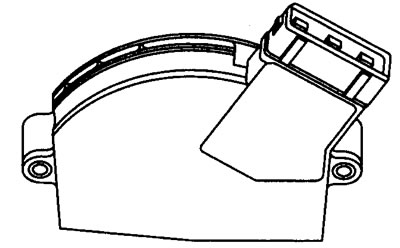
12.16 Throttle Position Sensor (TPS)
Throttle position sensor voltage and resistance values
Terminal numbers
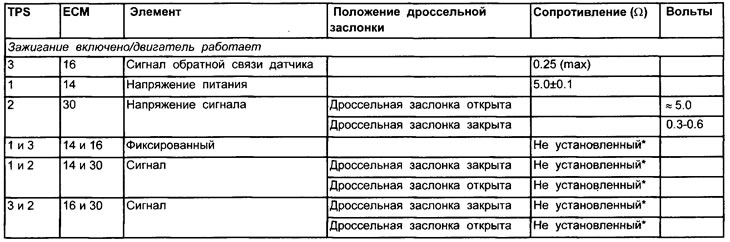
* Throttle position sensor resistance values are not specified for the MM8R system. However, the resistance between the corresponding terminals should change smoothly as the throttle valve opens and closes.
See illustration 12.11
Influence of external factors
- The mounting screws are too tight
- The throttle position sensor multi-pin connector is loose
- Poorly adjusted or sticking throttle valve
- Poorly adjusted or sticking throttle cable
Adjusting the TPS sensor
If a fault is detected or if the voltage and resistance values are not within specifications, the throttle position sensor must be replaced.
Checking the throttle position sensor (TPS) (general check)
1. Inspect the throttle position sensor multi-pin connector for signs of corrosion or damage.
2. Make sure the connector terminal pins are properly installed and have good contact with the throttle position sensor multi-pin connector.
3. Any of the above faults occur as a result of a weak or unstable signal from the throttle position sensor.
Checking the TPS sensor's functionality using an oscilloscope or voltmeter
1. Bend back the rubber insulation (where possible) to the multi-contact connector of the throttle position sensor, OR connect the output unit (BB) between the multi-contact connector of the electronic control unit and the electronic control unit.
2. Connect the negative probe of the oscilloscope or voltmeter to ground at the engine OR to the #1 ground terminal of the throttle position sensor.
3. Connect the positive probe of an oscilloscope or voltmeter to the wire attached to terminal #3 of the throttle position sensor.
4. The throttle valve is closed, the ignition is on.
5. Compare the closed throttle voltage value with the value specified in the specifications.
6. Open and close the throttle valve several times and check for a smooth increase in voltage to a value greater than 4.25-4.95 volts. If the signal is unstable, proceed to the test described below, titled "Output Signal Unstable.".
7. If a digital voltmeter is used, it is important that it can function as a plotter.
8. If the oscilloscope time base is approximately 5 seconds, the screen may display a "waving" pattern of the throttle position sensor output signal as the throttle valve opens and then closes (see illustration 12.15).
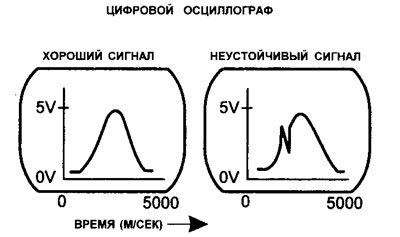
12.15 Typical Manifold Absolute Pressure/Throttle Position Sensor (MAP/TPS) Output Waveform
9. If there is no throttle position sensor signal voltage, proceed to the test described below under "No Signal Voltage"
Unstable output signal
1. An unstable output signal occurs when the output voltage changes stepwise, or drops to zero, or an open circuit occurs.
2. Check the resistance of the throttle position sensor at different terminals.
3. If the output signal from the throttle position sensor is unstable, the potentiometer is most likely faulty. In this case, the only solution is to replace the throttle position sensor with a new one.
The signal voltage or supply voltage matches the battery voltage
Check for a short circuit in the wire connected to the positive (+) terminal of the battery or in the supply voltage of the sensor.
There is no signal voltage
- Check for reference voltage (5.0 V) at terminal No. 2 of the throttle position sensor.
- Check for proper grounding at terminal #1 If the power and ground portions of the circuit are good, check for continuity in the signal wire running between the throttle position sensor and the ECU.
- If there is no power supply and/or ground, check for continuity in the power supply wire and/or ground wire running between the throttle position sensor and the ECU.
- If the throttle position sensor wiring is OK, check all power and ground connections to the ECU. If these contacts are in working order, then the electronic control unit may be faulty.