
English Русский
Български
Беларускі
Український
Српски
Hrvatski
Română
Polski
Slovenský
Magyar
Bookmark Articles Sitemap Contacts
Company Hyundai Company Opel Company Skoda Company Kia Company Mitsubishi Company LADA Company Audi
PeugeotBook.ru


Series 100   Series 200   Series 300   400-500   Series 600   Crossovers   Others
 
Peugeot 206 (1998-2012) Peugeot 207 (2006-2014)

Crankshaft speed and position sensor (TU5 petrol engine) (Peugeot 207)

  • Main
  • 20X
  • Peugeot 207 (2006-2014)
  • Power unit
  • Ignition system
  • Crankshaft speed and position sensor (TU5 petrol engine)
0
Crankshaft speed and position sensor (TU5 petrol engine)


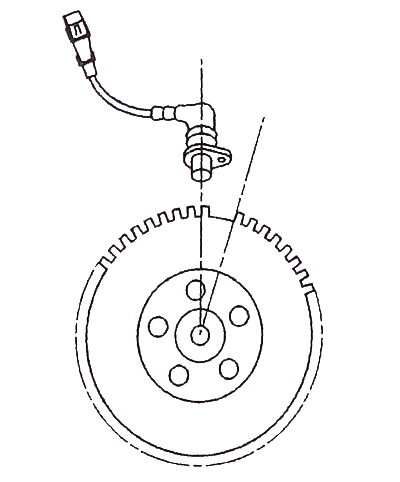
The crankshaft speed and position sensor faces the marks on the flywheel. It consists of a magnetic core surrounded by a winding.

When the flywheel teeth pass the sensor, a change in the magnetic field is created in it, which causes an alternating voltage in the winding (sine wave signal) the frequency and amplitude of this voltage are proportional to the engine speed.

The flywheel has 60 teeth around its circumference, two of which are removed to determine the TDC position of the 1st cylinder.
This article is available at russian, bulgarian, belarusian, ukrainian, serbian, croatian, romanian, polish, slovak, hungarian
Article reviewed by editor: Matveev Demid
Share information:
Previous
Peugeot 207: Ignition system
Next

Ignition coils (TU5 petrol engine)
Ignition system device
General information about the ignition system of the TU5 petrol…
Characteristics of ignition components (TU5 petrol engine)
General information about the ignition system of gasoline…
Characteristics of ignition components (EP series gasoline…
Crankshaft speed and position sensor (EP series gasoline engines)
Knock sensor (EP series gasoline engines)
See similar information for other Peugeot models

➨ Petrol engine in-car repair procedures — specifications Peugeot 106 (1991-2003)
➨ Electrical diagram of the starter, alternator, fuel heating… Peugeot 306 (1993-2002)
➨ 1.4 liter petrol engine — design description Peugeot 405 (1987-1997)
➨ Engine bay. Cars with 2.0L turbocharged petrol engine Peugeot 605 (1989-2000)
➨ High Idle Speed Thermostatic Sensor (1.9L Engine Models) Peugeot Partner I (1996-2008)
Link to this article in different formats
Comments and feedback from visitors
No comments yet


Add two numbers 24 + 11


Peugeot 207 (2006-2014) 
  • General information
  • Car care
  • Governing bodies
  • Driving and operation
  • Power unit
  • Engine characteristics
  • Engine repair
  • Cooling system
  • Lubrication system
  • Ignition system
  • Control system (gasoline)
  • Fuel system (gasoline)
  • Control system (diesel)
  • Transmission
  • Clutch
  • Mechanical gearbox
  • Automatic gearbox
  • Drive shafts
  • Chassis, running gear
  • Car suspension
  • Steering
  • Brake system
  • Body and interior
  • Exterior (external elements)
  • Interior (internal elements)
  • Heating and air conditioning
  • Electrical equipment
  • Equipment and devices
  • Headlights and lighting
  • Power devices
  • Electrical circuits
Peugeot 206 (1998-2012) 
  • General information
  • User manual
  • Maintenance
  • Power unit
  • Gasoline engines
  • Diesel engines
  • Diesel power system
  • Engine management system
  • Transmission
  • Clutch
  • Mechanical gearbox
  • Automatic gearbox
  • Drive shafts
  • Chassis, running gear
  • Front suspension
  • Rear suspension
  • Steering
  • Brake system
  • Body and interior
  • Body elements
  • Doors, locks and windows
  • Electrical equipment
  • Equipment and devices
  • Electrical circuits
PeugeotBook.ru © 2018–2026 | Mobile version | Sitemap: EN BG BY UA RS HR RO PL SK HU | Write message | Site search | Add to bookmarks | Peugeot owners
106 (1991-2003) | 206 (1998-2012) | 207 (2006-2014) | 305 (1977-1989) | 306 (1993-2002) | 307 (2001-2008) | 405 (1987-1997) | 406 (1995-2004) | 605 (1989-2000) | Partner-I (1996-2008) | Eurovans-807 (2002-2014) | Eurovans-806 (1994-2002) | J5 (1981-1993) |
Cookies are used to ensure the correct display of pages on the site.