



Table of contents: Engine compartment - visual…🠇 Engine oil level - checking and…🠇 Engine oil pressure - checking 🠇 Cars with gasoline engines…🠇 Cars with ES9J4S gasoline engine 🠇
In order to ensure reliable operation of the vehicle, it is necessary to carry out its maintenance in a timely manner. Most car maintenance and service jobs can be done by yourself. In some cases, vehicle servicing should be entrusted to a workshop. This may be caused by a lack of proper skills and experience or control and measuring instruments, or by the need for urgent maintenance.
If the vehicle is operated in difficult conditions, for example, in dusty conditions, with a trailer, or in urban areas, then it is recommended to perform maintenance more frequently or within shorter timeframes.
The service interval for a vehicle under normal operating conditions is determined by the time factor or mileage. The vehicle manufacturer has set the following maintenance intervals:
- every 30,000 kilometers for vehicles with gasoline engines;
- every 20,000 kilometers for vehicles with diesel engines or once every two years.
Types of continuous monitoring:
- refilling the washer fluid supply
- checking the condition of the windshield wiper and washer
- checking the engine oil level
- checking the coolant level in the expansion tank
- checking the power steering fluid level
- checking tire pressure and checking the condition and thickness of brake pads and brake discs
- checking the brake fluid level
- checking the exterior lights: parking lights, low and high beam headlights
- checking the reversing lights and rear fog lights
- checking brake lights and turn signals
- hazard warning light test
- sound signal testing
The maintenance plan provides for replacement
- motor oil. Performed once a year or after 30,000 kilometers for gasoline engines and 20,000 kilometers for diesel engines
- oil filter. Performed together with engine oil change
- brake fluid. It is carried out once every two years
- of the timing belt of the gas distribution mechanism. The timing belt on cars with a gasoline engine is scheduled to be replaced after 120,000 kilometers, and on diesel engines - after 160,000 kilometers or after 10 years of operation
- air filter. The air filter should be changed every 60,000 kilometers
- cabin filter. The cabin filter should be changed at least once a year or after 30,000 kilometers for gasoline engines and 20,000 kilometers for diesel engines
- spark plugs. On vehicles with an EW10J4/EW12J4 engine, spark plugs must be replaced every 60,000 kilometers, and with an ES9J4S engine - every 120,000 kilometers
- fuel filter. The fuel filter is replaced every 60,000 kilometers
Caution! The fuel system of a vehicle with a gasoline engine may have a removable fuel filter installed on the fuel supply line, or a built-in filter that is a component of the fuel pump. The built-in filter does not require maintenance.
For vehicles with a diesel engine with a particulate filter, it is necessary to add a special additive and replace the filter. The frequency of additive refills depends on its type. When using DPX 42 additive, it should be refilled and the filter replaced every 80,000 kilometers. As a result of technical improvements, a new additive, Eolys 176, was developed, which made it possible to change the timing of additive refills and particulate filter replacements. When using the new additive, the refill and replacement intervals are 120,000 kilometers.
Engine compartment - visual inspection
A visual inspection of the following pipelines, hoses, and their connections should be carried out to ensure that they are tight, free of chafing, porosity, and brittleness:
- a) fuel lines;
- b) cooling system hoses;
- c) brake drive pipelines;
- d) power steering pipelines.
Engine oil level - checking and replacing
The engine oil level should be checked every 600 km. It is recommended to check the oil level every time you refuel. The dipstick is located on the side of the engine.
Engine oil should be changed every two years or after 30,000 kilometers for gasoline engines and 20,000 kilometers for diesel engines.
Examination
1. Place the car on a horizontal surface.
2. Wait at least five minutes if the engine has reached operating temperature to allow the oil to drain into the crankcase. It is best to check the oil level before starting the engine when it is cold.
3. Remove the dipstick. Wipe it with a lint-free cloth or paper towel and reinsert it, then remove it again. If the oil level is between the Max. and Min. marks on the dipstick, then everything is fine. If the level only reaches the lower mark on the dipstick, then oil needs to be added (see illustration).
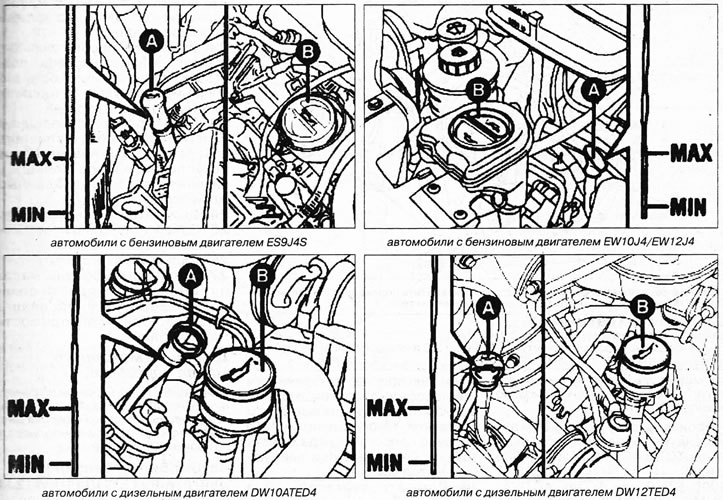
5.3. Engine oil level indicator rod A and filler neck B
When it comes to replenishing the engine oil volume, it is recommended to adhere to the following rule. If your driving style and driving characteristics are moderate, the oil level should be closer to the lower mark on the dipstick. If the vehicle is constantly driven at high speeds, the oil level should be kept higher, i.e. almost at the upper mark on the dipstick.
Adding too much motor oil will have a negative impact on the engine. The oil level should not be above the MAX mark on the dipstick. Excess oil is quickly consumed, but it also creates carbon deposits that negatively impact engine performance and exhaust emissions. Excess engine oil in gasoline-powered vehicles can damage the catalytic converter.
Some of the motor oil is burned off as a result of friction. Therefore, oil consumption is natural. A well-functioning engine consumes approximately 0.5 liters of oil per 1000 km.
The quality of motor oil is designated by the corresponding standard of car and oil manufacturers, for example, ACEA AZ-98, which corresponds to API SJ - for gasoline engines - or ACEA BZ-98 (API CF) - for diesel engines.
Please note: Motor oils labeled for diesel engines cannot be used in gasoline engines. However, there are oils that are suitable for both gasoline and diesel engines. In such cases, both specifications are indicated on the motor oil packaging.
All-season oils are used for engine lubrication, eliminating the need for seasonal (summer/winter) oil changes. The basis of all-season oils is a low-viscosity single-season oil; by adding so-called "viscosity index improvers," all-season oils are stabilized in a hot state. This ensures the necessary lubrication of the engine both in cold and hot conditions.
Also, easy-flowing oils can be used for engine lubrication (low friction oils). We are talking about all-season oils, which contain additives that reduce the coefficient of friction, as a result of which friction of internal engine parts is reduced. The base of easy-flowing oils is synthetic oil.
Since the application areas of related oils according to SAE classification overlap, short-term temperature fluctuations can be ignored. It is permissible to mix oils of different viscosities if it is necessary to add oil and the ambient temperature does not correspond to the viscosity class of the oil poured into the engine.
Caution! Lubricating additives of any kind must not be added to either fuel or lubricating oils.
Caution! Inconsistent use of different types of oils can adversely affect engine performance. If possible, do not mix motor oils of the same type but different brands. If necessary, you can safely mix oils of the same brand and type, but of different viscosities.
The car manufacturer recommends using TOTAL ACTIVA/QUARTZ 7000 10W40, TOTAL ACTIVA/QUARTZ 9000 5W40 or TOTAL ACTIVA/QUARTZ 9000 5W30 engine oil of ACEA AZ-98 (API SJ) quality for gasoline engines or ACEA BZ-98 (API CF) for diesel engines. It is permissible to use motor oils from other manufacturers, but of the same quality. If lower quality oil is used, it should be changed more frequently. Finding engine oil leaks
6. Unscrew the oil filler cap and check the condition of its gasket for damage and porosity.
7. Check the reliability of the fastening of the ventilation hoses running from the cylinder block to the cylinder head cover, to the air filter or to the intake manifold.
8. Check the cylinder head cover gasket.
9. Check the cylinder head gasket.
10. Check the oil filter gasket.
11. Check the gasket on the engine oil drain plug.
12. Check the condition of the oil pan seal.
13. Check the tightness of the joint between the engine and gearbox.
Since a leak typically spreads oil over a large area on the engine surface, it can be difficult to determine the location of the leak at first glance. The following search method is recommended:
14. Wash the engine. To do this, spray the engine with an aerosol cleaner and, after letting it work, rinse with water. Before doing this, cover the generator and fuse box with a plastic bag.
15. Sprinkle the outside of the connecting seams and their gaskets with lime or talc. In specialized workshops, they use a spray to detect leaks.
16. Check the oil level again and top up if necessary.
17. Take the vehicle for a test drive of about 30 km to ensure the engine oil is well warmed up.
18. Inspect the engine after the test drive, using a flashlight to identify any leaks and correct any problems.
Replacement
Attention! The oil filter should also be changed every time the oil is changed.
19. Warm up the engine before draining the oil. To do this, it is enough to travel a short distance (within about 10 minutes).
20. Place the front of the vehicle on jack stands.
21. Unscrew the oil filler cap on the cylinder head.
22. Unscrew the drain plug at the bottom of the crankcase, placing a container underneath to collect the oil. Be careful because the oil is hot.
23. After the oil has drained, screw in the drain plug, replacing it with a new sealing ring, and tighten it to the specified torque.
24. Replace the oil filter.
25. Fill with the prescribed amount of engine oil.
26. Start the engine.
27. Check the oil level and the tightness of the drain plug and oil filter. Add oil if necessary.
Engine oil pressure - checking
Caution: Before checking engine oil pressure, make sure the oil level is correct. Checking engine oil pressure is performed on a hot engine.
Cars with gasoline engines EW10J4/EW12J4
28. Remove the engine compartment protection, if installed, and place containers under the engine to collect the engine oil.
29. Remove the oil filter and screw adapter 3 of the measuring device into its place and connect hose 2 with a pressure gauge to it (see illustration).
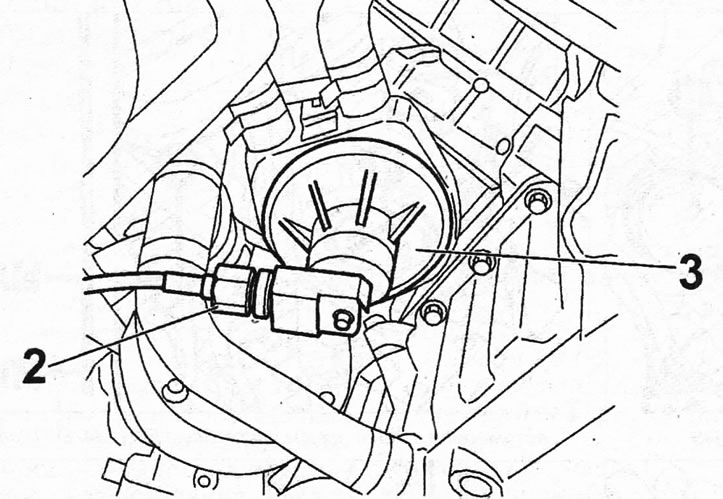
5.29. Remove the oil filter and screw adapter 3 of the measuring device in its place and connect hose 2 with a pressure gauge to it
Filling volumes
- 2.0 and 2.2 liter gasoline engines - 4.25 liters
- 3.0L - 5.4L V-shaped gasoline engine
- Diesel engines with a capacity of 2.0 and 2.2 liters - 4.75 liters
30. Start the engine and read the pressure gauge.
31. After completing the check, install a new oil filter and top up the engine oil level.
Cars with ES9J4S gasoline engine
32. Disconnect the engine oil pressure sensor plug and disconnect the sensor.
33. Connect adapter 3 of hose 2 with pressure gauge 1 instead of the sensor (see illustration).
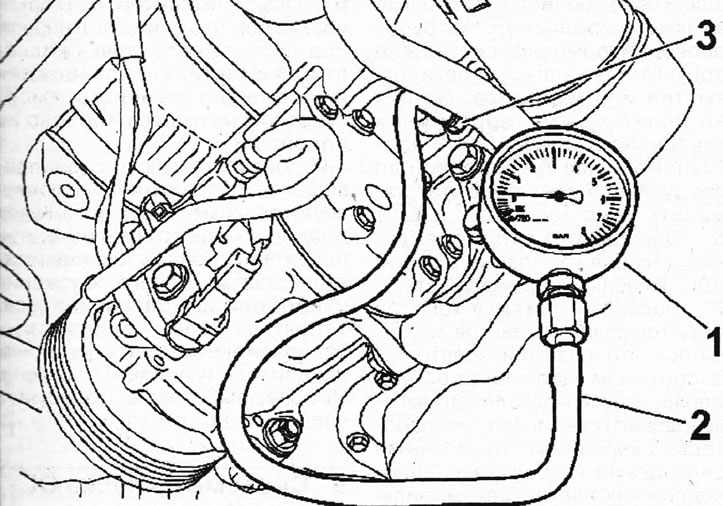
5.33. Connect adapter 3 of hose 2 with pressure gauge 1 instead of the sensor
34. Start the engine and check the engine oil pressure at different engine speeds.