
English Русский
Български
Беларускі
Український
Српски
Hrvatski
Română
Polski
Slovenský
Magyar
Bookmark Articles Sitemap Contacts
Company Hyundai Company Opel Company Skoda Company Kia Company Mitsubishi Company LADA Company Audi
PeugeotBook.ru


Series 100   Series 200   Series 300   400-500   Series 600   Crossovers   Others
 
Partner I (1996-2008) Peugeot 807 (2002-2014) Peugeot 806 (1994-2002) Peugeot J5 (1981-1993)

Exhaust Gas Recirculation System — General Information (Peugeot Eurovans 807)

  • Main
  • Пежо
  • Peugeot 807 (2002-2014)
  • Power unit
  • Exhaust system
  • Exhaust Gas Recirculation System — General Information
0
High levels of nitrogen oxides (NOx) in the exhaust gases are reduced by the exhaust gas recirculation system. The basis of the system is the valves through which part of the exhaust gases is diverted back into the intake manifold and from there into the combustion chambers. The volume of these gases is regulated and depends on the operating load on the engine. Since these gases contain almost nothing that could burn, they do not burn, but this allows for a reduction in the volume of fresh air supplied and at the same time reduces the temperature in the combustion chambers, thereby reducing the level of nitrogen oxides.

Since the supply of exhaust gases back to the intake manifold is only necessary from the moment the engine begins to operate under load, the recirculation process is regulated by a whole link of control elements. The main valve is the electromagnetic exhaust gas recirculation valve, which operates on reduced pressure and is controlled by a microprocessor. A vacuum pump generates reduced pressure for the mechanical recirculation valve.

The reference signal for the gasoline engine control unit to divert part of the exhaust gas into the combustion chambers is the information from the coolant temperature sensor. When the engine is cold, when the coolant temperature does not exceed 60°C, exhaust gas drainage is not required. On vehicles with a diesel engine, signals from the mass air flow sensor and the crankshaft speed sensor are used as reference signals (see illustrations 6.0, 6.0a). When switching the exhaust gas recirculation system on and off, the engine control unit also uses the parametric data stored in its memory based on the engine load, which in turn is determined by the position of the accelerator pedal.
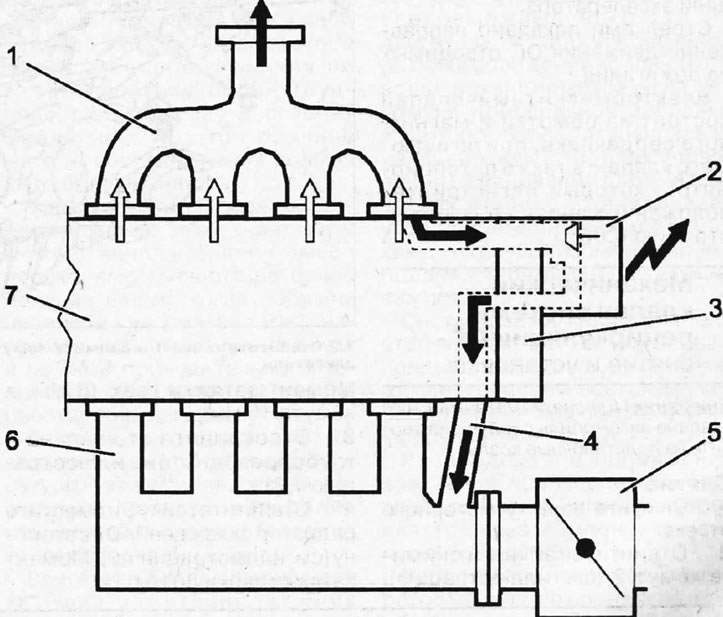


6.0. Functional diagram of the exhaust gas recirculation system of a vehicle with a gasoline engine…

6.0. Functional diagram of the exhaust gas recirculation system of a vehicle with a gasoline engine 1 - intake manifold; 2 - electromagnetic valve of exhaust gas recirculation; 3 - thermostat housing with coolant temperature sensor; 4 - exhaust gas pipe with mechanical valve; 5 - valve on the intake manifold inlet pipe; 6 - intake manifold; 7 - cylinder head
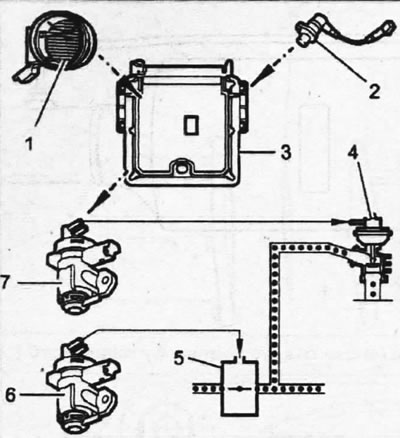

6.0a. Main components of the exhaust gas recirculation system of a diesel vehicle 1 - mass air flow…

6.0a. Main components of the exhaust gas recirculation system of a diesel vehicle 1 - mass air flow sensor; 2 - crankshaft speed/position sensor; 3 - engine control unit; 4 - EGR valve; 5 - intake manifold flap; 6 - electromagnetic valve of the intake manifold flap; 7 - electromagnetic valve of the exhaust gas recirculation system


The arrows show the direction of movement of exhaust gases diverted for afterburning.


The solenoid valve consists of a winding and a magnetic core that attracts the valve, as well as a potentiometer that registers the valve position (see illustration 6.0b).
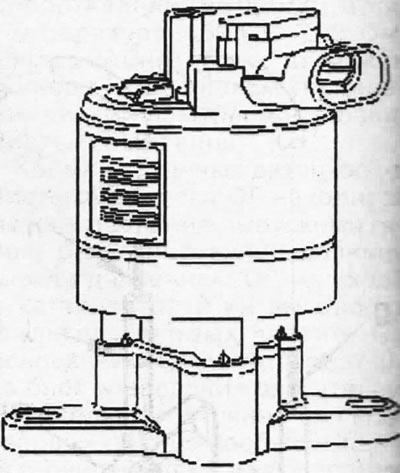
6.0b EGR solenoid valve

6.0b EGR solenoid valve
This article is available at russian, bulgarian, belarusian, ukrainian, serbian, croatian, romanian, polish, slovak, hungarian
Article reviewed by editor: Vinogradov Robert
Share information:
Previous
Peugeot 807: Exhaust system
Next

Diesel Exhaust System Sensors — General Information
Particulate filter — removal and installation
Exhaust Pipes — Removal and Installation (Gasoline Engine ES9J4S)
Exhaust manifold — removal and installation
Exhaust system — general description
Mechanical EGR valve — removal and installation
See similar information for other Peugeot models

➨ Exhaust system — general information and component renewal Peugeot 106 (1991-2003)
➨ Exhaust gas recirculation system Peugeot 206 (1998-2012)
➨ Fuel and exhaust system specifications Peugeot 305 (1977-1989)
➨ Exhaust system (diesel) Peugeot 405 (1987-1997)
➨ Exhaust Gas Recirculation System — General Information Peugeot 605 (1989-2000)
Link to this article in different formats
Comments and feedback from visitors
No comments yet


Add two numbers 44 + 28


Partner I (1996-2008) 
  • General information
  • Introduction to the guide
  • Faults en route
  • Weekly checks
  • User manual
  • Maintenance (petrol)
  • Maintenance (diesel)
  • Power unit
  • Petrol engines
  • Diesel engines «XUD»
  • Diesel engines «DW»
  • Overhaul of petrol engines
  • Overhaul of diesel engines
  • Cooling and heating
  • Power and exhaust (petrol)
  • Power and exhaust (XUD diesels)
  • Power and exhaust (DW diesels)
  • Emission reduction
  • Starting and charging system
  • Transmission
  • Clutch
  • Mechanical gearbox
  • Drive shafts
  • Chassis, running gear
  • Brake system
  • Car suspension
  • Steering
  • Body and interior
  • Exterior (external elements)
  • Interior (internal elements)
  • Doors, locks and windows
  • Electrical equipment
  • Equipment and devices
  • Electrical circuits
Peugeot 807 (2002-2014) 
  • General information
  • Operating instructions
  • Maintenance
  • Troubleshooting
  • Power unit
  • Gasoline engines
  • Diesel engines
  • Cooling and heating
  • Fuel injection (petrol)
  • Fuel system (diesel)
  • Fuel system
  • Exhaust system
  • Ignition system
  • Transmission
  • Clutch
  • Manual gearbox
  • Automatic gearbox
  • Chassis, running gear
  • Brake system
  • Car suspension
  • Steering system
  • Body and interior
  • Exterior (external elements)
  • Interior (internal elements)
  • Electrical equipment
  • Power devices
  • Electrical circuits
Peugeot 806 (1994-2002) 
  • General information
  • User manual
  • Maintenance
  • Power unit
  • Petrol engines
  • Diesel engines
  • Lubrication system
  • Cooling system
  • Fuel injection (petrol)
  • Fuel system (diesel)
  • Ignition and exhaust systems
  • ECM Bosch Motronic MP 3.2
  • ECM Magneti-Marelli (MM)
  • Transmission
  • Clutch
  • Mechanical gearbox
  • Chassis, running gear
  • Brake system
  • Car suspension
  • Steering
  • Electrical equipment
  • Equipment and devices
  • Electrical circuits
Peugeot J5 (1981-1993) 
  • General information
  • Introduction to manual
  • Specifications
  • Gasoline engine
  • Engine repair
  • Lubrication system
  • Cooling system
  • Fuel system
  • Ignition system
  • Diesel engine
  • Engine repair (DB9)
  • Lubrication system (DB9)
  • Cooling system (DB9)
  • Fuel injection (DB9)
  • Engine repair (U25)
  • Lubrication system (U25)
  • Cooling system (U25)
  • Fuel injection (U25)
  • Transmission
  • Clutch
  • Gearbox
  • Drive shafts
  • Chassis, running gear
  • Steering system
  • Car suspension
  • Brake system
  • Electrical equipment
  • Power devices
  • Electrical circuits
PeugeotBook.ru © 2018–2026 | Mobile version | Sitemap: EN BG BY UA RS HR RO PL SK HU | Write message | Site search | Add to bookmarks | Peugeot owners
106 (1991-2003) | 206 (1998-2012) | 207 (2006-2014) | 305 (1977-1989) | 306 (1993-2002) | 307 (2001-2008) | 405 (1987-1997) | 406 (1995-2004) | 605 (1989-2000) | Partner-I (1996-2008) | Eurovans-807 (2002-2014) | Eurovans-806 (1994-2002) | J5 (1981-1993) |
Cookies are used to ensure the correct display of pages on the site.