



Check the condition of the driven disk springs and the splined conical notch of the disk. Oily disc linings cannot be cleaned; in this case, the driven disc should be replaced. The damping springs of the driven discs are not color-coded the same on all engines, and here too, it is important to indicate the year of manufacture and engine number when purchasing a new driven disc.
Check the clutch linings for reinstallation by measuring the distance from the top surface of the linings to the top side of the rivet heads with a depth gauge, as shown in Figure 105. If this dimension is less than 0.30 mm, the disc should be replaced. The disc is also replaced when the measured size approaches the limit value.
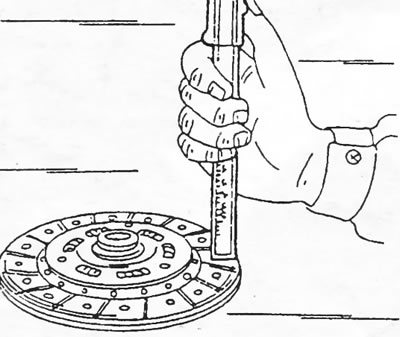
Figure 105. Measuring the depth between the top of the clutch linings and the rivet heads. The residual size determines the possibility of reinstalling the slave disk.
To check the runout of the driven disk, the corresponding rod or clutch shaft is installed in the centers of the lathe. Place a dial indicator on a suitable stand next to the disk so that the measuring probe is adjacent to the edge of the disk (Figure 106). Slowly rotate the disk and read the readings from the dial indicator scale. If the readings exceed 0.4 mm, you can, if desired, carefully straighten the disc. Otherwise, replace the driven disk.
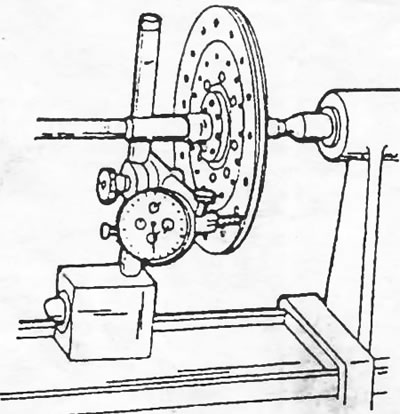
Figure 106. Checking the runout of the driven disk.
Check the movement of the driven disk hub on the clutch shaft splines. To do this, put on the disc and grasp the outer edge with your thumb and index finger. Move the washer in both directions in the direction of rotation. If the play is more than 0.4 mm, the spline connection is worn. The cause in this case is most often found in the slave disk.
Check the wear on the inner ends of the diaphragm springs. If deep wear is detected, the clutch should be replaced as a set.
The ends of the diaphragm springs should be positioned at the same height, no more than 0.5 mm. Bent ends can be straightened.
A special tool is usually used for this. but to straighten the ends of the springs you can also use a steel strip with a slot. If the wear at the ends reaches a depth of 0.3 mm, the clutch must also be replaced.
Place a steel ruler on the working surface of the drive disk, as shown in Figure 107, and measure the gap with feeler gauges. If the gap size exceeds 0.3 mm, the clutch must be replaced.
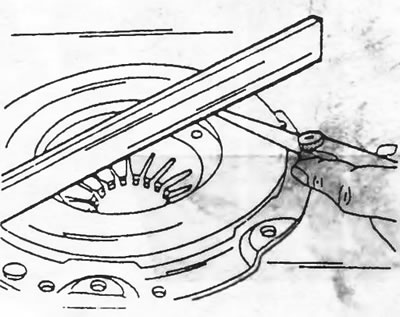
Figure 107. Measuring the skew of the clutch drive disc.
Information copied from the resource (peugeotbook.ru)