



Note: Valve clearances should only be checked and adjusted when the engine is cold.
Note: This procedure only applies to 1.4L engines. Valve clearances on 1.6L engines are maintained within normal limits by hydraulic compensators built into the valve lifters.
1. The importance of correct valve clearance adjustment cannot be overestimated, as they have a significant impact on the dynamic characteristics of the engine. If the gaps are too large, the engine will make noise when running (knocking or rattling), and engine efficiency will be reduced because the valves open too late and close too early. A more serious problem occurs if the gaps are too small. In this case, the valves cannot close completely when the engine is hot, which leads to serious engine damage (for example, burnt valve seats and/or deformation/cracks in the cylinder head). Checking and adjusting clearances is performed as described below.
2. Remove the cylinder head cover as described in paragraph 4.
3. The engine can now be turned over using a suitable socket head and extension on the crankshaft timing pulley bolt.
4. The valve clearance in each valve should be checked and adjusted only with the valve fully closed, with the valve lever resting on the heel of the cam lobe (directly opposite the toe). This can be achieved by performing adjustments in the following sequence. Keep in mind that cylinder #1 is the one closest to the gearbox. The correct valve clearance values are given in "Specifications" at the beginning of this chapter. The location of the valves can be determined by the position of the manifolds.
Fully open valve
- Graduation No. 1
- Graduation No. 3
- Graduation No. 4
- Graduation No. 2
Adjustable valves
- Inlet No. 3 and outlet No. 4
- Inlet #4 and outlet #2
- Inlet No. 2 and outlet No. 1
- Inlet No. 1 and outlet No. 3
[Source available on the website: PeugeotBook.ru]
5. With the appropriate valve fully open, check the clearances in the two specified valves. To check the clearance, insert a feeler gauge of the correct thickness between the valve stem and the valve lever adjusting screw. The feeler gauge should slide in with a slight sliding fit. If adjustment is necessary, loosen the lock nut on the adjusting screw and turn the screw as necessary (figure 9.5).
Once the correct clearance is achieved, hold the adjusting screw and tighten the lock nut securely. After tightening the lock nut, check the valve clearance again and readjust if necessary.
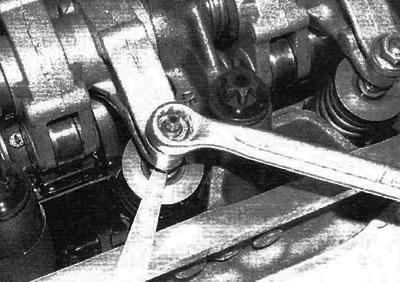
Figure 9.5. Check the valve clearances using a fan-shaped feeler gauge
6. Rotate the crankshaft to fully open the next valve in the prescribed sequence and check the clearances in the next two prescribed valves.
7. Repeat the procedure until you complete the check (and adjustment if necessary) clearances in all eight valves, and then install the cylinder head cover as described in paragraph 4.