



Note: Wait for the engine to cool before removing the cylinder head.
Removal
1. Disconnect the ground cable from the battery (see "Disconnecting the battery").
2. Drain the coolant from the cooling system as described in chapter 1A.
3. Remove the ignition coil assembly (see chapter 5B), and then remove the spark plugs (see Chapter 1A).
4. Remove the cylinder head cover as described in paragraph 4.
5. Remove the upper and lower timing belt covers as described in paragraph 5.
6. Align the engine/camshaft assembly mounting holes as described in paragraph 3, and lock the camshaft timing pulley and flywheel.
Warning. Do not attempt to crank the engine with the locking tools installed.
1.4L engines
7. The following description is based on the assumption that the cylinder head will be removed together with the intake and exhaust manifolds. This is simpler, but requires handling a more bulky and heavy unit. If you want to remove the manifolds first, proceed as described in chapter 4A.
8. Perform the following steps as described in chapter 4A:
- a) Remove the air cleaner assembly and air intake duct.
- b) Disconnect the exhaust pipe from the manifold and from the bracket on the gearbox. Disconnect or release the oxygen sensor wiring.
- c) Disconnect the fuel supply hose (and, if applicable, a return hose) from the fuel rail (plug all openings to prevent fuel leakage and dirt from entering the fuel system).
- d) Mark the installation positions of the electrical connectors and vacuum/vent hoses on the intake manifold and throttle body, and then disconnect and disconnect them.
- d) If necessary, remove the bolts and support bracket from the intake manifold.
- e) Disconnect the accelerator cable (if available).
- g) On air-injected models, disconnect the hose from the fuel injection valve, which is located on the exhaust manifold.
9. Loosen the clamps and disconnect the coolant hoses from the cylinder head, after marking their installation position. Similarly, mark the location and then disconnect all electrical connectors on the cylinder head.
10. Loosen and unscrew the bolt securing the engine oil dipstick tube to the cylinder head.
11. On later models with power steering, remove the power steering pump mounting bolt from the power steering pump support bracket (see chapter 10). Remove the power steering line clamp mounting screws, and then position the pump away from the engine. Securely tie the pump to the vehicle body to prevent excessive strain on the lines/hoses. Note: There is no need to disconnect the lines/hoses from the pump.
12. Loosen the timing belt tensioner pulley mounting nut. Turn the pulley approximately 60° clockwise using a wrench inserted into the hole in the pulley hub, then retighten the corresponding nut. On early engines you will need an 8mm square key, while on later engines with an automatic tensioner you will need an Allen key.
13. Remove the timing belt from the camshaft sprocket and position the belt away from the sprocket. Do not bend or twist the belt sharply.
14. Working in the reverse order of tightening (figure 11.39, a), gradually loosen the cylinder head mounting bolts, performing half a turn at a time, until all the bolts can be unscrewed by hand (figure 11.14).
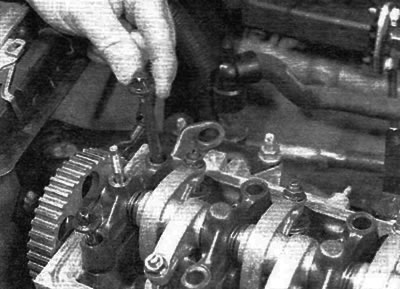
Figure 11.14. Loosen and remove the cylinder head mounting bolts (1.4 l engines)
15. After unscrewing all the cylinder head mounting bolts, remove the valve lever assembly from the cylinder head (figure 11.15). Note: Do not touch the working surfaces of the valve lever roller bearings with your fingers. Note the dowel pins located at the base of each rocker arm assembly support. If any pin is not secured in the head or support, remove it and store it in a safe place.
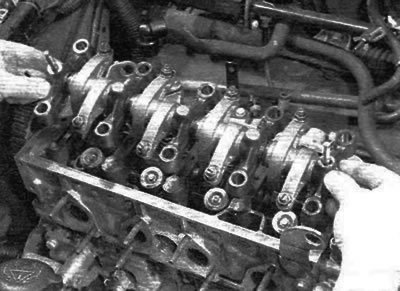
Figure 11.15. Remove the valve lever assembly (1.4 l engines)
16. Now you need to open the joint between the cylinder head gasket and the cylinder block/crankcase without disturbing the wet cylinder liners. To open the joint, take two strong screwdrivers and insert them into the holes for the cylinder head mounting bolts. To release the cylinder head, gently rock it towards the front of the vehicle (figure 11.16). Do not attempt to rotate the head horizontally relative to the cylinder block/crankcase, as its position is determined by the dowel pins and the upper sections of the cylinder liners.
Note: If care is not taken and the sleeves become misaligned, the seals at the base of the sleeves may be compromised, causing a leak after the head is installed. After opening the joint, lift the cylinder head and remove it. If possible, have an assistant help you, as this is a bulky unit, especially if the head is removed along with the manifolds.
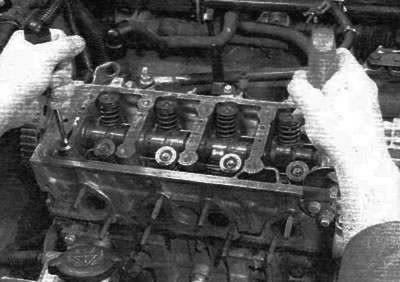
Figure 11.16. Use two strong screwdrivers to separate the cylinder head from the cylinder block (1.4 l engines)
17. Remove the gasket from the top surface of the block; note the two locating pins. If the dowel pins are loose, remove them and store them in a safe place along with the head. Don't throw away the pad; it will be needed for identification purposes (see paragraphs 29 and 30). Actions that require turning the crankshaft (for example, cleaning the piston bottoms), should be performed only after ensuring reliable fixation of the cylinder liners (figure 11.17). If the manufacturer does not provide special sleeve clamps, the sleeves can be secured using large flat washers placed under bolts of the appropriate length. Alternatively, the original cylinder head bolts can be temporarily installed by fitting suitable spacers to them.
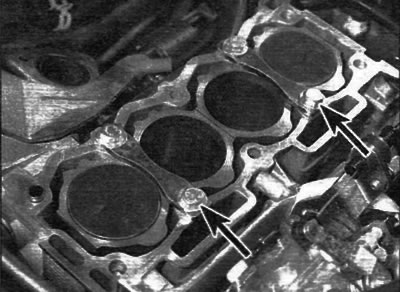
Figure 11.17. Clamp the cylinder liners before turning the crankshaft (the clamps are marked with arrows) (1.4 l engines)
18. If the cylinder head must be disassembled to perform a major overhaul, remove the camshaft as described in paragraph 10, and then refer to chapter 2G.
1.6L engines
19. Mark the installation position, then release the clamps and disconnect the coolant hoses from the cylinder head. Mark the location and then disconnect all electrical connectors on the cylinder head.
20. Remove the intake and exhaust manifolds as described in chapter 4A.
21. Remove the inner timing belt cover as described in paragraph 5.
22. Working in the reverse order of tightening (figure 11.39, b), gradually loosen the cylinder head mounting bolts, performing half a turn at a time, until all the bolts can be unscrewed by hand.
23. Lift the cylinder head and remove it. If possible, have an assistant help you as this is a bulky knot.
24. Remove the gasket from the top surface of the block; note the two locating pins. If the dowel pins are loose, remove them and store them in a safe place along with the head. Don't throw away the pad; it will be needed for identification purposes (see paragraphs 29 and 30).
25. If the cylinder head must be disassembled for major repair, remove the camshafts as described in paragraph 10, and contact part G of this chapter.
Preparing for installation
26. Before installing the cylinder head, thoroughly clean the mating surfaces of the cylinder head and cylinder block/crankcase. To remove any remaining gasket material and carbon deposits, use a hard plastic or wooden scraper. Clean the piston crowns.
Note: On 1.4L engines, tighten the liners before turning the crankshaft (see item 17). Use extreme caution when cleaning, as the soft aluminum alloy is easily damaged. Prevent carbon deposits from entering the lubrication and coolant passages. This is especially important for the lubrication system, as carbon deposits can block the supply of oil to engine components. Cover the cooling and lubrication passages and bolt holes in the cylinder block/crankcase with masking tape and paper. To prevent the removed carbon deposits from getting into the gaps between the pistons and the cylinder walls, introduce a small amount of grease into the gap. After cleaning each piston, take a small brush and remove all traces of grease and carbon deposits from the gap, then wipe everything with a clean cloth. Also clean all pistons.
27. Inspect the mating surfaces of the cylinder block/crankcase and cylinder head for burrs, deep scratches and other damage. If they are minor, carefully remove them with a file. But if they are large, the only alternative to replacement may be mechanical treatment.
28. If there is a suspicion of deformation of the mating surface of the cylinder head (under the gasket), check this surface with a ruler. If necessary, please contact chapter 2G.
29. When purchasing a new cylinder head gasket, care should be taken to ensure that the gasket is of the correct thickness. Some models only use one thickness of gasket, in which case this is not a problem. Other models have gaskets in two different thicknesses: a standard gasket and a slightly thicker (+0.2 mm) "repair" gasket. The gaskets can be identified, as described in the next paragraph, by the cutouts on the left edge of the gasket.
Source of the article is posted at: www.peugeotbook.ru
30. When the gasket is correctly positioned on the top plane of the cylinder block, one or two notches will be visible on the left side of the gasket closer to the rear edge, which indicate the engine type (for example, the TU3JP engine). In the center of the gasket there may be another group of notches (from 0 to 4), indicating the manufacturer of the gasket and the presence of asbestos in its material (these cutouts have little significance). An important group of cutouts is located on the front side of the gasket; on a standard gasket there will be no cutout in this area, but on a thicker "repair" gasket there will be one cutout (figure 11.30). Determine the gasket type and ensure the new gasket is the correct thickness. If there is any doubt about which gasket is installed, show the "old" gasket to the dealer and ask him to confirm the gasket type.
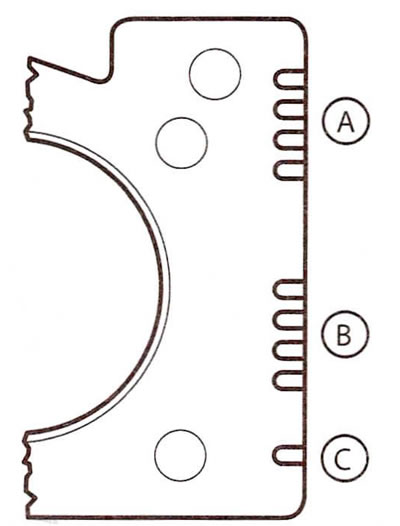
Figure 11.30. Identification cutouts on the cylinder head gasket
A. Engine Type Identification Notch Group
B. Gasket manufacturer identification cutout group
C. Group of identification cutouts for gasket thickness
31. Check the condition of the cylinder head bolts, especially the threads. This should be done every time bolts are removed. Wash the bolts in a suitable solvent and wipe them dry. Inspect each bolt for signs of wear or damage and replace if necessary. Measure the length of each bolt from the back of its head to the end of the bolt to check for stretching (figure 11.31). New bolts for 1.4L engines are 175.5mm long; if the bolt is stretched more than 176.5 mm, replace all cylinder head bolts as a set. On 1.6L engines, the maximum bolt length is 122.6 mm. Although the manufacturer doesn't specifically specify the need for bolt replacement, it is strongly recommended to replace the bolts as a set, regardless of their external condition, each time they are removed.
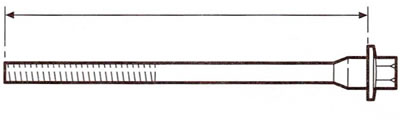
Figure 11.31. Measure the length of the bolt from the back of the head to the end of the bolt
32. On 1.4L engines, before installing the cylinder head, check the cylinder liner protrusion as described in paragraph 11 of chapter 2G.
Installation
1.4L engines
33. Wipe clean the mating surfaces of the cylinder block/crankcase and cylinder head. Ensure that two dowel pins are in place on each edge of the cylinder block/crankcase mating surface and remove the cylinder liner retaining clips if necessary (figure 11.33).
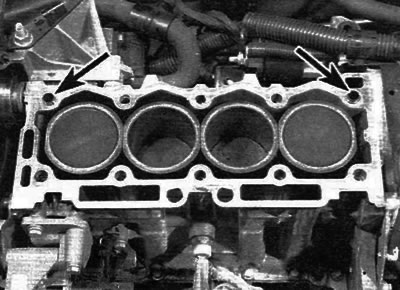
Figure 11.33. Make sure the dowel pins are present (marked with arrows) and install a new cylinder head gasket
34. Install the new gasket onto the cylinder block/crankcase mating surface, orienting it so that the identification notches are located on the left edge of the gasket and the side marked "TOP" is facing up.
35. Ensure that the flywheel and camshaft timing pulley are still properly locked using the appropriate tools, then, with the help of an assistant, carefully install the cylinder head onto the block, aligning it with the dowel pins.
36. Ensure that the locating pins are in place at the base of each rocker arm bearing, then install the rocker arm assembly onto the cylinder head.
37. Lightly lubricate the threads and the back of the cylinder head bolt heads with clean engine oil.
38. Carefully insert each bolt into its corresponding hole (don't let them fall) and screw them in with just the force of your hand.
39. Working gradually and in the prescribed sequence, using a torque wrench and a suitable socket, tighten the cylinder head bolts to the prescribed torque as per stage 1 (figure 11.39, a, b).
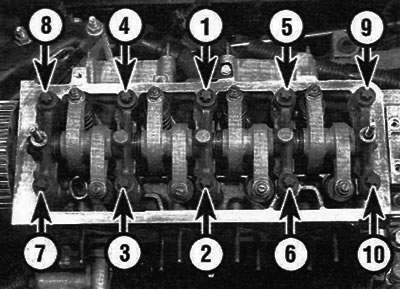
Figure 11.39, a. Tightening sequence of cylinder head bolts (1.4 l engines)
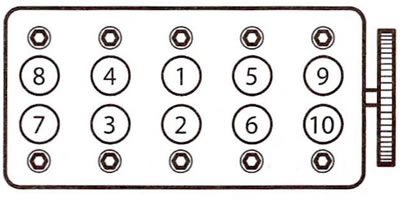
Figure 11.39, b. Sequence of tightening the cylinder head bolts (1.6 l engines)
40. Once all the bolts have been tightened according to stage 1, again working in the same sequence, use a socket head and extension to tighten the bolts to the specified angle according to stage 2. To ensure accuracy at this stage of tightening, it is recommended to use a protractor. If a protractor is not available, mark the relative positions of the bolt head and cylinder head with white paint before tightening. The marks can then be used to check that the bolts are turned to the correct angle when tightened.
41. Install the timing belt as described in paragraph 6.
42. Connect all coolant hoses to the cylinder head, intake manifold and throttle body. Connect all relevant electrical connectors.
43. Screw in the bolt securing the engine oil dipstick tube to the cylinder head.
44. Working as described in Chapter 4A, do the following:
- a) Connect all disturbed fuel hoses and control cable to the intake manifold and fuel system components.
- b) Connect and adjust the accelerator cable (if available).
- c) Connect the exhaust pipe to the manifold and transmission bracket and connect the oxygen sensor electrical connector.
- d) Install the air cleaner assembly and air intake ducts.
45. Check and, if necessary, adjust the valve clearances as described in paragraph 9.
46. Install the cylinder head cover as described in paragraph 4.
47. Install the spark plugs and install the ignition coil (see chapter 1A and 5B).
48. Install the power steering pump as described in chapter 10.
49. Finally, reconnect the battery and refill the cooling system as described in chapter 1A.
1.6L engines
50. Remove the flywheel locking tool and use a wrench or socket to turn the crankshaft in the opposite direction using the crankshaft pulley bolt (counterclockwise) by 90°. This should prevent any accidental contact between the pistons and valves when installing the cylinder head.
51. Make sure that the camshafts are correctly positioned in the cylinder head. The timing groove on the right end of each camshaft should be located at the 7 o'clock position on the intake camshaft and at the 8 o'clock position on the exhaust camshaft (figure 10.32). If necessary, adjust the camshaft position by turning each shaft with an open-end wrench on the rectangular section between the cams.
52. Wipe clean the mating surfaces of the cylinder block/crankcase and cylinder head. Ensure there are two dowel pins on each edge of the cylinder block/crankcase mating surface.
53. Install the new gasket onto the cylinder block/crankcase mating surface, orienting it so that the identification notches are located on the left edge of the gasket and the side marked "TOP" is facing up.
54. Lightly lubricate the threads and the back of the cylinder head bolt heads with clean engine oil, then install and tighten the bolts as described in step. p. 38-40.
55. Install the inner timing belt cover as described in paragraph 5, and then install the camshaft timing pulley as described in paragraph 7.
56. Install the timing belt as described in paragraph 6.
57. Working as described in Chapter 4A, do the following:
- a) Install the intake and exhaust manifolds.
- b) Connect all disturbed fuel hoses and control cable to the intake manifold and fuel system components.
- c) Install the air cleaner assembly and air intake ducts.
58. Connect all coolant hoses to the cylinder head, intake manifold and throttle body. Connect all relevant electrical connectors.
59. Install the cylinder head covers as described in paragraph 4.
60. Install the spark plugs and install the ignition coil (see chapter 1A and 5B).
61. Finally, connect the battery and fill the cooling system as described in chapter 1A.