



2. Apply the footbrake firmly several times to establish correct shoe-to-drum clearance, then apply and release the handbrake several times to ensure that the self-adjust mechanism has compensated fully for any wear in the linings.
3. Fully release the handbrake, and check that the rear wheels rotate freely, without binding. If not, check that all cables are routed correctly and that the cable components and levers move freely.
4. If all components are free to move, but the wheels still bind when rotated, adjustment is required as follows.
5. Again, apply the footbrake several times to settle the shoes.
6. Ensure that the handbrake is fully released, then working under the vehicle, slacken the adjuster nut on the cable equaliser assembly until the drums are free to rotate (see illustration).
[Original is contained on the portal: PeugeotBook.ru]
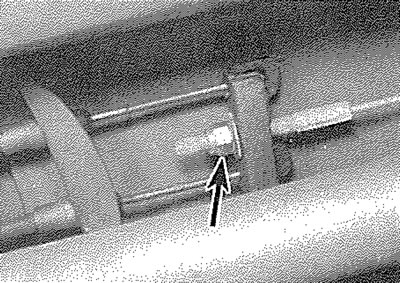
15.6. Handbrake cable adjuster nut (arrowed)
7. Inside the vehicle, apply the handbrake so that the lever is on its 4th notch up from the "off" position.
8. Tighten the adjuster nut until the brake shoes just rub on the drums (slight resistance as the wheels are rotated).
9. Check that there is a total handbrake lever travel of between 4 and 7 notches (the wheels should lock fully after a maximum 7 notches of handbrake lever movement).
10. Check that both the left- and right-hand rear cables move together when the handbrake is operated.
11. Fully release the handbrake, and check that both rear wheels turn freely by hand.
12. Check that the handbrake warning light illuminates from the 4th notch of handbrake lever travel.
13. On completion, lower the vehicle to the ground.