



Automatic transmission components
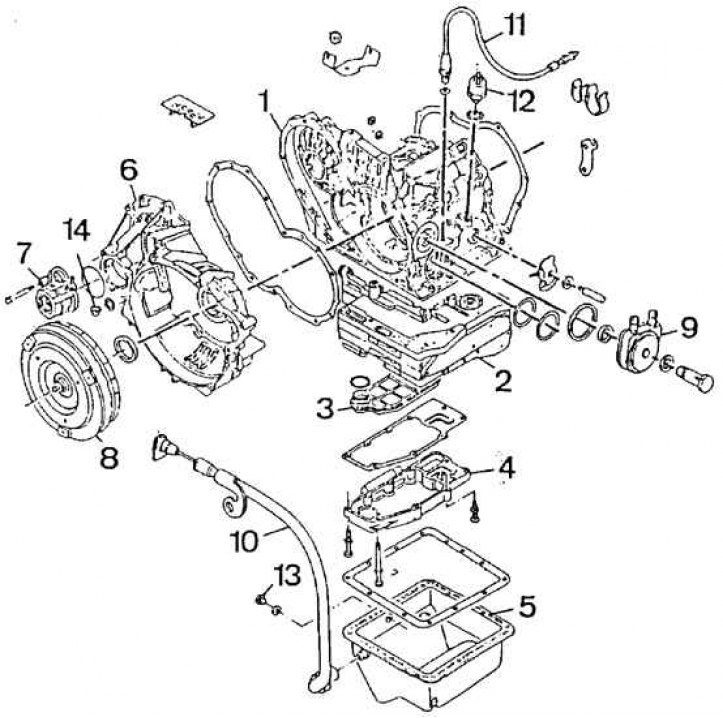
1 – automatic transmission housing; 2 – control servomotor; 3 – filter; 4 – filter cover; 5 – oil pan; 6 – hydrokinetic transmission housing; 7 – differential bearing housing; 8 – hydrokinetic transmission; 9 – Coolant/oil heat exchanger; 10 – oil level indicator; 11 – forced downshift cable ("kick-down"); 12 – Reversing light switch; 13 – oil drain plug; 14 – differential oil drain plug
Automatic transmission external components
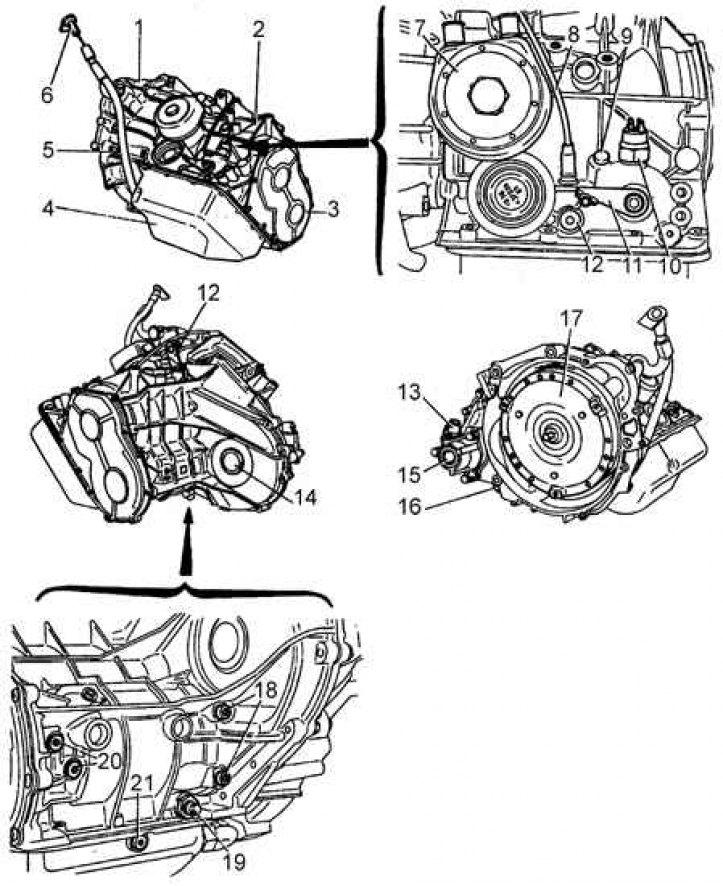
1 – hydraulic transformer housing; 2 – main crankcase; 3 – end cap; 4 – pallet; 5 – dipstick tube for measuring oil level; 6 – dipstick for measuring oil level; 7 – heat exchanger; 8 – forced downshift cable; 9 – breather; 10 – Starter/reversing light switch; 11 – selector lever; 12 – eye; 13 – speedometer drive; 14 – left gearbox output; 15 – right gearbox output; 16 – drain plug; 17 – torque converter; 18 – driven shaft bearing bolts; 19 – brake band regulator; 20 – pressure check; 21 – drain plug
The drive consists of the following units: hydrokinetic transmission, gearbox, centrifugal regulator.
The hydrokinetic transmission consists of a pump, a turbine and a guide apparatus.
The gearbox primarily consists of:
- planetary gear, allowing for four forward gears and one reverse gear;
- hydraulic control servomotor providing automatic gear shift control;
- gear oil pump, continuously driven by the hydrokinetic transmission pump, feeding the hydraulic control servo pump and the hydrokinetic transmission, and also providing lubrication for the planetary transmission; the maximum pressure is limited by an overflow valve.
The centrifugal governor is driven by an intermediate shaft; directly under the influence of the revolutions of the driven wheels, the centrifugal force acts on the weights, which change the speed signal into a pressure signal by throttling the flow: this pressure is "analyzed" inside the control servomotor and determines the gear shift.
Kinematic diagram of automatic transmission
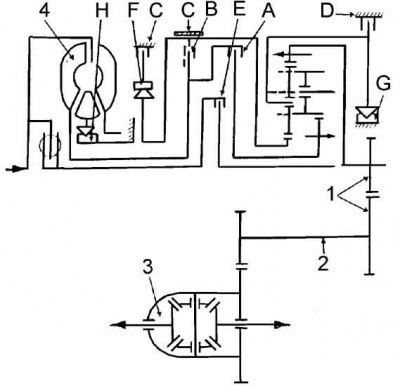
The gearbox contains:
- planetary gear;
- three multi-plate clutches (A, B and E), each controlled by a hydraulic piston;
- three one-way clutches (F, G and H);
- one gear transmission at the output of the planetary gear, transmitting traction to the intermediate shaft (2), which drives the differential (3);
- hydrokinetic transmission (4) at the input of the gearbox, providing connection of the engine with the gearbox;
- final drive and differential.
The mechanical components assembly is controlled by a hydraulic servomotor located at the bottom of the gearbox.