



SAE designation (Society of Automotive Engineers) indicates the viscosity of the motor oil.
For example, SAE 10W40 means:
- 10 - viscosity of oil in cold state; the lower this number, the lower the viscosity of the cold motor oil;
- W — oil is suitable for use in winter conditions;
- 40 - viscosity of oil when hot; the higher this number, the higher the viscosity of hot engine oil.
Also, easy-flowing oils can be used for engine lubrication (low friction oils). We are talking about all-season oils, which include additives that reduce the friction coefficient, as a result of which the friction of the internal parts of the engine is reduced. The basis of easy-flowing oils is synthetic oil
Caution! Lubricating additives of any kind must not be added to either fuel or lubricating oils.
Motor oil specification
Classification of motor oils of American manufacturers is carried out according to the API system: an abbreviation of the first letters of the American Petroleum Institute (american Petroleum Institute). The designation is made using two letters. The first letter indicates the scope of application S - for gasoline engines, C - for diesel engines. The second letter determines the quality of the oil, in alphabetical order. The highest quality oils have the specification SJ - for gasoline engines, CF - for diesel engines.
European oil manufacturers use the ACEA (Association des Constructeurs Europeans d'Automobiles) specification, which takes into account European engine manufacturing technologies. Oils for gasoline engines of passenger cars have ACEA classes from A1-96 to AZ-96; diesel engines - classes from B1-96 to B4-96. The highest quality oils are AZ oils for gasoline and VZ oils for diesel engines.
Attention! Some motor oils have been specified by the manufacturer as being intended for diesel engines and cannot be used in petrol engines. However, there are oils that are suitable for both petrol and diesel engines. In such cases, both specifications are indicated on the motor oil packaging (for example, ACEA AZ-96/VZ-96 or API SH/CD).
Oil circulation
The oil pump sucks engine oil from the oil pan through the oil intake and pumps it into the oil filter. The necessary pressure in the lubrication system is provided by a pressure reducing valve, which opens when a certain level is exceeded, and some of the oil flows back into the oil pan.
An engine oil pressure sensor is installed in the main lubrication line, which informs the driver of low oil pressure via a warning light on the instrument panel.
The oil filter has a bypass valve through which, in the event of severe contamination of the filter, uncleaned oil flows directly into the lubrication line. The oil filter should be replaced every 20,000 km or every two years.
From the main line, engine oil is supplied under pressure through channels to lubricate the main and connecting rod bearings.
To cool the pistons, oil is sprayed through nozzles onto the lower part of the pistons.
The oil pump is driven by the crankshaft. The pump shaft is sealed with a seal.
The oil pan is made of stamped sheet steel and is secured with bolts (see illustration 8.0).
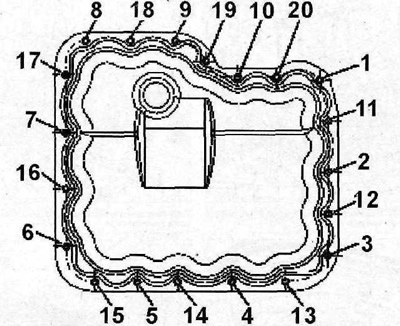
8.0 Oil pan mounting bolt tightening procedure
Tightening torque.
- 1st pass - tighten the bolts to 5 Nm;
- 2nd pass - tighten the bolts to 8 Nm
Oil consumption
Oil consumption in internal combustion engines refers to the amount of oil produced as a result of the combustion process. Oil consumption should never be equated with oil losses that occur as a result of leaks due to leaks in the oil pan, cylinder head cover, etc.
Normal oil consumption occurs as a result of the combustion of small amounts of oil in the cylinders, the removal of residual combustion products and particles formed as a result of friction. In addition, oil is consumed under the influence of high temperatures and high pressures, to which it is constantly exposed in the engine. In addition, the degree of oil consumption is also affected by external operating conditions, driving mode, and operating tolerances. Oil consumption should not exceed 1 liter per 1000 kilometers.
Attention! Do not fill the oil above the maximum mark on the tank. Otherwise, unburned oil, getting into the exhaust system of the exhaust gases, can damage the catalyst.