



2. Remove the front wheels and mudguards.
3. Drain the coolant.
4. Drain the engine oil (if necessary).
5. Remove the drive shafts (see the relevant chapter).
6. Remove the battery and its tray.
7. Move the slave cylinder 1 of the clutch away from the work area (see arrows in the illustration).
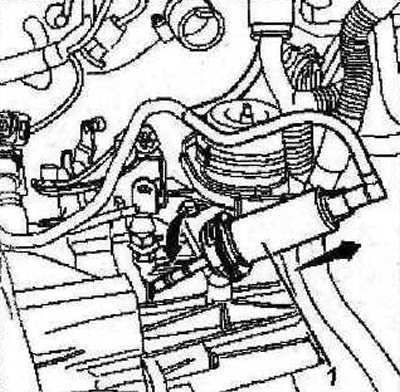
7.7 Move the clutch slave cylinder 1 away from the work area (see arrows)
8. Put the protective cover "a", catalog number 0216-E2, on the slave cylinder 1 of the clutch (see arrows in the illustration).
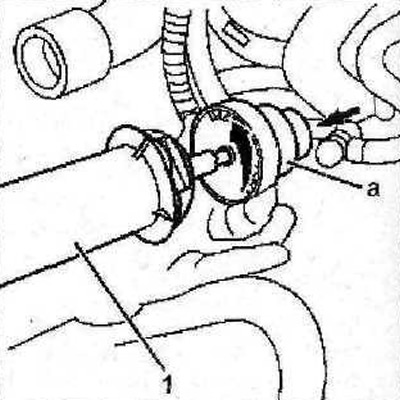
7.8 Put the protective cover "a", catalog number 0216-F2, on the slave cylinder 1 of the clutch (see arrows)
9. Move fuse box 2 away from the work area, disconnect wires 3, plug 4 (see illustration).
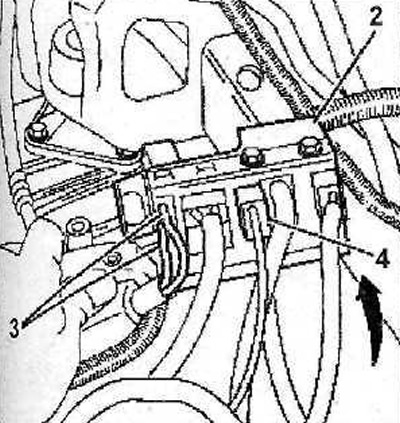
7.9 Move fuse box 2 away from the work area, disconnect wires 3, plug 4
10. Disconnect the supply 5 and outlet 6 coolant hoses, move the pipelines 7 to the side (see illustration).
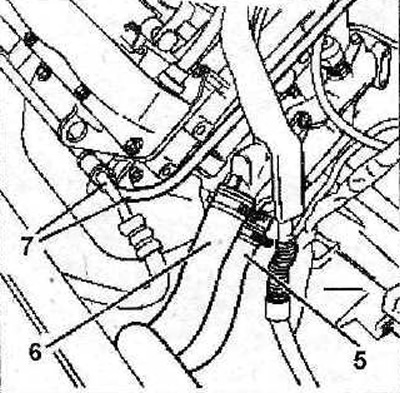
7.10 Disconnect the supply 5 and outlet 6 coolant hoses, move the pipelines 7 to the side
11. Detach and slide in) accelerator cable 8 away from the work site (see illustration).
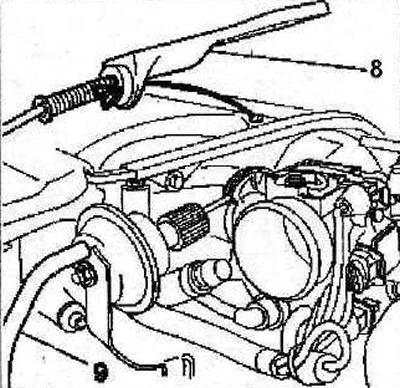
7.11 Disconnect and move away from the work area accelerator cable 8
12. Disconnect and move away from the work site pipeline 9 (see illustration 7.11).
13. Remove clamps 10 and using puller 0216-C1 for 10 mm, disconnect the end of the cable traction from the spherical head 11, and using puller 0216-G2 for 13 mm - from the spherical head 1 2 of the gear selection and shift rods (see illustration).
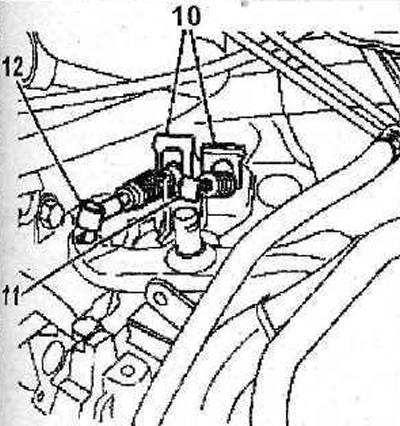
7.13 Remove clamps 10 and using puller 0216-G1 for 10 mm, disconnect the end of the cable traction from the spherical head 11, and using puller 0216-G2 for 13 mm - from the spherical head 12 of the gear selection and shift rods
14. Disconnect and move aside the low pressure hose 13 of the brake booster, the heater hoses 14, the pipeline 15 (see illustration).
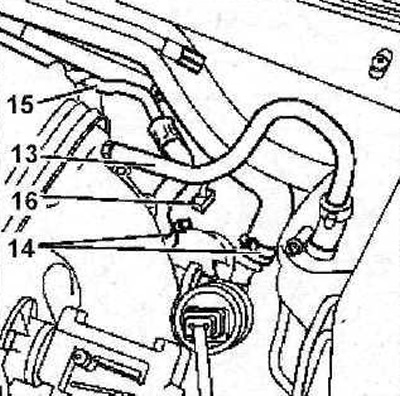
7.14 Disconnect and move aside the low pressure hose 13 of the brake booster, the heater hoses 14, the pipeline 15
15. Disconnect plug 16 from the transmitter (see illustration 7.14).
16. Move hose 17 away from the work site (see illustration).
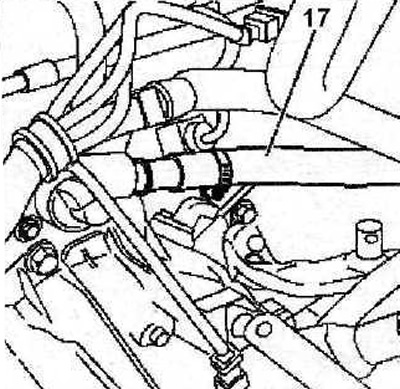
7.16 Move hose 17 away from the work site
17. Remove the cover 18 of the engine control unit (see illustration).
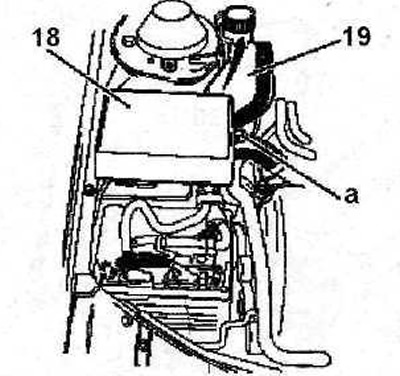
7.17 Remove cover 18 of the engine control unit
18. Clamp the low pressure hose of the power steering pump with a suitable clamp, for example, clamp "a" part number 1512 (see illustration 7.18), disconnect the hose and move it away from the work area (see illustration 7.17).
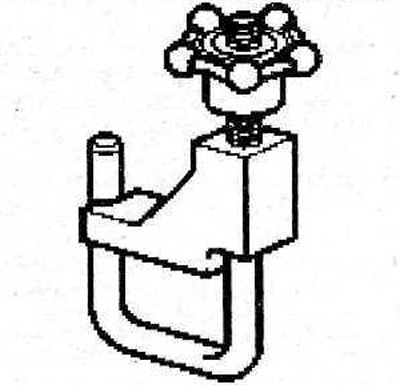
7.18 Clamp 1512
19. Move the power steering reservoir 19 away from the work area, having first plugged its openings (see illustration 7.17).
20. Disconnect the connectors 20 from the engine control unit (see illustration).
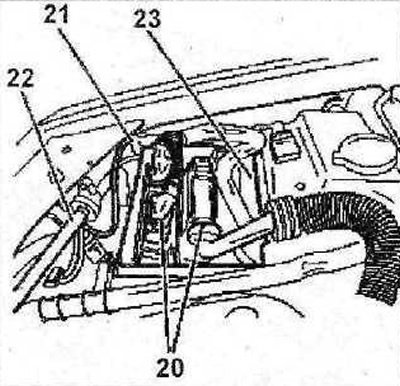
7.20 Disconnect plugs 20 from the engine control unit
21. Disconnect wire 21 "ground" (-) (see illustration 7.20).
22. Disconnect pipe 22, and then remove engine control unit 23 (see illustration 7.20).
23. Move the front cross member forward without disconnecting anything from it (see arrows in the illustration).
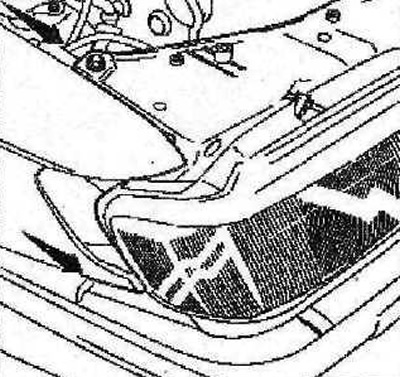
7.23 Move the front cross member slightly forward without disconnecting anything from it (see arrows)
24. Remove the accessory drive belt (see the relevant chapter).
25. Remove the power steering pump pulley.
26. Remove the radiator.
27. Release the power steering pump 24 from the holders and move it away from the work area (see illustration).
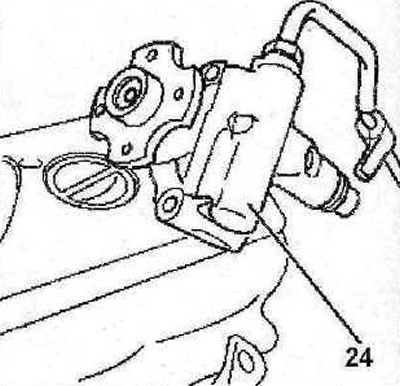
7.27 Release the power steering pump 24 from the holders and move it away from the work area
28. Disconnect the power wire plug from the air conditioning compressor.
Attention! All work related to the air conditioner should be entrusted to a specialized workshop. Do not open the refrigerant circulation system yourself - risk of frostbite!
29. Release the hoses from the fasteners, then move the air conditioner compressor 25 together with the bracket away from the work area, without disconnecting the hoses from the compressor (see illustration).
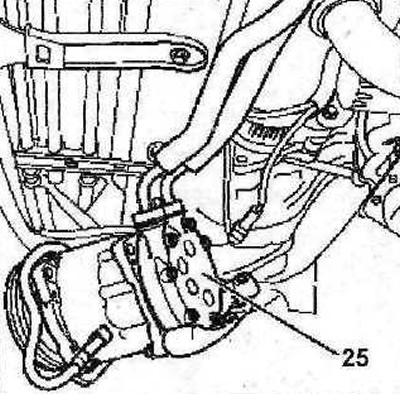
7.29 Move the air conditioner compressor 25 together with the bracket away from the work site without disconnecting the hoses from the compressor
30. Remove the belt pulley 26 from the crankshaft, move aside the coolant hose 27 (see illustration).
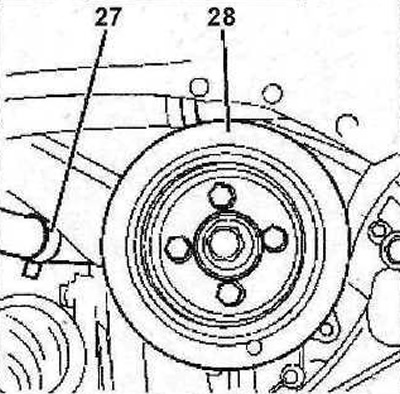
7.30 Remove the belt pulley 26 from the crankshaft, move aside the coolant hose 27
31. Disconnect the jet thrust 28 (see illustration).
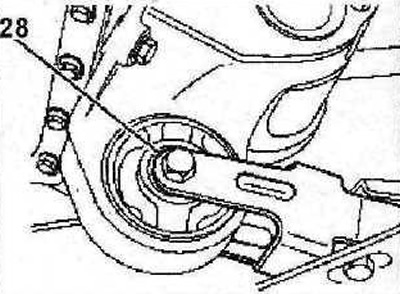
7.31 Disconnect the reaction rod 28
32. Disconnect the exhaust pipe.
33. Remove the protective cover 29 of the engine, disconnect the plug 30 (see illustration).
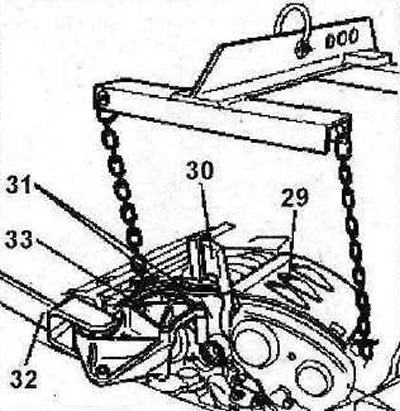
7.33 Remove the protective cover 29 of the engine, disconnect the plug 30
34. Release the pressure in the fuel system: workshops use a special vacuum pump for this purpose (see illustration 7.34). Then disconnect the fuel lines 31 (see illustration 7.33).
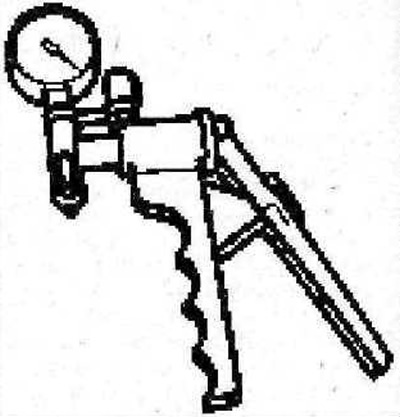
7.34 Vacuum pump, which is used to relieve pressure in the fuel system
35. Install a support beam on the front end to use it to lift the engine and relieve the load on the power unit supports, or lift the engine using a crane or hoist (see illustration 7.33).
36. Disconnect the reaction rod 32 (see illustration 7.33).
37. Remove the right engine mount support 33 (see illustration 7.33).
38. Remove support 34, unscrew bolts 35 and remove support mounting bracket 36 (see illustration).
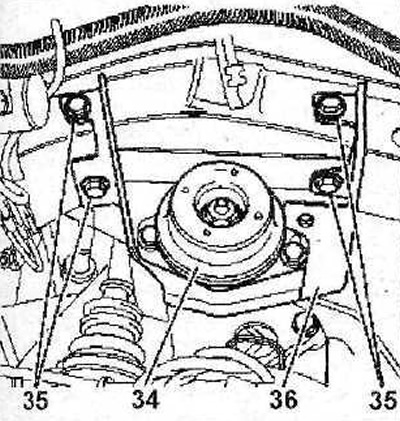
7.38 Remove support 34, unscrew bolts 35 and remove support mounting bracket 36
39. Remove the tip 37 of the speedometer shaft drive (see illustration).
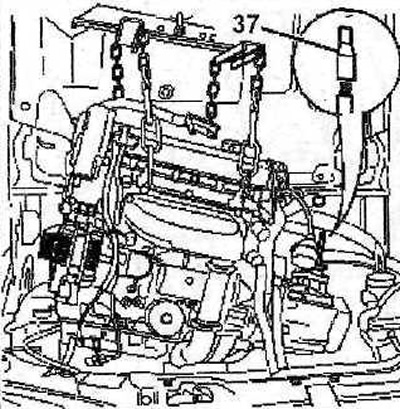
7.39 Remove tip 37 of the speedometer shaft drive
40. Carefully remove the engine from the engine compartment.