



Please note: The pressure plate and diaphragm spring are not separable and must be replaced as a set if damaged. The manufacturer is constantly improving the design of the pressure and driven disks. For this reason, when ordering them, it is necessary to indicate the vehicle identification number and engine number.
The clutch can be removed without removing the engine from the engine compartment.
1. Remove the gearbox (see the relevant chapter).
2. Mark the mounting position of the clutch relative to the flywheel using a punch.
3. Loosen the six clutch-to-flywheel mounting bolts in a cross pattern to relieve the pressure from the diaphragm spring. After this, completely unscrew all the bolts in order. To prevent the flywheel from turning, block it with a brake shoe or a large screwdriver by inserting it between the teeth of the ring gear (see illustration).
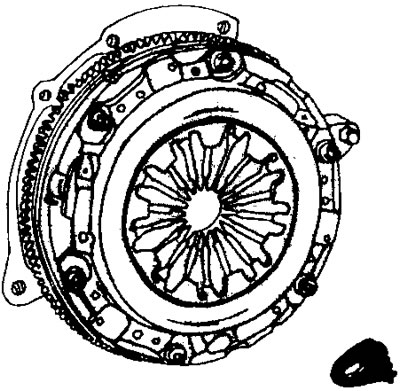
2.3 Brake shoe, installed on the flywheel ring gear to prevent it from turning
4. Remove the clutch by first disconnecting the pressure plate and at the same time pressing the driven plate towards the flywheel (see illustration).
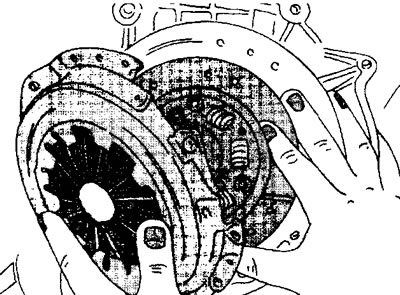
2.4 Remove the clutch by first disconnecting the pressure plate, and at the same time pressing the driven plate towards the flywheel
[The source is located on the website peugeotbook.ru]
After this, remove the driven disk.
5. Wipe the inside of the flywheel with a rag and inspect its working surface. If the driven disk has worn down to the rivet heads, it is possible that the rivets could have scratched the surface of the flywheel or the clutch pressure plate.
Caution! If work requires removing the engine or gearbox, it is recommended to remove the clutch to inspect the condition of its discs.