



Table of contents: Using this Chapter 🠇 TUD series engine description 🠇 Repair operations possible with the…🠇
Using this Chapter
Chapter 2 is divided into three Parts: A, B and C. Repair operations that can be carried out with the engine in the vehicle are described in Parts A (TU series petrol engines) and B (TUD series diesel engines). Part C covers the removal of the engine/transmission as a unit, and describes the engine dismantling and overhaul procedures.
In Parts A and B, the assumption is made that the engine is installed in the vehicle, with all ancillaries connected, if the engine has been removed for overhaul, the preliminary dismantling information which precedes each operation may be ignored.
TUD series engine description
The diesel engine fitted to the Peugeot 106 is derived from the TU series of engines. The diesel version is a well-proven engine which has been fitted to several other Peugeot and Citroen vehicles. The bottom end of the engine is very similar to that of the TU petrol engine covered in Part A of this Chapter.
Information copied from the resource [www.PEUGEOTBOOK.ru]
The 106 range is fitted with either a 1360 cc (TUD 3) or the 1527 cc (TUD 5) version of the engine (see illustration). The engine is of the in-line four-cylinder, overhead camshaft (OHC) type, mounted transversely at the front of the car. The clutch and transmission are attached to its left-hand end.
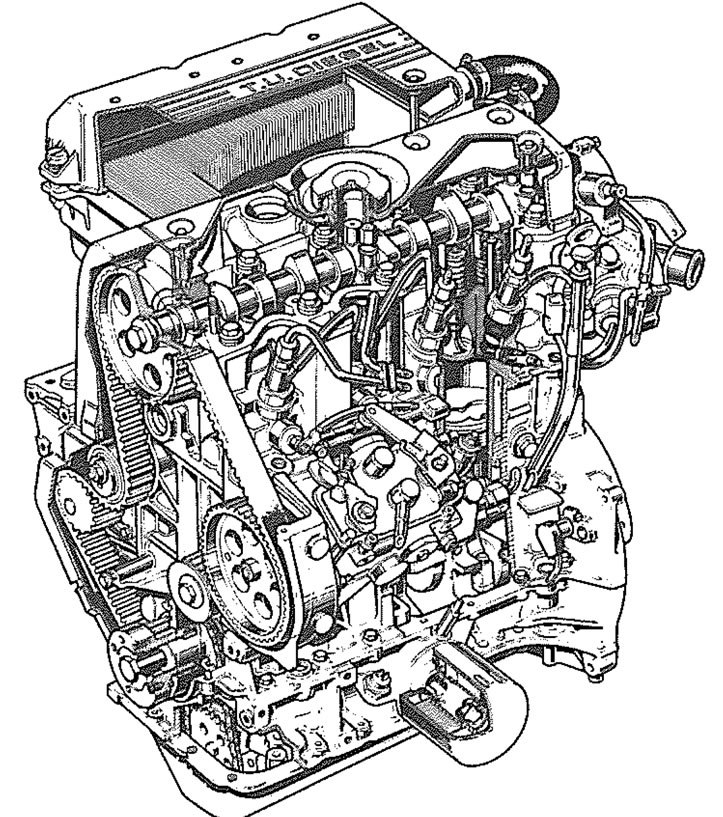
1.4. Cutaway view of the TUD diesel engine
The crankshaft runs in five main bearings. Thrustwashers are fitted to No 2 main bearing (upper half) to control crankshaft endfloat.
The connecting rods rotate on horizontally split bearing shells at their big-ends. The pistons are attached to the connecting rods by gudgeon pins, which are secured in position with circlips. The aluminium-alloy pistons are fitted with three piston rings - two compression rings and an oil control ring.
The cylinder bores on 1360 cc (TUD 3) engines have replaceable wet liners, whereas on the 1527 cc (TUD 5) engines, the cylinder bores are an integral part of the cylinder block. On TUD 3 engines, sealing O-rings are fitted at the base of each liner, to prevent the escape of coolant into the sump.
The inlet and exhaust valves are each closed by coil springs, and operate in guides pressed into the cylinder head. The valve seat inserts are also pressed into the cylinder head, and can be renewed separately if worn.
The camshaft is driven by a toothed timing belt, and operates the eight valves via bucket type followers which are positioned directly below the camshaft. Valve clearance adjustment is by means of shims. The camshaft is supported by three bearings machined directly in the cylinder head.
Lubrication is by means of an oil pump, which is driven (via a chain and sprocket) off the right-hand end of the crankshaft. It draws oil through a strainer located in the sump, and then forces it through an externally-mounted filter into galleries in the cylinder block/crankcase. From there, the oil is distributed to the crankshaft (main bearings) and camshaft. The big-end bearings are supplied with oil via internal drillings in the crankshaft, while the camshaft bearings also receive a pressurised supply. The camshaft lobes and valves are lubricated by splash, as are all other engine components.
Throughout this manual, it is often necessary to identify the engines not only by their capacity, but also by their engine code which can be found on the left-hand end of the front face of the cylinder block. The code is stamped on a plate which is riveted to the block. The first part of the engine number gives the engine code - eg "K9B" (see illustration).
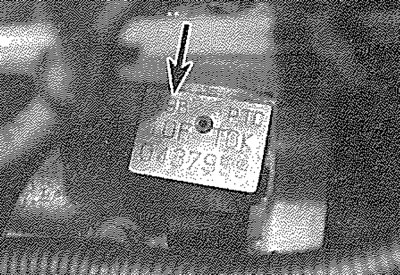
1.11. The engine code is stamped on a plate (arrowed) attached to the front of the cylinder block - viewed from above
Repair operations possible with the engine in the car
The following work can be carried out with the engine tn the car:
- a) Compression pressure and leakdown - testing.
- b) Cylinder head cover - removal and refitting.
- c) Timing belt covers - removal and refitting.
- d) Timing belt - removal, refitting and adjustment.
- e) Timing belt tensioner and sprockets - removal and refitting.
- f) Camshaft oil seal - renewal.
- g) Camshaft and followers - removal, inspection and refitting.
- h) Cylinder head - removal and refitting.
- i) Cylinder head and pistons - decarbonising (refer to Part C of this Chapter).
- j) Sump - removal and refitting.
- k) Oil pump - removal, overhaul and refitting.
- i) Crankshaft oil seals - renewal.
- m) Engine/transmission mountings - inspection and renewal.
- n) Flywheel - removal, inspection and refitting.