
English Русский
Български
Беларускі
Український
Српски
Hrvatski
Română
Polski
Slovenský
Magyar
Bookmark Articles Sitemap Contacts
Company Hyundai Company Opel Company Skoda Company Kia Company Mitsubishi Company LADA Company Audi
PeugeotBook.ru


Series 100   Series 200   Series 300   400-500   Series 600   Crossovers   Others
 
Peugeot 305 (1977-1989) Peugeot 306 (1993-2002) Peugeot 307 (2001-2008)

General description of the clutch (Peugeot 305)

  • Main
  • 30X
  • Peugeot 305 (1977-1989)
  • Transmission
  • Clutch
  • General description of the clutch
0
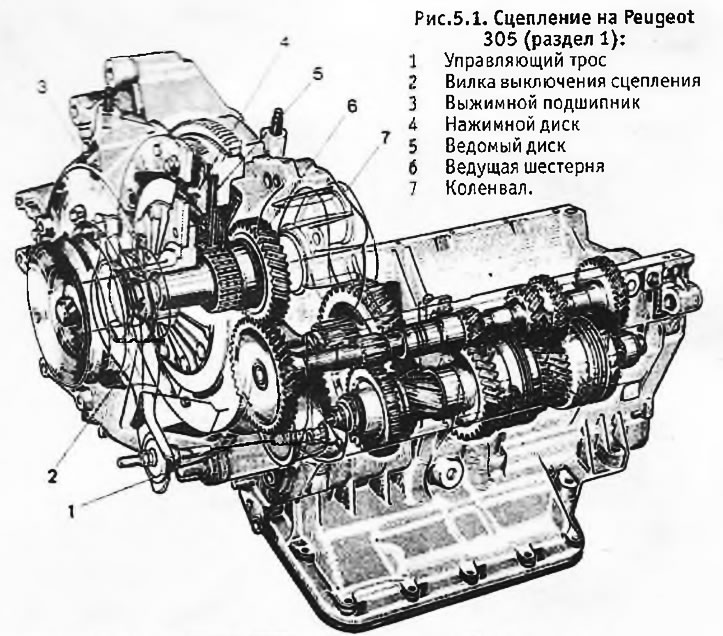
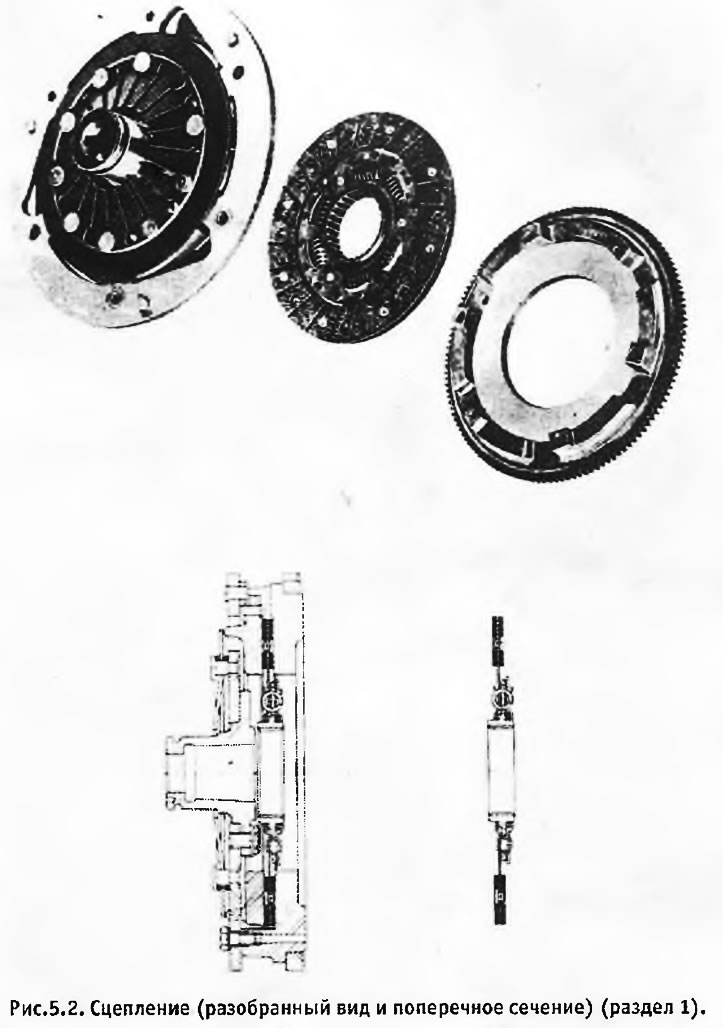
The clutch is a single-disc dry, diaphragm type and is located on the left side of the engine. The clutch basket is bolted to the flywheel surface.

The driven clutch disc is located on the splines of the drive gear of the gearbox and can move freely between the surfaces of the flywheel and the pressure plate. The dual friction linings on the outer side of the disc are attached to the internally splined hub by 6 spring dampers, which dampen the initial shock when the clutch is engaged.

The drive gear is located on the crankshaft, from which it is separated by a double-row needle bearing. The clutch is located outside the pinion gear teeth, which mesh with the input shaft of the gearbox. Although this design requires a more complex seal system, it allows the clutch to be removed and worked on without disturbing the gearbox.

The clutch mechanism is located at the end of the crankshaft, with which it is engaged by means of a conical polyhedron (trihedron). To remove the clutch from the crankshaft, a special tool is required. The pressure plate is driven by a release bearing sliding on the mounting sleeve and pressing on the fingers of the diaphragm spring. Due to this, the pressure plate ring moves away from the friction linings of the driven disk, and the transmission of torque from the clutch to the drive gear stops.

The release bearing is moved by the clutch release lever, which is operated by a cable and a release spring. The other end of the cable is attached to the clutch pedal.

When the clutch pedal is pressed, the cable moves the clutch release lever, which in turn moves the release bearing, which presses on the fingers of the diaphragm spring. The outer edge of the spring lifts the pressure plate, moving it away from the driven plate, which then becomes stationary despite the fact that the clutch basket continues to rotate. In this state, there is no transmission of torque from the pinion to the gearbox.


When the clutch pedal is released, the reverse process takes place. The driven disk is clamped between the pressure plate and the flywheel, and torque begins to be transmitted from the pinion gear to the gearbox.
When the clutch pedal is released, the reverse process takes place. The driven disk is clamped…


When the clutch pedal is released, the reverse process takes place. The driven disk is clamped…
This article is available at russian, bulgarian, belarusian, ukrainian, serbian, croatian, romanian, polish, slovak, hungarian
Article reviewed by editor: Ostrovsky Fedor
Share information:
Previous
Peugeot 305: Clutch
Next

Clutch specification
Clutch — adjustment
Clutch cable — removal and installation
Clutch — removal
Clutch — inspection and tidying up
Clutch — installation
See similar information for other Peugeot models

➨ General information Peugeot 106 (1991-2003)
➨ Brake and Clutch Hydraulic Fluid Peugeot 207 (2006-2014)
➨ Checking, adjusting and lubricating the clutch (20,000 km/12… Peugeot 405 (1987-1997)
➨ General information about the clutch Peugeot 605 (1989-2000)
➨ General description of the clutch Peugeot 806 (1994-2002)
Link to this article in different formats
Comments and feedback from visitors
No comments yet


Add two numbers 34 + 24


Peugeot 307 (2001-2008) 
  • User manual
  • Keys, doors and alarm
  • Controls and instruments
  • Driving and operation
  • Maintenance
  • Power unit
  • Petrol engines TU3 and TU5
  • Petrol engines EW10
  • Diesel engines DV10
  • Diesel engines DW10
  • Transmission
  • Clutch and drive shafts
  • Mechanical gearbox
  • Automatic gearbox
  • Chassis, running gear
  • Front suspension
  • Rear suspension
  • Steering
  • Brake system
  • Body and interior
  • Exterior (external elements)
  • Interior (internal elements)
  • Doors, locks and windows
  • Heating and air conditioning
  • Electrical equipment
  • Equipment and devices
  • Power devices
  • Airbags
  • Electrical circuits
Peugeot 306 (1993-2002) 
  • General information
  • Introduction to manual
  • Specifications
  • Gasoline engine
  • Engine repair
  • Lubrication system
  • Cooling system
  • Fuel injection
  • Ignition system
  • Diesel engine
  • Engine repair
  • Lubrication system
  • Cooling system
  • Fuel injection
  • Transmission
  • Clutch
  • Gearbox
  • Drive shafts
  • Chassis, running gear
  • Steering system
  • Front suspension
  • Rear suspension
  • Brake system
  • Electrical equipment
  • Power devices
  • Electrical circuits
Peugeot 305 (1977-1989) 
  • General information
  • Maintenance
  • Power unit
  • Gasoline engines
  • Diesel engines
  • Cooling system (gasoline)
  • Cooling system (diesel)
  • Fuel system (gasoline)
  • Fuel system (diesel)
  • Ignition system
  • Transmission
  • Clutch
  • Mechanical gearbox BB8
  • Mechanical gearbox BE1
  • Automatic gearbox ZF4
  • Shafts, hubs and wheels
  • Chassis, running gear
  • Brake system
  • Car suspension
  • Steering
  • Body and interior
  • Exterior (external elements)
  • Interior (internal elements)
  • Electrical equipment
  • Equipment and devices
  • Headlights and lighting
  • Power devices
  • Electrical circuits
  • Wiring diagrams (diesel)
PeugeotBook.ru © 2018–2026 | Mobile version | Sitemap: EN BG BY UA RS HR RO PL SK HU | Write message | Site search | Add to bookmarks | Peugeot owners
106 (1991-2003) | 206 (1998-2012) | 207 (2006-2014) | 305 (1977-1989) | 306 (1993-2002) | 307 (2001-2008) | 405 (1987-1997) | 406 (1995-2004) | 605 (1989-2000) | Partner-I (1996-2008) | Eurovans-807 (2002-2014) | Eurovans-806 (1994-2002) | J5 (1981-1993) |
Cookies are used to ensure the correct display of pages on the site.