
English Русский
Български
Беларускі
Український
Српски
Hrvatski
Română
Polski
Slovenský
Magyar
Bookmark Articles Sitemap Contacts
Company Hyundai Company Opel Company Skoda Company Kia Company Mitsubishi Company LADA Company Audi
PeugeotBook.ru


Series 100   Series 200   Series 300   400-500   Series 600   Crossovers   Others
 
Peugeot 305 (1977-1989) Peugeot 306 (1993-2002) Peugeot 307 (2001-2008)

Clutch — removal (Peugeot 305)

  • Main
  • 30X
  • Peugeot 305 (1977-1989)
  • Transmission
  • Clutch
  • Clutch — removal
0
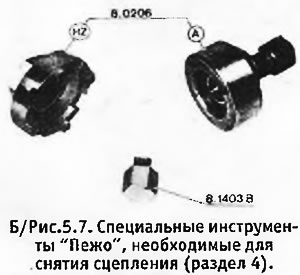
1. Removing the clutch from the crankshaft requires the use of at least one special Peugeot tool, which is a clutch hub puller (N 80.0206A). If the clutch is to be removed with the engine still on the vehicle, a crankshaft pulley locking tool will also be required (N 8.0206 HZ) and a 1/2-inch to 23 mm adapter. A puller is needed to remove the clutch from the crankshaft cone with the engine removed from the car; you'll likely be unable to remove the clutch from the crankshaft using a standard universal puller. With the engine in the car, access to the clutch is very difficult, and to remove the pulley, you'll need a locking tool and adapter, as well as a socket wrench and 41mm open-end wrenches. If you don't have the necessary tools, it's best to leave the clutch removal job to a professional.

1. Removing the clutch from the crankshaft requires the use of at least one special Peugeot tool,…


2. Disconnect the negative cable from the battery and jack up and support the front of the car. Apply the handbrake.

3. To save yourself from unnecessary work, install a nut from the clutch housing bolts under the cooling system thermostat. (see B/Figure 5.8). and fix it in place with a lump of plasticine.
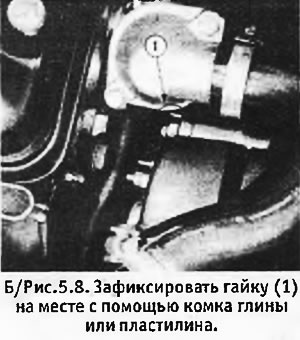


3. To save yourself from unnecessary work, install a nut from the clutch housing bolts under the…


4. Remove the following parts in the order shown in the figure.
  • a. air intake duct (from the air cleaner onwards (see chapter 3)
  • b. generator (see chapter 10)
  • in. brackets of the upper and lower pulleys on which the fan/pump belt is located (see chapter 2)
  • g. Fan/pump drive belt (see chapter 2)
  • d. Generator drive belt (see chapter 10).

5. Without draining the coolant, disconnect the radiator from its mountings (see chapter 2) and move it towards the battery.
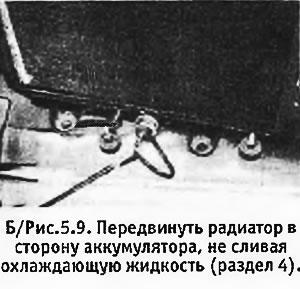
5. Without draining the coolant, disconnect the radiator from its mountings (see chapter 2) and…


You can find the original on the page PeugeotBook.ru

6. Support the left end of the engine with a jack, placing it under the exhaust pipe support bracket.
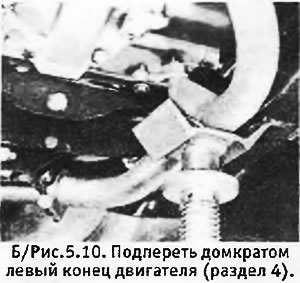
6. Support the left end of the engine with a jack, placing it under the exhaust pipe support…


7. Unscrew the fastening nuts of the generator regulator and, without disconnecting the wires from the regulator, move it to the side.


8. Unscrew the 4 nuts and washers securing the upper left engine support bracket and remove the bracket.

9. Using special tool 8.0206 HZ, block the crankshaft from rotating and unscrew the crankshaft pulley bolt. Remove the bolt and pulley (see B/ Figure 5.11).
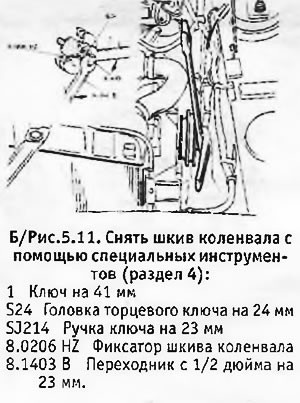
9. Using special tool 8.0206 HZ, block the crankshaft from rotating and unscrew the crankshaft…


10. Loosen the lock nut and adjusting nut on the clutch cable. Pull the cable end out of the clutch release lever (there is no need to remove the nuts and washers from the cable).

11. Loosen the clutch housing mounting bolts and remove the outer half of the housing and the clutch release lever. Remove the release bearing.

12. Remove the hex bolt securing the TDC sensor bracket to the bottom of the inner half of the clutch housing. Remove the bracket together with the sensor. Do not touch the Phillips screw that secures the sensor to the bracket (see photo).
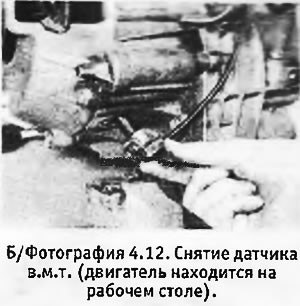
12. Remove the hex bolt securing the TDC sensor bracket to the bottom of the inner half of the…


13. Using special puller 8.0206 A, remove the flywheel with clutch from the crankshaft. They are secured by two half rings that sit in a groove on the clutch centering sleeve and are held in place by the coupling. It will take considerable force to disengage the flywheel and clutch from the crankshaft. If necessary, the crankshaft can be held from rotating by blocking the pinion gear or flywheel.
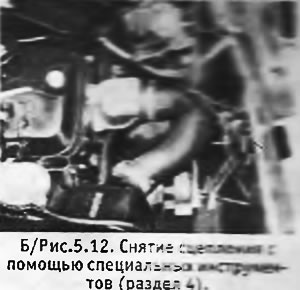


13. Using special puller 8.0206 A, remove the flywheel with clutch from the crankshaft. They are…


14. Carefully remove the flywheel with the clutch, being careful not to damage the cooling system hoses.
This article is available at russian, bulgarian, belarusian, ukrainian, serbian, croatian, romanian, polish, slovak, hungarian
Article reviewed by editor: Ostrovsky Fedor
Share information:
Previous
Peugeot 305: Clutch
Next

Clutch cable — removal and installation
Clutch — adjustment
General description of the clutch
Clutch specification
Clutch — inspection and tidying up
Clutch — installation
Removal, inspecting and installing the clutch (XU engines)
Pinion gear and seals — removal and installation
Removal and installation the clutch release mechanism (XU series…
See similar information for other Peugeot models

➨ Clutch adjustment check and control mechanism lubrication Peugeot 106 (1991-2003)
➨ Brake and Clutch Hydraulic Fluid Peugeot 207 (2006-2014)
➨ Checking, adjusting and lubricating the clutch (20,000 km/12… Peugeot 405 (1987-1997)
➨ General information about the clutch Peugeot 605 (1989-2000)
➨ Clutch specifications Peugeot 806 (1994-2002)
Link to this article in different formats
Comments and feedback from visitors
Henry Nzioki
(25.07.2025 20:20)
Where can I buy the clutch removal tool for peugeot 305?
answer quote


Add two numbers 15 + 28


Peugeot 307 (2001-2008) 
  • User manual
  • Keys, doors and alarm
  • Controls and instruments
  • Driving and operation
  • Maintenance
  • Power unit
  • Petrol engines TU3 and TU5
  • Petrol engines EW10
  • Diesel engines DV10
  • Diesel engines DW10
  • Transmission
  • Clutch and drive shafts
  • Mechanical gearbox
  • Automatic gearbox
  • Chassis, running gear
  • Front suspension
  • Rear suspension
  • Steering
  • Brake system
  • Body and interior
  • Exterior (external elements)
  • Interior (internal elements)
  • Doors, locks and windows
  • Heating and air conditioning
  • Electrical equipment
  • Equipment and devices
  • Power devices
  • Airbags
  • Electrical circuits
Peugeot 306 (1993-2002) 
  • General information
  • Introduction to manual
  • Specifications
  • Gasoline engine
  • Engine repair
  • Lubrication system
  • Cooling system
  • Fuel injection
  • Ignition system
  • Diesel engine
  • Engine repair
  • Lubrication system
  • Cooling system
  • Fuel injection
  • Transmission
  • Clutch
  • Gearbox
  • Drive shafts
  • Chassis, running gear
  • Steering system
  • Front suspension
  • Rear suspension
  • Brake system
  • Electrical equipment
  • Power devices
  • Electrical circuits
Peugeot 305 (1977-1989) 
  • General information
  • Maintenance
  • Power unit
  • Gasoline engines
  • Diesel engines
  • Cooling system (gasoline)
  • Cooling system (diesel)
  • Fuel system (gasoline)
  • Fuel system (diesel)
  • Ignition system
  • Transmission
  • Clutch
  • Mechanical gearbox BB8
  • Mechanical gearbox BE1
  • Automatic gearbox ZF4
  • Shafts, hubs and wheels
  • Chassis, running gear
  • Brake system
  • Car suspension
  • Steering
  • Body and interior
  • Exterior (external elements)
  • Interior (internal elements)
  • Electrical equipment
  • Equipment and devices
  • Headlights and lighting
  • Power devices
  • Electrical circuits
  • Wiring diagrams (diesel)
PeugeotBook.ru © 2018–2026 | Mobile version | Sitemap: EN BG BY UA RS HR RO PL SK HU | Write message | Site search | Add to bookmarks | Peugeot owners
106 (1991-2003) | 206 (1998-2012) | 207 (2006-2014) | 305 (1977-1989) | 306 (1993-2002) | 307 (2001-2008) | 405 (1987-1997) | 406 (1995-2004) | 605 (1989-2000) | Partner-I (1996-2008) | Eurovans-807 (2002-2014) | Eurovans-806 (1994-2002) | J5 (1981-1993) |
Cookies are used to ensure the correct display of pages on the site.