



Petrol engines
Frequent engine oil and filter changes are the most important part of maintenance. Old engine oil contains dissolved particles and contaminants, which leads to premature engine wear.
Before changing the oil, it is necessary to warm up the engine to operating temperature, as this significantly increases the fluidity of the oil and helps to completely remove the old oil from the engine. When draining the oil, be careful, as the leaking oil is at a high temperature.
Please note: On models from 1994 onwards, the specified interval for this procedure is 15,000 km or 12 months.
Attention! To unscrew the drain plug of the pan, you must use a square wrench with a square side of 8 mm.
1. Position the vehicle so that the drain plug is at its lowest point.
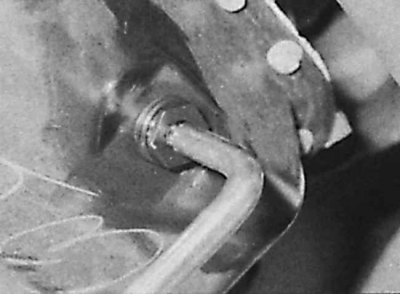
2. Loosen the drain plug approximately half a turn, place a container to collect the drained oil under the drain plug, then unscrew the plug completely.
3. Allow the used motor oil to drain for a while. As the oil drains, gradually move the container toward the stream of oil.
4. Clean the drain plug with a clean cloth. Remove the old O-ring from the plug and install a new one. Clean the plug installation area on the pan.
5. To replace the filter, place a container under the oil filter, which is located on the front side of the cylinder block below the exhaust manifold.
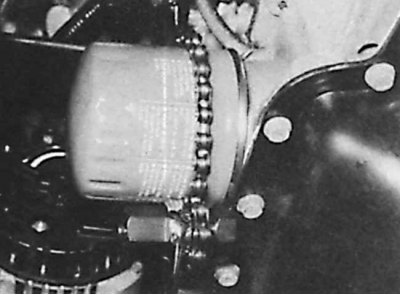
6. Use a special oil filter wrench to unscrew the used filter.
7. Clean the connection surface, lubricate the rubber gasket with fresh oil and screw in the new filter.
8. Screw the filter on by hand (according to the installation instructions supplied with the filter).
9. Fill with fresh oil, maintaining the correct level.
10. Start the engine and let it run for a few minutes, then check for leaks around the oil filter and oil pan drain plug.
Caution! After starting the engine, the oil pressure indicator light will remain on for a while until the pump pumps fresh oil into the line.
11. Turn off the engine and wait a few minutes for the engine oil to drain into the pan, then re-measure the oil level and add oil if necessary.
Diesel engines
Checking the level
The oil level should be checked every 500 km and before each long-distance trip. The car should be on a level surface, the engine should be cold or at least not running for a few minutes.
1. Remove and wipe dry the oil level indicator.
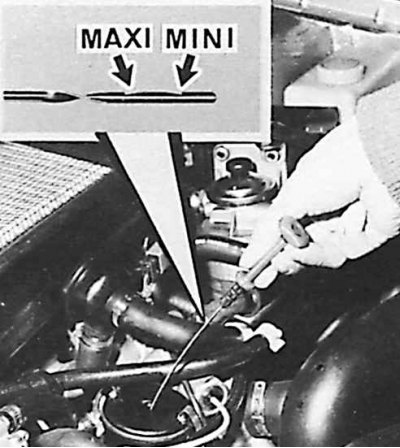
2. Insert the pointer all the way, remove it and read the oil level.
3. If necessary, add oil so as not to exceed the maximum level.
Attention! The oil filler cap has a hole in the middle for the indicator and ensures its correct position. This cap is secured with two elastic grips.
Oil change
Oil change is performed when the engine is warm. The first time the oil is changed after a run of 1500 to 2500 km, the second time - after a run of 10,000 km, subsequent changes - every 10,000 km.
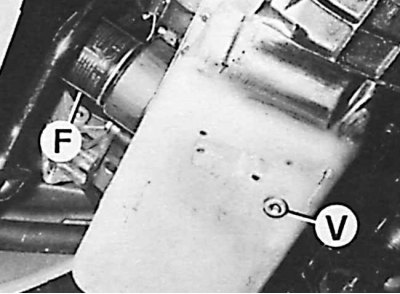
1. Unscrew the oil drain plug (V) (square 8 mm side) and drain the oil (F – oil filter).
2. Screw the oil drain plug back on, using a new gasket. This plug needs to be screwed on properly, without using too much force.
3. Add fresh oil so as not to exceed the maximum level on the oil level indicator.
Replacing the oil filter
The first time the oil filter is replaced after a run of 1,500 to 2,500 km, the second time - after a run of 10,000 km, subsequent replacements - every 20,000 km.
1. Use a special oil filter wrench to unscrew the used filter.
2. Clean the connection surface, coat the rubber gasket with oil and screw in the new filter.
3. Tighten the filter by hand (according to the installation instructions supplied with the filter).
4. Fill with fresh oil, maintaining the correct level.