



Table of contents: 4NR20 automatic transmission 🠇 Features of the AL4 gearbox 🠇 Electronically controlled suspension 🠇
4NR20 automatic transmission
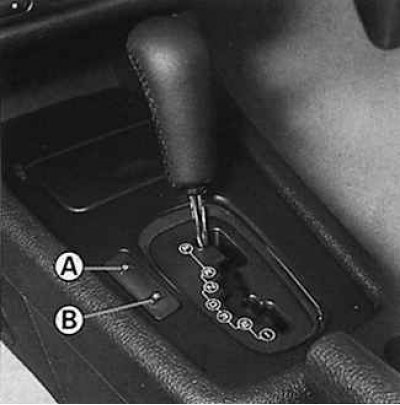
A, B. Mode switching buttons
Starting the engine
To start the engine, move the gearshift lever to position N or P. Press the brake pedal when starting the engine and when engaging gears.
Gear shift lever position
This is confirmed by the readings of the indicator on the instrument panel.
P – Parking. Used simultaneously with the parking brake when the car is parked.
R – reverse. This gear can only be engaged after the vehicle has come to a complete stop and the engine is idling.
N – neutral gear. If you accidentally set the lever to position N while driving, then before engaging any forward gear, switch to idle speed.
D – driving. In this position, 4 gears are automatically engaged. The gear shift moments are selected depending on the set program.
3 – only the first 3 gears are engaged automatically. This position is recommended if there is a need to frequently shift from 3rd to 4th gear (driving in the city or on a winding road).
2 or L – only the first 2 gears are engaged automatically. This position is especially convenient when driving on mountain roads, as it allows full use of engine power when climbing and engine braking when descending.
1 – only first gear engaged. Used on steep climbs, especially when towing a trailer.
Features of the AL4 gearbox
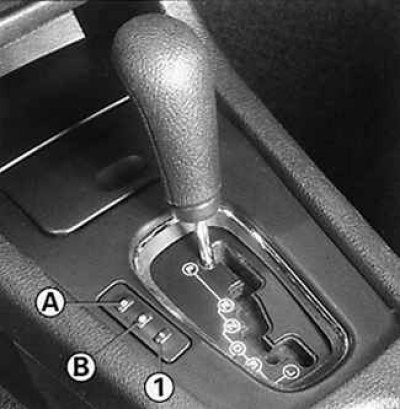
Each time the ignition is switched on, the S and * indicators flash three times.
The first gear is engaged from position L by pressing switch 1.
To exit position 1, press switch 1 again or move the gearshift lever.
Work programs
The gearbox provides the execution of 3 operating programs:
- automatic (normal);
- sporty;
- driving in the snow.
Pressing buttons A or B once switches on the "sport" or "snow driving" programs, respectively. The program selection is confirmed by the indicator on the instrument panel. Pressing buttons A or B again returns to the "automatic" program.
Automatic (normal) program
Gear shifting occurs automatically depending on a number of parameters: driving style, road profile, vehicle load. The gearbox continuously selects from the recorded programs the one that is best suited to the driving conditions. Thus, with a moderate driving style, a program is selected that allows saving fuel. With faster driving with intensive acceleration, the gearbox will select a more sporty program with gear shifting at higher engine speeds. Shifting to higher or lower gears occurs in different modes depending on the road profile (horizontal, lift) and loading the vehicle.
Sports program
The sport program allows you to use a sporty driving style and provides faster acceleration.
Snow Driving Program
In position D, the snow program is activated, which provides a smooth ride on slippery roads to improve traction and control. The car starts moving in second or third gear, depending on the effort required to start off, and downshifts to lower gears occur at lower engine speeds.
In positions 3, 2 or L, the gearbox operates as a manual. In position 3, starting off occurs in 3rd gear and this gear remains engaged at all times. In position 2 or L, starting off occurs in 2nd gear and this gear remains engaged.
Features of work
During prolonged braking, the gearbox automatically shifts to a lower gear for more effective engine braking.
If the gas pedal is released abruptly (for example, you saw some obstacle on the road), the gearbox does not shift to a higher gear. This serves to increase safety.
In order to reduce the emission of toxic components, a special program is used that allows the engine to warm up to the optimum temperature faster.
Downshifting
To quickly get maximum acceleration during acceleration without touching the gearshift lever, press the accelerator pedal all the way down. The transmission will automatically downshift or select the gear in which the engine develops maximum power.
Attention! Any malfunctions in the system are accompanied by simultaneous flashing of the S and * indicators on the instrument panel. In this case, you can feel a noticeable impact when engaging reverse gear (this does not threaten the gearbox to break down).
If the idle speed is increased, the car can move off without pressing the gas pedal.
Do not press the accelerator pedal when changing gears when the vehicle is stationary.
The brake pedal must be pressed when changing gears.
If the vehicle is braked, do not press the accelerator pedal while the gear is engaged.
Do not shift to a lower gear to brake on slippery roads.
Never move the gearshift lever to position N, P or R while the vehicle is still rolling.
Electronically controlled suspension
The suspension automatically and immediately adapts to different driving styles and road profiles, ensuring the greatest comfort for passengers and vehicle stability. Thus, the suspension remains soft most of the time, but under hard driving conditions (sporty driving, sharp turns, overtaking) it automatically becomes more rigid, allowing the car to maintain optimal stability.
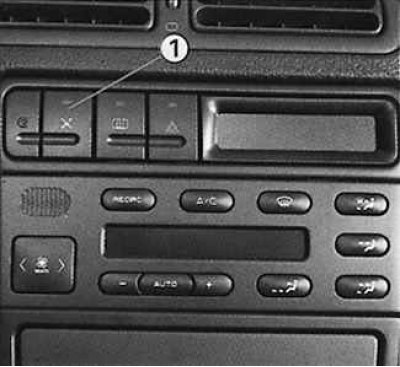
To select SPORT mode, press switch 1. The indicator light will come on. In this switch position, the suspension operates in sport mode. To return to automatic mode, press switch 1 again. The indicator light will go out.
The malfunction is determined by the indicator on the instrument panel. It lights up for about 3 seconds each time the ignition is turned on. When the indicator flashes, there may be a malfunction in the system.