
English Русский
Български
Беларускі
Український
Српски
Hrvatski
Română
Polski
Slovenský
Magyar
Bookmark Articles Sitemap Contacts
Company Hyundai Company Opel Company Skoda Company Kia Company Mitsubishi Company LADA Company Audi
PeugeotBook.ru


Series 100   Series 200   Series 300   400-500   Series 600   Crossovers   Others
 
Partner I (1996-2008) Peugeot 807 (2002-2014) Peugeot 806 (1994-2002) Peugeot J5 (1981-1993)

Rear disc brakes — removal, installation, and replacement of brake pads (Peugeot Eurovans 806)

  • Main
  • Пежо
  • Peugeot 806 (1994-2002)
  • Chassis, running gear
  • Brake system
  • Rear disc brakes — removal, installation, and replacement of brake pads
0
Table of contents: Replacing brake pads 🠇 Installation of disc brake mechanism…🠇 Adjusting the position of the brake…🠇
Removal and installation of rear disc brake pads is performed in the same way as for the front wheels. The only difference is that in this case you need to unscrew both guide pins of the rear wheel brake caliper, and also remove the spring located on the upper part of the caliper (see illustration 4.0).
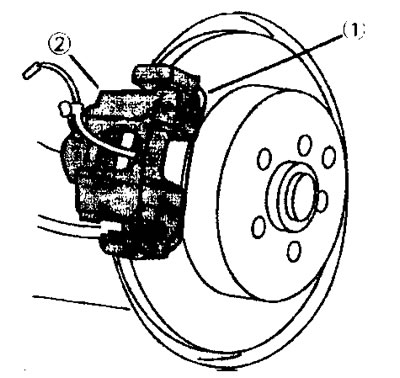
4.0 Rear disc brake caliper. Disconnect spring 1, then unscrew the guide pins at the top and bottom…

4.0 Rear disc brake caliper. Disconnect spring 1, then unscrew the guide pins at the top and bottom and remove the caliper


When installing the caliper, lubricate the guide pins with Loctite protective grease. The pin tightening torque is 30 Nm.

1. Install the caliper spring into place. All recommendations related to the removal and installation of brake pads, replacement of calipers or discs of the front wheel brake mechanisms should be fully taken into account when performing similar work on the disc brake mechanisms of the rear wheels, because the procedure is the same in both cases.

Replacing brake pads


Brake shoes on both drum and disc brakes are used to stop the vehicle with the parking brake. Brake pads can be replaced, but when installing new pads you will need a caliper to measure their fit to the inside diameter of the brake disc. If this correspondence is not observed, the brake pads will not self-install on the brake disc (see illustration 4.5).
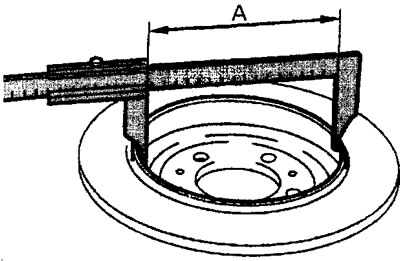


4.5 Measure the inner diameter of the brake disc and record the obtained value

4.5 Measure the inner diameter of the brake disc and record the obtained value


Removing the brake pads from the rear disc brakes is done in the same way as from the drum brakes, with the only difference being that it is necessary to remove the caliper and the brake disc. After disconnecting the parking brake cable from the lever (as well as on brake drum shoes) spread the brake pads apart by holding them at the bottom until the adjuster mechanism at the top of the pads can be removed. At the top of the pads there is a release bar that can be disconnected along with the brake adjustment mechanism. When disassembling the rear disc brake mechanism, mark or remember the mounting position of the parts in order to install them correctly during assembly.

Installation of disc brake mechanism components is carried out in the reverse order of disassembly.


2. Install the rear brake adjuster between the top of both brake pads so that the adjusting gear fits into the groove on the rear brake pad (see illustration).

(Original text is located at peugeotbook.ru)
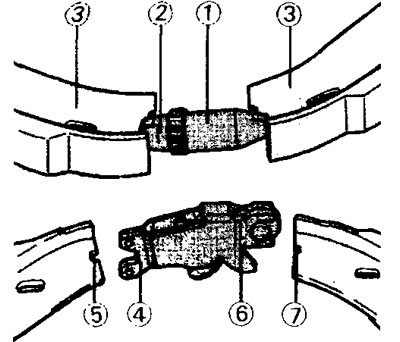
4.2 Install the rear brake adjuster between the top of both brake pads so that the adjusting gear…

4.2 Install the rear brake adjuster between the top of both brake pads so that the adjusting gear fits into the groove on the rear brake pad
1 - brake adjustment mechanism
2 - adjusting gear
3 - brake pads
4 - expansion bar fork
5 - recess on the brake shoe
6 - expansion bar fork
7 - recess on the brake shoe


3. Install the expansion bar. The corresponding forks on both sides of the bar are installed in the recesses on both brake pads (see illustration 4.2).

All subsequent work is carried out in the reverse order of removal. After installation, the brake pads should be adjusted. The parking brake also needs to be adjusted.

Adjusting the position of the brake pads


When it comes to adjusting the brake pads, a distinction must be made between actually moving the pads and adjusting the tension of the parking brake cables (see the relevant chapter).

4. Make sure the parking brake cable is completely loose.

5. Measure the inner diameter A of the brake disc with a caliper and record the obtained value. Do the same with the brake disc of the second wheel (see illustration).

6. Use a caliper to measure the diameter of the circle formed by the installed brake pads (see illustration). The caliper is installed at the points that form the maximum diameter.
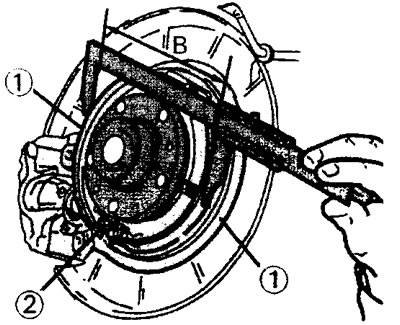
4.6 Using a caliper, measure the diameter of the circle B formed by the installed brake pads. The…

4.6 Using a caliper, measure the diameter of the circle B formed by the installed brake pads. The caliper is installed at points 1, forming the maximum diameter


7. Rotate the adjusting gear 2 (see illustration 4.7), install the brake pads so that the diameter of the circle they form is 0.6 mm smaller than the inner diameter A (see illustration 4.5).


8. Repeat the above measurements with the brake mechanism of the second rear wheel. The diameter size A on the brake disc of the second wheel must be the same. However, if the disk has been modified, the internal diameter value will be slightly larger.

9. Install the brake disc and tighten its mounting bolt to a torque of 25 Nm.

10. Adjust the parking brake (see the relevant chapter).
This article is available at russian, bulgarian, belarusian, ukrainian, serbian, croatian, romanian, polish, slovak, hungarian
Article reviewed by editor: Shirokov Arseny
Share information:
Previous
Peugeot 806: Brake system
Next

Rear drum brakes
Front Disc Brake Caliper Repair
Front disc brakes — replacing brake pads
General description of the braking system
Brake system specifications
Brake Master Cylinder — removal, installation, and repair
Vacuum booster brake drive
Brake system — bleeding
Parking brake adjustment
Brake force regulator
See similar information for other Peugeot models

➨ Rear brake pad condition check — models with rear disc brakes Peugeot 106 (1991-2003)
➨ Removal and installation rear disc brake pads BOSCH Peugeot 206 (1998-2012)
➨ Rear brake pads — removal, inspection and installation Peugeot 305 (1977-1989)
➨ Replacing rear brake pads on disc brakes Peugeot 405 (1987-1997)
➨ Brake disc — removal Peugeot 605 (1989-2000)
Link to this article in different formats
Comments and feedback from visitors
No comments yet


Add two numbers 35 + 34


Partner I (1996-2008) 
  • General information
  • Introduction to the guide
  • Faults en route
  • Weekly checks
  • User manual
  • Maintenance (petrol)
  • Maintenance (diesel)
  • Power unit
  • Petrol engines
  • Diesel engines «XUD»
  • Diesel engines «DW»
  • Overhaul of petrol engines
  • Overhaul of diesel engines
  • Cooling and heating
  • Power and exhaust (petrol)
  • Power and exhaust (XUD diesels)
  • Power and exhaust (DW diesels)
  • Emission reduction
  • Starting and charging system
  • Transmission
  • Clutch
  • Mechanical gearbox
  • Drive shafts
  • Chassis, running gear
  • Brake system
  • Car suspension
  • Steering
  • Body and interior
  • Exterior (external elements)
  • Interior (internal elements)
  • Doors, locks and windows
  • Electrical equipment
  • Equipment and devices
  • Electrical circuits
Peugeot 807 (2002-2014) 
  • General information
  • Operating instructions
  • Maintenance
  • Troubleshooting
  • Power unit
  • Gasoline engines
  • Diesel engines
  • Cooling and heating
  • Fuel injection (petrol)
  • Fuel system (diesel)
  • Fuel system
  • Exhaust system
  • Ignition system
  • Transmission
  • Clutch
  • Manual gearbox
  • Automatic gearbox
  • Chassis, running gear
  • Brake system
  • Car suspension
  • Steering system
  • Body and interior
  • Exterior (external elements)
  • Interior (internal elements)
  • Electrical equipment
  • Power devices
  • Electrical circuits
Peugeot 806 (1994-2002) 
  • General information
  • User manual
  • Maintenance
  • Power unit
  • Petrol engines
  • Diesel engines
  • Lubrication system
  • Cooling system
  • Fuel injection (petrol)
  • Fuel system (diesel)
  • Ignition and exhaust systems
  • ECM Bosch Motronic MP 3.2
  • ECM Magneti-Marelli (MM)
  • Transmission
  • Clutch
  • Mechanical gearbox
  • Chassis, running gear
  • Brake system
  • Car suspension
  • Steering
  • Electrical equipment
  • Equipment and devices
  • Electrical circuits
Peugeot J5 (1981-1993) 
  • General information
  • Introduction to manual
  • Specifications
  • Gasoline engine
  • Engine repair
  • Lubrication system
  • Cooling system
  • Fuel system
  • Ignition system
  • Diesel engine
  • Engine repair (DB9)
  • Lubrication system (DB9)
  • Cooling system (DB9)
  • Fuel injection (DB9)
  • Engine repair (U25)
  • Lubrication system (U25)
  • Cooling system (U25)
  • Fuel injection (U25)
  • Transmission
  • Clutch
  • Gearbox
  • Drive shafts
  • Chassis, running gear
  • Steering system
  • Car suspension
  • Brake system
  • Electrical equipment
  • Power devices
  • Electrical circuits
PeugeotBook.ru © 2018–2026 | Mobile version | Sitemap: EN BG BY UA RS HR RO PL SK HU | Write message | Site search | Add to bookmarks | Peugeot owners
106 (1991-2003) | 206 (1998-2012) | 207 (2006-2014) | 305 (1977-1989) | 306 (1993-2002) | 307 (2001-2008) | 405 (1987-1997) | 406 (1995-2004) | 605 (1989-2000) | Partner-I (1996-2008) | Eurovans-807 (2002-2014) | Eurovans-806 (1994-2002) | J5 (1981-1993) |
Cookies are used to ensure the correct display of pages on the site.