



Table of contents: Front wheel speed sensor - removal…🠇 The sensor is installed in the…🠇 Rear wheel speed sensor - removal…🠇 The sensor is installed in the…🠇
The installed ABS system was developed by Bendix. The location of the ABS components on the vehicle is shown in Figure 11.0.
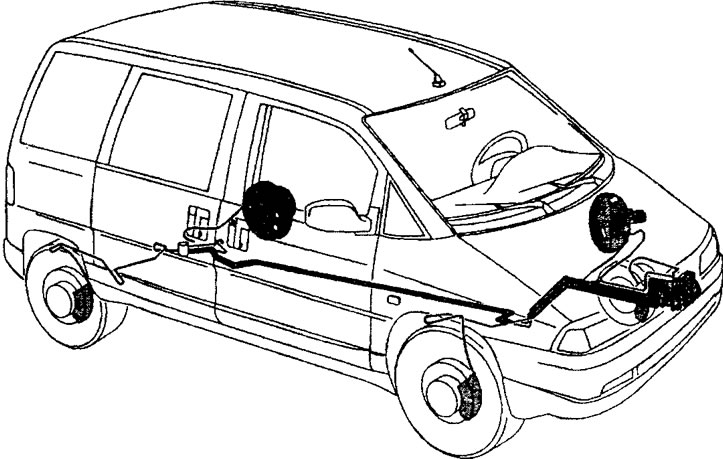
11.0 ABS System Components. The lines in the front of the vehicle are connected to the hydraulic unit
The main elements of ABS are:
- electronic control unit combined with a hydraulic unit.
- wheel speed sensors. The front wheel speed sensors are mounted on the steering knuckles, and the rear wheel speed sensors are mounted on the brake shields. The tightening torque for the front and rear wheel speed sensor mounting bolts is 11 Nm.
- gears on the drive shaft and wheel hub. The sensors receive information about the number of wheel revolutions by induction from the gears on the front wheel drive shafts. The rear wheel ABS sensor gears are mounted on the hubs. Due to the fact that the number of teeth on the gears for the vehicles discussed in this manual is strictly defined, ABS parts can only be ordered by specifying the model and year of manufacture of the vehicle. To replace the front wheel ABS sensor gear, you need to remove the drive shaft, and to replace the rear wheel ABS sensor gear, you need to remove the hub.
The main quality of the ABS system is its ability to prevent wheel locking during sudden braking. This ensures that the vehicle remains controllable. This means that during emergency braking, the driver has a chance to avoid the obstacle, thanks to the fact that the rear wheels do not lock.
The effectiveness of ABS should not be overestimated. If the braking force exceeds the physical limits for which the ABS is designed, the vehicle, even though it is equipped with ABS, may skid.
Wheel speed sensors operate independently of each other and continuously monitor the rotation speed of their wheel by recording the signal coming from the corresponding gear. If the car is equipped with ABS, but the brake mechanisms on all wheels are disc brakes. At the same time, the possibility of installing drum brakes on the rear wheels is not excluded.
We recommend that you do not attempt any ABS work yourself, even though some of it is not particularly difficult. The workshop will perform work related to ABS with higher quality, especially since ABS is a safety component.
However, certain types of work on a vehicle may directly or indirectly affect the ABS system. This is especially true for the braking system. Therefore, when performing work on the brake system, it is necessary to comply with a number of requirements.
1. Clean all connections before disconnecting them.
2. Place the removed parts on a clean surface and cover them with film or paper. Do not use lint-containing cloths.
3. Cover exposed system parts if repair work is not to be performed immediately. This is especially important if the vehicle is located outdoors.
4. Install only clean parts. Do not install parts that have been removed from their packaging and stored without it for a long time.
[Original can be viewed at: PEUGEOTBOOK.ru]
5. Do not clean parts with compressed air if the brake system is open.
The electronic control unit is performing a check (diagnostics) ABS components. If a malfunction is detected, the ABS is disabled and the braking system operates as in a vehicle without ABS. In this case, a warning light comes on. Contact the workshop.
Front wheel speed sensor - removal and installation
6. Disconnect the negative (-) cable from the battery.
7. Loosen the front wheel mounting bolts and place the front of the vehicle on jack stands.
8. Remove the front wheel.
9. Disconnect the wheel speed sensor plug. Remember the wire routing and release the wire from the fasteners (in two places).
10. Remove the cover over the wheel speed sensor and unscrew the sensor itself.
The sensor is installed in the reverse order of removal.
11. Check the hole where the sensor is screwed and make sure it is clean. Lubricate the hole threads with a small amount of grease.
12. Screw in the sensor and tighten it to a torque of 11 Nm.
13. Place and secure the sensor wire as it was located before removal and make sure that it will not be frayed when the vehicle is moving.
Rear wheel speed sensor - removal and installation
14. Disconnect the ground (-) cable from the battery.
15. Place the rear of the vehicle on jack stands.
16. Remember the wire routing and release the wire from the fasteners.
17. Unscrew the sensor.
The sensor is installed in the reverse order of removal.
18. Lubricate the ABS sensor threads with Loctite protective grease.
19. Screw in the sensor and tighten it to a torque of 11 Nm.
20. Lay and secure the sensor wire.