



Table of contents: Replacing brake pads 🠇 Installation 🠇
Replacing brake pads
On the rear side of the brake mechanism support shield there is an inspection hole, sealed with a plug. After removing the plug, you can shine a flashlight into the hole and visually check the thickness of the brake linings. Removing the brake pads is performed as follows.
1. Loosen the wheel mounting bolts and place the rear of the vehicle on jack stands.
2. Remove the rear wheels.
3. Use a chisel to knock off the protective cap of the hub nut. The cap is knocked down along the entire diameter where it fits onto the hub. The hub should be turned during this process.
4. Unscrew the brake drum mounting bolt and remove the drum. If it does not come off, the drum can be knocked down with a plastic or rubber hammer, striking the circumference of the drum. If it is not possible to knock down the drum in this way, you can insert a punch of a suitable diameter (or a screwdriver) into the hole as shown (illustrations 3.4), on the back side of the brake drum. The punch will rest against the parking brake lever and push the lever forward. The brake pads will then take a neutral position.
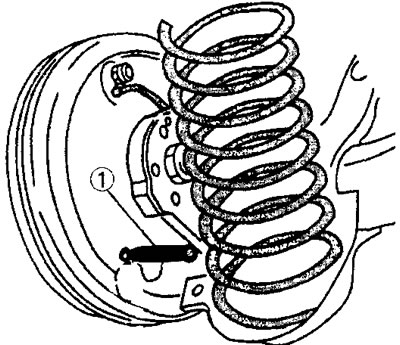
3.4 Insert a punch of suitable diameter into the hole on the rear side of the brake drum to depress the parking brake lever and move the brake shoes to the neutral position
5. Remove the brake drum from the hub, moving it from side to side (see illustration).
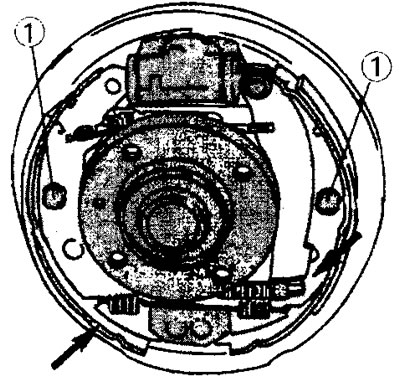
3.5 Brake drum assembly. In order to disassemble the brake mechanism, it is necessary to remove the pins 1 securing the brake pads. At the point marked by the arrow on the right side, there is a parking brake drive lever, to which the parking brake cable is attached. The arrow on the left side indicates the return spring mount
6. Disconnect the upper tension spring using pliers.
7. Remove pins 1 from both brake pads (see illustration 3.5). Hold the pin itself with your finger on the back side of the support shield and at the same time use pliers on the end side of the pin to turn and release the clamp of the guide spring, which is located on the pin.
8. Remove the clamp and spring. Push the pin towards the back and remove it. Perform the same steps with the pin of the other brake shoe.
9. Clamp the end of the parking brake cable with pliers (see arrow in illustration 3.5) and pull it outward to compress the spring and allow the cable to be disconnected from the parking brake lever.
10. Remove both brake pads from the backing plate by pushing them towards you. After this, close the lower ends of the pads (see arrows in the illustration), so that the upper part of the pads comes out of the wheel cylinder, and also so that the release plate of the parking brake lever is released together with the adjusting mechanism.
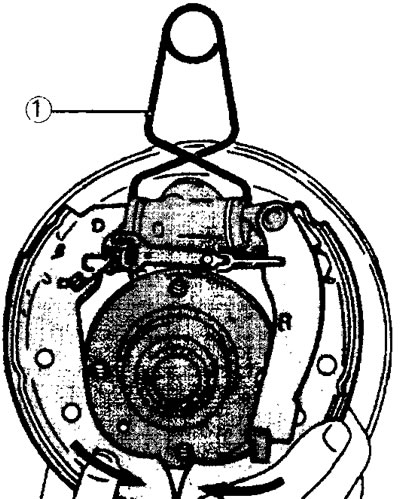
3.10 Remove both brake pads from the backing plate by pushing them towards you. After this, close the lower ends of the pads. Spring 1 is designed to hold the wheel cylinder pistons inside the cylinder. To prevent the pistons from coming out of the cylinder, it can be covered with a rubber band
11. Remember the installation position of the adjustment mechanism. The adjuster gear must be installed in the same position because both ends of the adjuster mechanism are not equal. Once the pads are removed, the lower tension spring and the small return spring of the expansion bar will be released and can also be removed.
Caution: Do not damage the wheel cylinder protective cap when removing the brake pads. To prevent the pistons from coming out of the cylinder, it can be covered with a rubber band or elastic tape. Remember the mounting position of the drum brake components to facilitate subsequent assembly.
12. Make sure that the parking brake levers on the brake shoes move easily. It is possible that new brake pads may be supplied without levers. In this case, replace the levers with the old brake pads (see illustration).
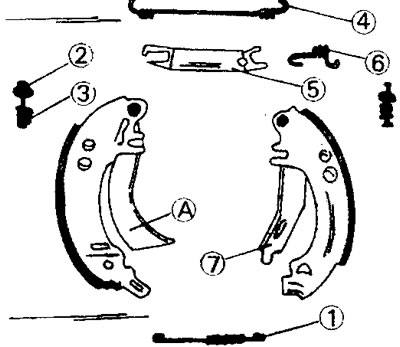
3.12 Rear wheel brake mechanism parts. The letter A indicates the flange on the parking brake drive lever, which locks the lever. When the lever is pressed using a punch inserted from the rear side of the brake mechanism shield, this flange disengages and the lever is pressed.
1 - lower tension spring
2 - clamp of the guide spring on the pin of the shoe
3 - shoe mounting pin and guide spring
4 - upper tension spring
5 - expansion bar
6 - return spring of the expansion bar
7 - parking brake lever
13. Clean all parts of the rear wheel brake mechanism, including the shield. If you use cleaning gasoline for cleaning, do not allow it to come into contact with the rubber caps of the wheel brake cylinder.
If the brake pad linings have a remaining thickness of 1.0 mm, the brake pads should be replaced. It is also recommended to replace the brake pads if the lining thickness is 2.0 mm. If there are signs of brake fluid leakage from the wheel cylinder, the cylinder should also be replaced. The wheel cylinder cannot be repaired.
Caution! Do not clean the brake mechanism with compressed air. With this cleaning method, dust generated by friction of brake linings gets into the respiratory tract. This dust is harmful to health.
Installation
If the wheel cylinder was removed, it should be installed in place.
14. Lubricate the brake pad contact points on the brake shield. There are six such points. Apply lubricant to these areas with your finger.
15. Replace the lower part of the brake pads and secure the lower tension spring to the pads.
16. Insert the expansion bar into the slot at the top of the brake shoe and secure the spring to it.
17. Secure the top of the rear brake shoe to the shield.
18. Attach the return spring of the expansion bar to the shoe.
19. Push the brake shoe towards you until both springs are stretched and the top of the brake shoe enters the hole in the wheel cylinder.
Caution! Be careful not to damage the wheel cylinder protective cap.
20. Secure the parking brake cable to the rear brake shoe lever. Release the cable spring and make sure that the parking brake cable is securely fastened to the drive lever.
21. Center the brake pads on the shield.
22. Insert the brake shoe mounting pins from the rear of the brake shield and place the guide springs and clamps on the pins. While holding the pin against the back of the brake shield, grasp the spring guide clip with pliers and push it onto the pin head. Once the pin head is through the hole in the clamp, rotate the clamp to secure it onto the pin. Re-center the brake pads on the brake shield.
To set the brake pads to their basic position, rotate the adjusting gear on the expansion bar until both pads are positioned so that the diameter of the circle they form is 225 mm (value of X) (see illustration 3.22). At the same time, measure the diameter of the brake drum. If a modified brake drum is installed, the maximum permissible drum diameter must not exceed 256 mm.
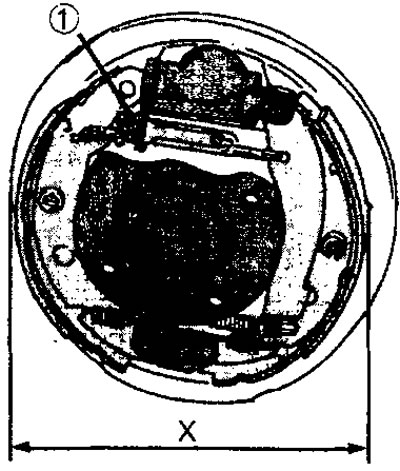
3.22 Measuring the diameter of the circle formed by the installed brake pads (value of X). The position of the brake pads is adjusted using the adjusting gear 1 of the adjusting mechanism
23. Install the brake drum and secure it with the bolt, tightening it to a torque of 25 Nm.
24. Apply the parking brake and press the brake pedal several times to engage the self-adjusting mechanism of the brakes and center the brake shoes in the drum. The parking brake sometimes needs to be adjusted.
25. Take the car for a test drive. Take some care to allow the brakes to break in.
The rear drum brake wheel cylinder can be removed after removing the brake shoes. Considering that the cylinder cannot be disassembled, it should be replaced as a set if there is a suspicion that it is faulty or defective. When installing the wheel cylinder, its mounting bolts are tightened to a torque of 14 Nm.