



The operating principle of hydraulic tappets
Oil under pressure fills chamber A of tappet 1 and from chamber A enters chamber B, where the pressure is low. This causes the ball valve 4 to open and chamber C to fill.
Piston 2 and sleeve 3 are pressed by the force of pressure of spring 5, thus creating mechanical contact between the cam and the valve stem. A small gap between the piston and the sleeve ensures ventilation of the pusher (see illustration 9.0).
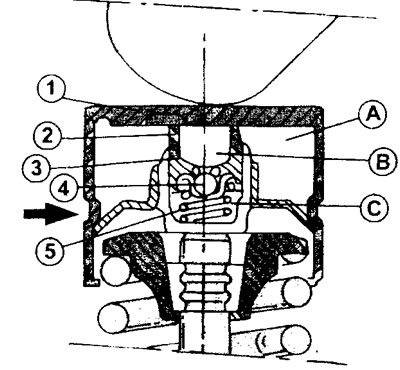
9.0 Hydraulic tappet in section. 16-valve engine
A, B, C - chambers filled with oil
1 - pusher
2 - piston
3 - sleeve
4 - ball valve
5 - spring
When the camshaft rotates, the cam presses the tappet, thus increasing the oil pressure in chamber C. The ball valve blocks the oil from leaving the chamber and the stroke (pressure) of the cam is thus transferred to the valve.
If adjusting the valve clearance on an 8-valve engine is performed without removing the engine from the vehicle, some preparatory work must be performed to provide access to the valves. These works include removal of the air filter and cylinder head (see above).
1. Place the front of the car on jack stands and engage fifth gear. This will allow the engine to be turned by rotating the wheel.
2. Mark the spark plug wires accordingly and disconnect them from the spark plugs.
3. Remove the spark plugs.
4. Measure the valve clearance and record the obtained data, presenting it in the form of a table (see illustration).
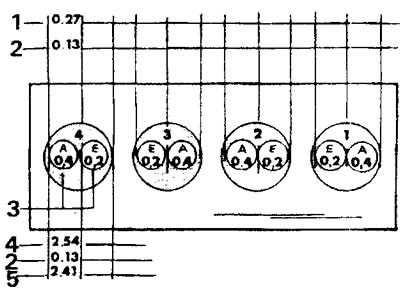
9.4 Plate with valve clearance measurement results
On this plate you can then record the values by which the corresponding valve clearance will be adjusted
5. Turn the engine in the direction of travel by one of the front wheels. To measure valve clearance, the corresponding cam must be facing upwards. This means that the opposite valve of the same cylinder must be open at this moment. Cylinder No. 1 is located near the flywheel.
6. Measure the valve clearance using a template by inserting it between the cam and the valve lifter (see illustration).
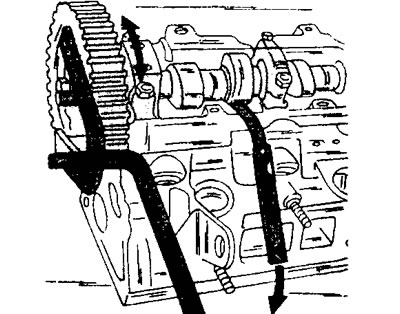
9.6 Measure the valve clearance using a template by inserting it between the cam and the valve lifter
7. Write the obtained value in the appropriate column on the prepared table (see illustration 9.4). In the given example, the valve clearance height was 0.27 mm
8. Turn the engine by the front wheel in the direction of travel another half turn and measure the clearance of the next valve. Rotate the engine half a turn every time. before checking the clearance of all valves. Enter the obtained data into the table. The nominal valve clearance values for intake valves are 0.15-0.25 mm, and for exhaust valves, 0.35-45 mm. If the measured clearance value falls outside the specified nominal tolerances, the clearance must be adjusted by installing adjusting shims of a different size between the valve lifter and stem. If the gap is too large, thicker adjusting washers are installed; if the gap is small, thin ones are installed (see illustration).
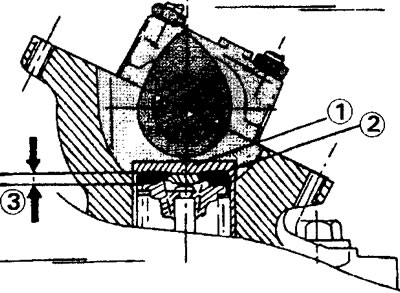
9.8 Sectional view of camshaft and valve tappet
1 - valve tappet
2 - adjusting washer
3 - clearance provided by an adjusting washer of the appropriate thickness
If the valve clearance needs to be adjusted, then this requires dismantling the camshaft.
9. Disconnect the negative (-) terminal of the battery.
10. Loosen the right front wheel mounting bolts and remove the wheel arch protective inserts (fender liners) to gain access to the end of the crankshaft.
11. Remove the upper part of the timing belt guard.
12. Insert the stop bolt into the hole of the belt pulley, which should be at the 11 o'clock position, to lock the camshaft and the camshaft timing belt gear.
13. Remove the drive belt from the accessories.
14. Remove the cylinder head and air filter.
15. Loosen the timing belt tension roller bolt, move the roller away from the belt and remove the timing belt from the camshaft gear.
16. Remove the gear from the camshaft. When loosening the gear mounting bolt, hold it or turn it.
17. Move the oil line that runs above the camshaft to the side (see illustration 9.18).
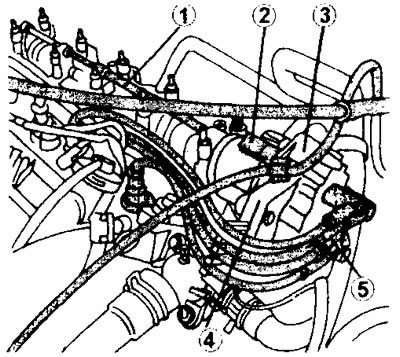
9.18 Remove the parts located on the top of the cylinder head
1 - oil pipeline
2 - coolant outlet pipe
3 - ignition coil block
4 - holder
5 - high-voltage spark plug wires
18. Disconnect the coolant inlet pipe and ignition coil assembly from the cylinder head (see illustration).
19. Remove the M6 socket head bolt from the front of the cylinder head, then evenly loosen all the nuts of the five camshaft journal bearings, in the reverse order of tightening the nuts. Be guided by this (illustration 9.19).
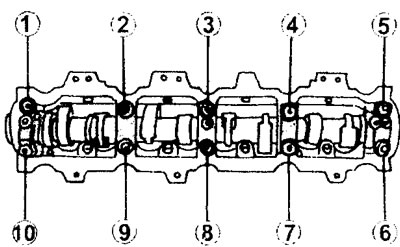
9.19 Sequence of tightening the nuts of the camshaft journal supports. The tightening torque for the nuts is 16 Nm. Loosening and unscrewing the nuts is performed in the reverse order
20. Remove the camshaft and remove the oil seal from the shaft. When installing the shaft, a new seal is packed in.
21. Remove the valve tappet and the adjusting washer located under the tappet.
22. Measure the thickness of the adjusting washer. Since we are talking about very small values, the thickness of the washer should be measured using a micrometer. If it is not available, you can use a pointer-type measuring indicator (see illustration).
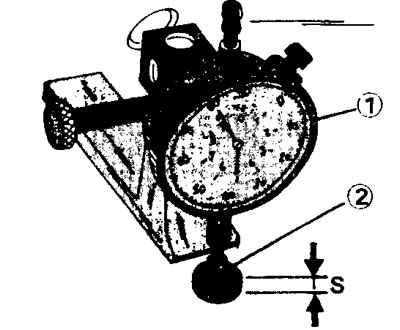
9.22 Measuring the thickness S of the adjusting washer 2 using a measuring indicator 1 with an arrow indication. In this case, the adjusting washer should be placed on a polished surface
The value K, by which the clearance must be adjusted, is determined as the remainder from subtracting the nominal value of the valve clearance O from the value obtained by measuring the valve clearance I.
The valve clearance value to be adjusted can be positive or negative. If the gap value is positive, a thicker adjusting washer is installed; if the value is negative, a thinner one is installed. Taking into account that the nominal values of valve clearance are expressed not by one specific number, but by a whole range of tolerances, then the average value from this range is taken as the nominal value and the thickness of the new adjusting washer H is equal to the value obtained when measuring the clearance plus the correction value (H = I + K).
23. Select an adjusting washer whose thickness is as close as possible to or equal to the value obtained during the calculation. The thickness of the offered shims ranges from 2.225 to 3.550 mm. The thickness increment is 0.025 mm.
24. Lubricate the new adjusting washer with engine oil before placing it under the tappet.(see illustration).
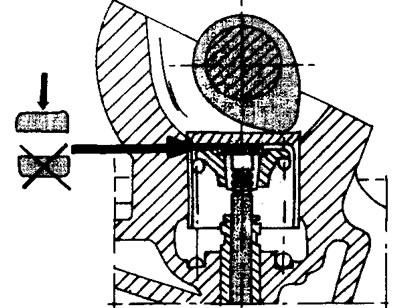
9.24 The rounded side of the adjusting washer must face upwards when installed
Perform the same calculations and actions for the remaining valves whose clearance needs to be adjusted.
Important! If the camshaft or valve lifters have been replaced, the adjusting shims must be the same nominal thickness—2.25 mm—regardless of the shim size that was installed before these parts were replaced.
25. Lubricate the valve lifters with engine oil and install them in place.
Caution! Once the tappets are installed, do not lift them, as the adjusting washer may lift along with the tappet and then fall to the opposite side. If it is necessary to adjust the position of the pusher, it must be removed completely and reinstalled, after checking that the adjusting washer is correctly positioned.
[Original text is located at: www.PeugeotBook.ru]
26. Lubricate the bearings under the camshaft journals and install the camshaft so that the fourth and sixth cams, counting from the flywheel, fit against the corresponding tappets (see illustration).
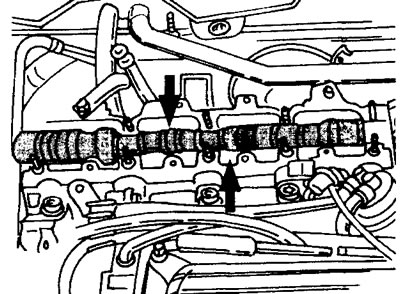
9.26 The cams must fit snugly against the valve lifters
27. Lubricate the mating surfaces of the support located on the toothed belt side with sealing compound "Auto Joint" and install the cover on it. Then, install the covers of the remaining supports in accordance with their numbering.
28. Tighten the cover mounting nuts in the specified tightening sequence, working from the middle outwards, to a torque of 16 Nm (see illustration 9.19).
29. Install the new seal onto the camshaft. Be careful not to allow the seal to become deformed. Considering that access to the end of the camshaft is difficult, it is recommended to press the oil seal with a mandrel or a ring made of a pipe of the appropriate diameter, pressing them with a bolt of increased length with a washer of sufficient diameter.
30. Install the driven gear onto the camshaft and secure it with the bolt. While holding the camshaft from turning, tighten the gear mounting bolt to a torque of 35 Nm (see illustration).
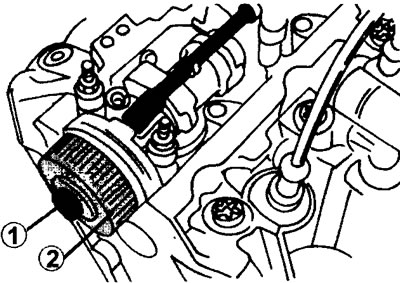
9.30 Installing driven gear 2 on the camshaft. While holding the camshaft from turning, tighten the gear mounting bolt to 35 Nm
31. Turn the camshaft at least two revolutions (very slowly) and measure the valve clearance. Adjust the gap if necessary.
32. Install the removed cylinder head parts in the reverse order of removal. Return the oil pipe to its original position (see illustration 9.18).
33. Install the timing belt (see the relevant chapter).