



Table of contents: 8-valve engines 🠇 Twin overhead cam engine with 16…🠇
When replacing the cylinder head, all parts from the old head must be installed on the new one. The following procedure for replacing the cylinder head concerns the replacement of parts from the previous head without performing a valve train overhaul.
Clean all parts thoroughly and lubricate all rubbing surfaces with engine oil.
1. Install the valve stem seals using a drift or a piece of 8 mm diameter pipe. Be careful not to damage the seals. Otherwise, it will lead to increased oil consumption (see illustration).
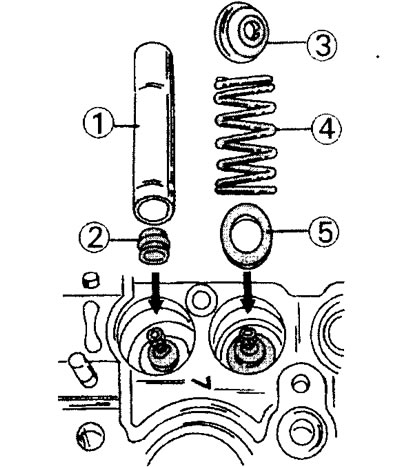
8.1 Installing oil seals and valves
1 - mandrel for installing oil-deflecting caps
2 - oil deflector cap
3 - valve plate
4 - valve spring
5 - spring support washer
2. Insert the valves into the guide bushings. If the valves have been ground, they must be installed on the corresponding seats. The same applies to the old valves, which must be installed on the same seats on which they stood.
3. Insert the valves, well lubricated with engine oil, into the cylinder head from the bottom and install the thrust washers, springs and plates on top (see illustration).
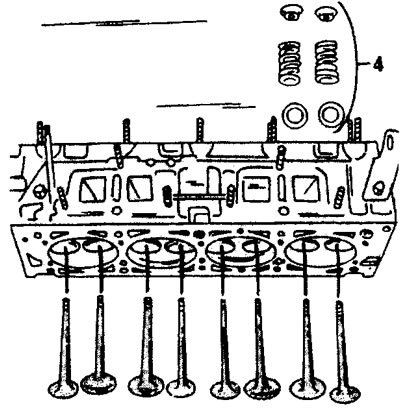
8.4 Valve installation procedure
4. Compress the valve spring with a special tool. Insert crackers into the grooves on the protruding upper end of the valve stem and carefully release the special device. Make sure the crackers are firmly in place. The intake and exhaust valve crackers are the same. To check the seating of the crackers, tap the top of the valve stems with a plastic hammer. Incorrectly placed crackers jump out when struck. To prevent parts from flying out, place a rag on the spring.
8-valve engines
5. Lubricate the valve lifters and valve lifter adjusting washers with engine oil and install them in their original positions. The adjusting washers have rounded edges on one side, while the other side is flat and not rounded. It is this side that the adjusting washers are installed on the valve stems (see illustration).
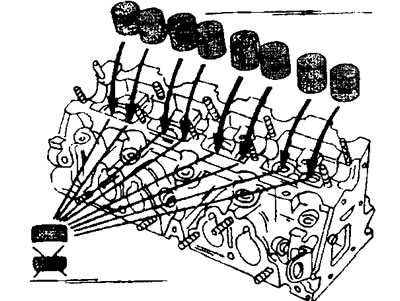
8.5 Lubricate the valve lifters and valve lifter adjusting washers with engine oil and install them in their original positions. The adjusting washers are installed with the side with the rounded edges facing up.
The side with the rounded edges should face up.
If it is necessary to check the correct installation of the adjusting washers, then the corresponding pusher must be completely removed, because the washer underneath it may turn over and lie on the opposite side during the check.
6. Lubricate the camshaft bearing journals with engine oil and place the camshaft into the cylinder head. Install the camshaft bearing housings according to the marks applied. Tighten the housing mounting bolts to a torque of 15 Nm, working from the middle outwards in a crosswise pattern.
7. Install the oil seal into the camshaft hole in the cylinder head after the valve clearance has been adjusted.
8. Install the drive gear onto the camshaft and secure it with the bolt, tightening it to a torque of 35 Nm. Hold the camshaft from turning while doing this.
9. Install all remaining cylinder head components in the reverse order of removal.
Twin overhead cam engine with 16 valves
10 Install the valves and valve stem seals.
11. Install the valve lifters one by one, following the marks made during removal.
12. Lubricate the bearing journals and cams of both camshafts and place the camshafts in place. Before laying the shafts, also lubricate the bearing surfaces with engine oil. After laying the shafts, ensure they are in the correct position.
13. Turn the left camshaft so that the notch on the highlander faces upward and is strictly perpendicular to the horizontal surface (12 o'clock position). The right camshaft must be positioned so that the notch on its end is in line with the timing adjustment reference mark (see illustration).
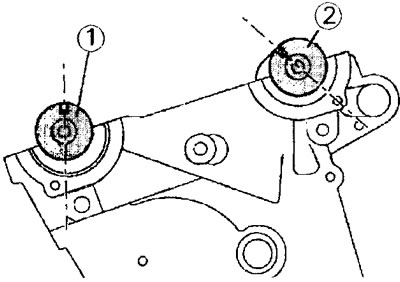
8.13 Mounting position of camshafts of 16-valve engine.
1 - left shaft. The notch on the end was facing upward and stood strictly perpendicular to the horizontal surface (12 o'clock position).
2 - right shaft. The notch on its end should be in line with the reference mark
14. Make sure that the centering pins are installed at the corners of the cylinder head to ensure correct installation of the head relative to the cylinder block.
15. Apply sealing compound to the mating surfaces of the cylinder head and block. Using the same mixture, lubricate the threads of the holes for the cylinder head mounting bolts and install the bearing housings.
16. Tighten the camshaft bearing housing bolts in two passes, using the diagram. At the first stage, tighten with a torque of 5 Nm, and at the second stage - 10 Nm (see illustration).
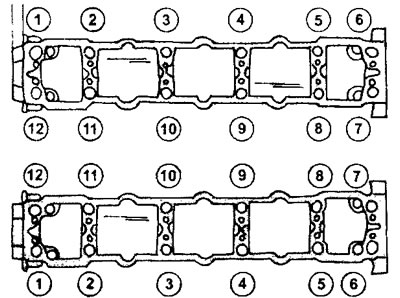
8.16 Camshaft bearing housing bolt tightening diagram
17. Press the oil seals into the camshaft holes. For this purpose, use a mandrel or a ring made of a pipe of the corresponding diameter, as well as a bolt with a washer of the corresponding diameter (see illustration).
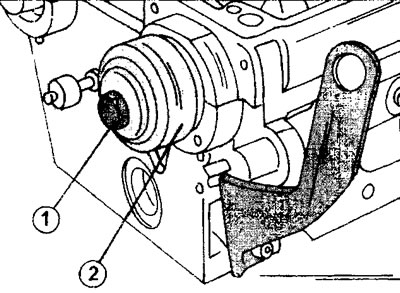
8.17 Pressing the camshaft oil seal into the hole in the cylinder head.
1 - bolt for pressing in the oil seal with a washer
2 - a mandrel or ring made of a pipe of the corresponding diameter
18. Install the parts removed during the removal of the cylinder head on the end side of the engine (see illustration 6.10). Tighten the bolts (1 and 2) securing the bushings (3 and 4) of the toothed belt gears to a torque of 75 Nm. To prevent the gears from turning, install stop bolts "a".
19. Install the thermostat housing on the opposite side of the cylinder head.
The cylinder head is installed in the order indicated above.