



1. Make sure all parts are clean.
2. Lubricate all rubbing parts with a thin layer of grease. Lubricate these parts before installing them, not after, because this will prevent the lubricant from reaching the mating surfaces. Be sure to thoroughly lubricate the pistons, piston rings and cylinder walls with engine oil.
3. Thoroughly clean all parts of the cylinder block if the engine was completely disassembled. When cleaning parts of a partially disassembled engine, be careful not to allow dirt and foreign particles to get onto the removed parts or into open openings in the engine. For this reason, it is recommended to cover or seal all openings.
4. Blow out oil passages and holes with compressed air. If this is not possible, then clean these holes with a wooden dowel. Never clean the holes with metal objects.
5. Be sure to replace oil seals, gaskets, etc. Do not skimp on these parts and do not install used ones.
6. Use the specifications for wearing parts. If there is any doubt about any part, it is recommended to replace it with a new one to avoid rebuilding the engine again.
7. Purchase spare parts only from an authorized dealer, specifying the engine number.
Before reassembling a disassembled engine, it's necessary to check the cylinder liner protrusion height for XU7 engines. These engines have circular shims installed at the base of the cylinder liners, which don't affect the protrusion height. As a rule, the dimensions of the sleeve protrusion always correspond to the stern, but this operation should be performed as a means of control.
XU10 Engines - Assembly
8. Remove the oil hole plugs to clear the holes while cleaning the cylinder block. The plugs are located on the back of the block (plug tightening torque 48 Nm) and on the end side (tightening torque - 25 Nm). To unscrew the plugs, you need a socket wrench.
9. Secure the cylinder block to the mounting stand and place it on the workbench so that the upper bearing shells can be inserted. The liners are identical, so they must be installed in accordance with the marks made during engine disassembly. During the engine fine-tuning process, the bearing clearance was reduced. For this reason, it is recommended to contact the relevant workshop to find out whether your vehicle's engine has been affected by such a change. The bearing clearance was reduced by installing four liners of different sizes in the bearing caps instead of one. The main bearing shells installed in the cylinder block have the same size and lubrication grooves. The engine crankshaft with four liners in the bearing caps has a corresponding designation. A similar designation is also applied to the cylinder block. On engines with reduced bearing clearance, the oil pump drive has also been changed (see illustration).
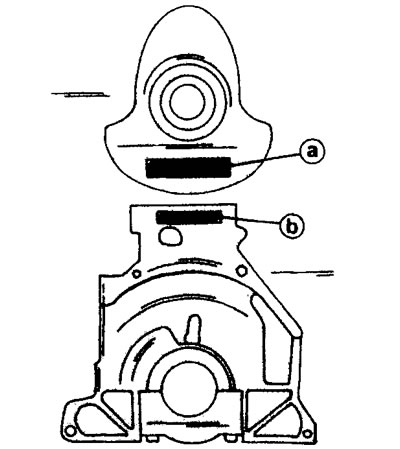
5.9 Marking of the crankshaft "a" and cylinder block "b" for engines with reduced clearance of main bearing shells
10. Lubricate the inserts inserted in the cylinder block sockets, making sure that they all have a lubrication groove (groove). Also lubricate the main bearing necks and connecting rod necks and place the crankshaft in the cylinder block. Turn the shaft several times to ensure the bearings are seated.
11. Install both thrust half rings to adjust the axial play of the crankshaft on the second bearing, counting from the rear side of the engine. The oil grooves must face the crank arm (see illustration).
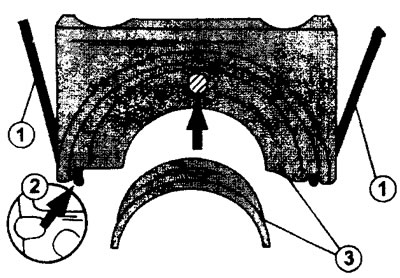
5.11 Installing the bearing cover.
1 - side sealing rings (gaskets)
2 - guide protrusions
3 - marks on the lid and inserts
12. Insert the liners without oil grooves into the main bearing caps. Insert both remaining half rings into the second bearing cover to adjust the axial play of the crankshaft. Fix the guide tabs into the grooves.
13. Install the lids with the inserts (and adjusting half rings in the cover of the second bearing) back into place in the same order, according to the marks made during removal. There are mounting protrusions on the ends of the covers that should fit into the recesses (see illustration 5.11). Install and tighten cover bolts 1, 2, 3 and 4.
The bearing cover near the flywheel has side sealing rings (see illustration 5.11). A special tool is required to install this cover together with the sealing rings and rubber gaskets.
14. Apply sealing compound to the surfaces of the crankcase to which the bearing cap will be attached (see illustration).
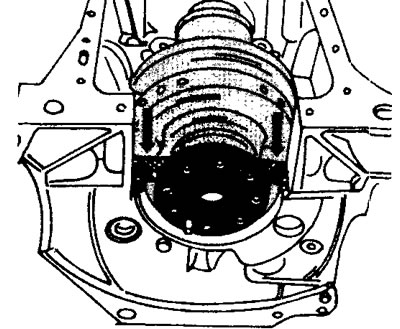
5.14 Apply sealing compound to the surfaces of the crankcase to which the bearing cap will be attached (see arrows)
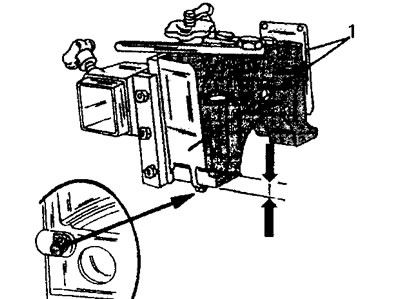
15. Secure the bearing cap in the guides of the special device so that the side seals fit into the grooves. The lower ends of the rings should protrude from the lid by at least 1 mm (see illustration).
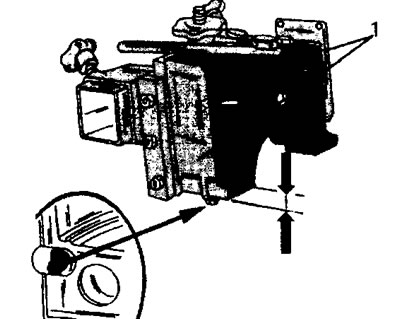
5.15 Secure the bearing cover in the guides 1 of the special device so that the side seals fit into the grooves. The lower ends of the rings should protrude from the lid by at least 1 mm (see arrows)
Tighten the guide bolts of the device by hand.
16. Install the rubber gaskets on the bearing cover. These shims are precisely sized and do not need to be adjusted to fit the cover's thrust surface.
17. Use your hands to squeeze the guides of the special tool and insert the entire structure into the cylinder block at a slight angle until the cover is fully seated in place.
18. Insert the bearing cap mounting bolts into the holes and tighten them by hand.
19. Remove the special tool for installing the rear bearing cover.
20. Tighten the bolts securing all covers, observing the sequence and working from the middle outwards. The tightening torque of the bolts is 70 Nm (see illustration).
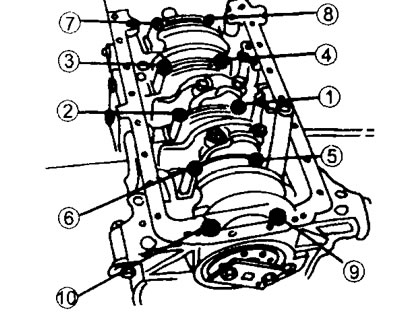
5.20 Tighten the bolts securing all covers, observing the sequence and working from the middle to the outside
21. Screw two bolts into the crankshaft flange (flywheel mounting bolts) and secure a screwdriver between them. Turn the crankshaft with a screwdriver to make sure that the crankshaft turns freely and does not jam anywhere. If the crankshaft is jammed, find out the cause and fix it.
22. Lubricate the outside of the new bore seal on the back of the cylinder block with engine oil and press it into the bore using a round metal mandrel (see illustration).
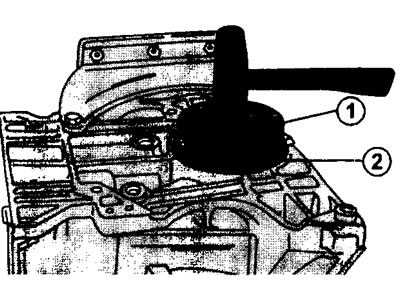
5.22 Press the new oil seal 2 into the hole on the rear side of the cylinder block using a round metal mandrel 1
23. Lay out the assembled pistons and connecting rods in the order of installation. Orient the piston ring locks evenly on the piston surfaces.
24. Install the mounting sleeve onto the piston to install the piston with piston rings into the cylinder and insert it into the cylinder bore, which is well lubricated with engine oil, following the marks made before removal. The piston bushing should be positioned so that the bottom of the piston protrudes from underneath it. This will allow the piston to be inserted into the cylinder bore. Once the piston is inserted into the hole, push it in and remove the mandrel (see illustration).
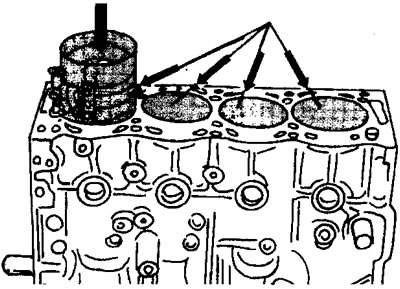
5.24 Install the mounting sleeve onto the piston to install the piston with piston rings into the cylinder and insert it into the cylinder bore. The bushing on the piston should sit so that the bottom of the piston comes out from under it.
Guide the connecting rod so that it "sits" on the crank pin. If you install the old liners, do not mix them up. After installing the piston, make sure that the combustion chamber in the piston is facing the correct direction. This means that the arrow on the piston pin should point towards the side where the timing belt is located. Install the piston of the fourth cylinder in the same way.
25. Insert the bearing shells into the bearing caps of both installed connecting rods, following the marks applied. Lubricate the bearing surfaces thoroughly with engine oil. If the old liners are installed, they should be placed on the same bearings with which they were installed before removal. Always replace the connecting rod bearing cap bolt nuts with new ones. Pre-tighten the cover nuts to 20 Nm and then tighten them an additional 70° using a protractor.
26. Turn the crankshaft so that the journals of the still installed pistons are in the lower position. Install the two remaining connecting rods and pistons onto these journals, proceeding in the same way as when installing the first and fourth pistons. After installing these pistons, make sure once again that the crankshaft is not jammed anywhere and that it rotates freely.
Crankshaft axial play - checking
27. Install a pointer-type indicator on the end face of the cylinder block, securing it with an appropriate holder. The indicator pin should rest against the flange of the crankshaft (see illustration).
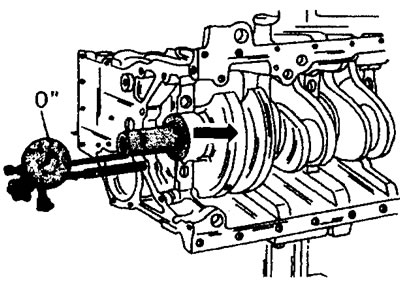
5.27 Install a pointer-type indicator on the end face of the cylinder block, securing it with an appropriate holder, to check the axial runout of the crankshaft
If you have a magnetic indicator, attach the indicator to the shaft so that the indicator pin touches the ground surface of the shaft.
28. Press the crankshaft along its axis in the opposite direction and set the indicator arrow to "0".
29. Press on the crankshaft from the opposite side and read the instrument reading. The reading should be between 0.07 and 0.27 mm. If the axial play reading is greater, two larger half rings of equal thickness must be installed. In addition to the 2.30 mm nominal thickness half-elbow, thrust half-rings with thicknesses of 2.35, 2.40, 2.45, and 2.50 mm are available. Half-rings of the same thickness must be installed.
30. Install the flywheel on the crankshaft. At the same time, rotate the flywheel on the shaft until the holes in the flywheel and flange align. The flywheel mounting bolts must be replaced with new ones. Lubricate the bolt threads with protective paste. When tightening the bolts, hold the flywheel from turning using a suitable stop. All bolts are tightened evenly to a torque of 50 Nm.
31. Secure the driven disk and clutch pressure plate to the flywheel. The longer part of the driven disk hub should face away from the flywheel. Attach the pressure plate only after the marks on the driven and pressure plates match. To install the clutch, a clutch centering rod is required (see section "Clutch").
32. While holding the flywheel from turning, tighten the pressure plate mounting bolts to a torque of 20 Nm in a crosswise pattern. When doing this, make sure that the centering rod does not fall out of the hole.
33. Check the flywheel runout after installing it on the crankshaft. The flywheel runout is measured using a pointer-type indicator, which is installed so that the measuring pin touches the flywheel surface (see illustration).
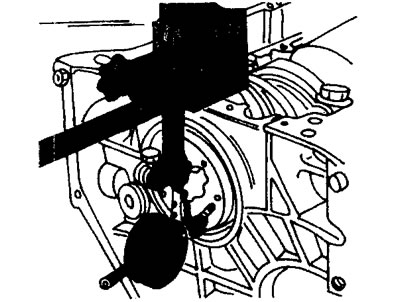
5.33 Check the flywheel runout after installation. The indicator measuring pin must touch the flywheel surface
34. Rotate the crankshaft and simultaneously watch the indicator arrow. During a full crankshaft revolution, the needle's deflection should not exceed 0.06 mm. Larger values indicate the presence of foreign bodies between the flywheel and the crankshaft. If the timing belt tension roller support pin was removed, lubricate the threads of the support pin and screw the pin into the hole on the cylinder head with a torque of 16 Nm.
35. Install the belt tension roller. On engines with two camshafts, install the second belt tensioner roller in the same way.
36. Attach the oil pump to the opposite side of the cylinder block. The drive chain and sprocket must be installed as shown in Illustration 4.23. Be sure to install a gasket between the pump and the cylinder block. Tighten the three pump mounting bolts to 16 Nm. The oil pump mounting bolts vary in length. The longest bolt (80 mm) is screwed into the hole on the right side, and the shortest (65 mm) into the hole on the left side. The length of the remaining third bolt is 70 mm (see illustration).
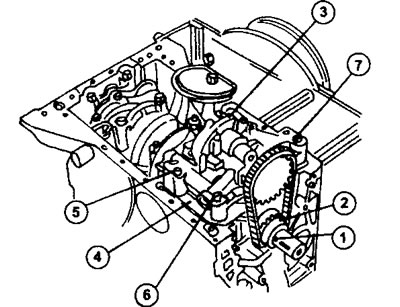
5.36 Installing the oil pump
1 - key
2 - oil pump drive chain
3 - oil pump
4 - gasket
5 - oil pump mounting bolt
6 - oil pump mounting bolt
7 - oil pump mounting bolt
37. Reinstall the front cylinder block cover. Before installation, apply sealing compound to the mating surface of the cover. The cover is secured with four bolts, including two 40 mm long ones at the top and two 20 mm long ones at the bottom. The tightening torque for all bolts is 15 Nm (see illustration).
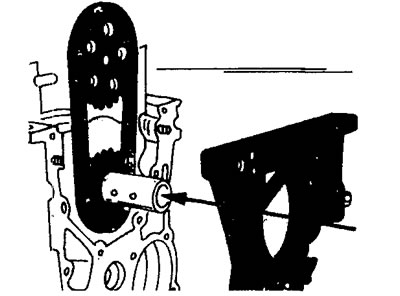
5.37 Install the front cylinder block cover. Before installation, apply sealing compound to the mating surface of the cover
38. Install a new oil seal into the cover and onto the crankshaft. Lubricate the outer part and the working edge of the oil seal with engine oil and hammer it into place using a mandrel or a pipe of the appropriate diameter.
39. Install the oil pump drive chain protective cover. Tighten the casing mounting bolts to a torque of 10 Nm (see illustration).
5.39 Install the oil pump drive chain guard
1 - gasket
2 - oil pan mounting bolts
3 - protective cover of the oil pump drive chain
40. Install the oil pan. There are two types of oil pans available. If the vehicle is equipped with air conditioning, apply sealing compound to the mating surfaces, install the oil pan and tighten the mounting bolts. Remember that the pan mounting bolts are of different lengths (see illustration).
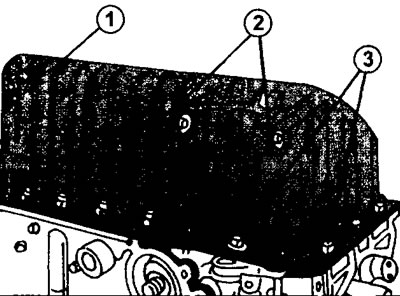
5.40 Installation and fastening of the oil pan on vehicles with air conditioning
1 - 19 tray mounting bolts, 22 mm long
2 - 2 tray mounting bolts, 40 mm long
3 - 2 tray mounting bolts, 20 mm long
Tighten all bolts to 16 Nm.
If the car does not have air conditioning, then a regular oil pan is installed. Before installing it, lay a new gasket. It is also possible to install the tray without a sealing gasket. In this case, a sealing compound is applied to the mating surfaces. In this case, the oil pan is secured with 23 bolts, tightened to a torque of 16 Nm. And in this case, the oil pan mounting bolts are of varying lengths. The bolts installed in the center of the end and side faces are 16 mm long. All other bolts are 20 mm long.
41. Place a new gasket on the cylinder block and secure the coolant pipe by tightening both its mounting bolts to a torque of 18 Nm.
42. Install a new water pump gasket, secure the water pump with five bolts and tighten them to 15 Nm.
43. Screw the threaded plug into the hole opposite the water pump and tighten it to a torque of 48 Nm. This threaded plug must be replaced every time it is unscrewed.
44. Install the engine mount bracket. The bracket is secured with five bolts, tightened to a torque of 60 Nm. Lubricate the bolt threads with Frenbloc protective paste.
45. Attach the engine oil pressure sensor to the opposite end of the cylinder block with a tightening torque of 25 Nm, or screw the threaded plug into this hole with a torque of 32 Nm. The plug, which is placed over the sensor/plug, is tightened with a torque of 25 Nm.
46. Lubricate the O-ring of the new oil filter with engine oil and secure the oil filter to the engine, tightening the bolts securely. After this, tighten the oil filter manually by 3/4 of a turn.
47. Install the cylinder head in place, following the procedure given for XU 10 engines with 8 or 16 valves (see the relevant chapter).
48. Adjust the valve clearance on an 8-valve engine (see the relevant chapter). To adjust the clearance, it is necessary to install the camshaft drive gear on the camshaft. After adjusting the valve clearance, the gear will need to be removed.
49. Press the new oil seal into the camshaft hole on the cylinder head, after lubricating its outer side and working surface with engine oil.
50. Install the drive gear onto the camshaft after pressing in the oil seal and secure it with a bolt and gasket. Tighten the mounting bolt to a torque of 35 Nm. While tightening the bolt, hold the gear from turning using a suitable device (see illustration).
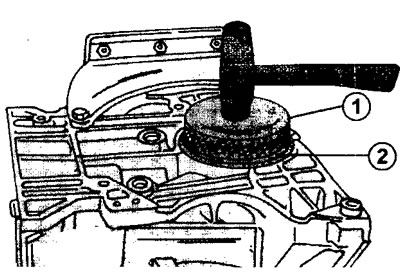
5.50 Hold the camshaft gear from turning using a suitable device
1 - camshaft gear
2 - gear mounting bolt. Tightening torque 35 Nm
3 - stop for holding the gear from turning
51. Install the timing belt and tighten it (see the relevant chapter). Remember that you will need thrust pins to secure the crankshaft and camshaft gear. Certain skills are also required when using a timing belt tensioner.
52. Install the oil line in the cylinder head and install the cylinder head cover. Tighten the cylinder head cover mounting bolts to a torque of 10 Nm (see illustration 4.13).
53. Screw in the spark plugs. Spark plug tightening torque: 18 Nm.
54. Install new exhaust manifold gaskets and secure the exhaust manifold with 8 nuts, tightening them to a torque of 35 Nm in a crisscross pattern.
55. Lubricate the guide tube of the engine oil level indicator with Frenbloc protective paste and secure it in the corresponding hole on the cylinder block. Tighten the bolt at the upper end of the guide to a torque of 10 Nm. 61 Secure the intake manifold to the opposite side of the cylinder head, installing a new gasket. Tighten both manifold mounting nuts to 30 Nm and the four bolts to 22 Nm.
56. Replace the O-rings and gasket of the upper thermostat housing mounting bolt with new ones. Tighten all three coolant temperature sensors to 18 Nm, as well as both thermostat housing cover bolts (see illustration).
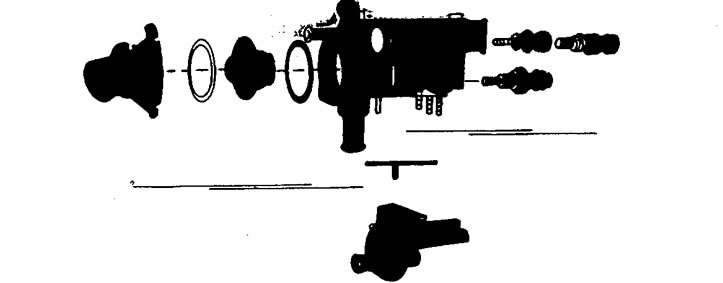
5.56 Thermostat housing parts
57. Install the assembled thermostat housing on the cylinder head above the end of the camshaft. Apply sealing compound to the mating surfaces of the thermostat housing and cylinder head. Tighten the thermostat housing mounting bolts to 13 Nm.
58. Perform all other work in the reverse order of disassembly.
XU7 engine
59. Measure the protrusion of the cylinder liners before starting to assemble the engine. At the base of the sleeves there are round gaskets that do not affect the size of the cylinder sleeve protrusion. Almost always the size of the sleeve protrusion corresponds to the norm, however such a check should be carried out as a means of control (see illustration).
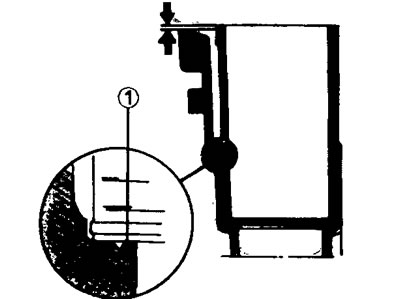
5.59 Round gasket 1 at the base of the cylinder liner
Checking the cylinder liner protrusion is performed as follows.
60. Install the cylinder liners without round gaskets into the cylinder block.
In this case, the marks on the sleeve and on the piston should be located on the same line, and the arrow on the bottom of the piston should point to the front side of the engine, on which the timing belt is installed (see illustration).
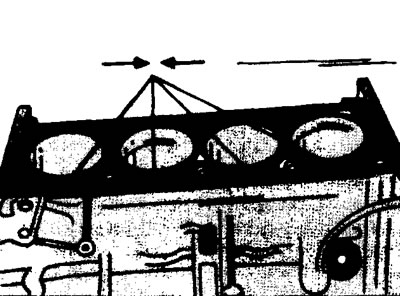
5.60 Install the cylinder liners without round gaskets into the cylinder block
61. Mount the dial indicator on the support with the holder and measure the protrusion size of each sleeve (see illustration).
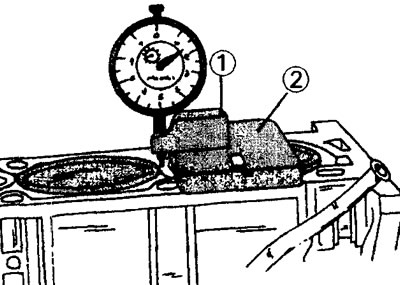
5.61 Install the dial indicator on support 1 with holder 2 and measure the protrusion size of each sleeve
You can use a suitable measuring ruler, placing it on the surface of the liner and measuring the distance between the ruler and the surface of the cylinder block using a template. First, measure the protrusion height of each sleeve individually. After this, determine the difference in the height of the protrusion of two adjacent sleeves. This difference should not exceed 0.05 mm. All liners should protrude above the cylinder block surface within 0.03 - 0.10 mm. Measure the protrusion of the liners on both sides of the liner.
If the sleeve protrusion size exceeds the nominal value, the cause may be a foreign object between the sleeve and the sleeve seat in the cylinder block. Remove the sleeve and inspect the hole. This is also possible when installing new sleeves. In this case, it is recommended to swap the sleeves.
62. Remove the sleeves and install the gaskets. When installing new sleeves, immediately apply the appropriate marks (see illustration 5.60).
Please note: When ordering new round cylinder liner base gaskets, please include the engine serial number.
After measuring the cylinder liner protrusion, the engine is assembled in the following order. When performing assembly, refer to Illustration 5.0, which shows the main parts of the crank mechanism.
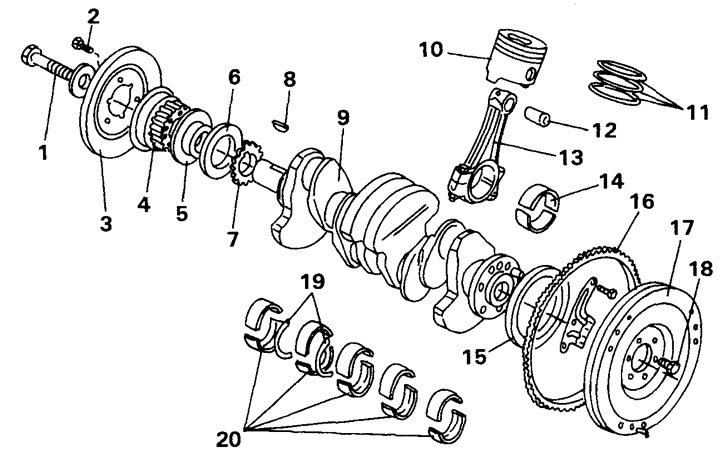
5.0 Crank mechanism
1 - crankshaft timing gear mounting bolt. Tightening torque 110 Nm
2 - crankshaft belt pulley mounting bolt
3 - belt pulley
4 - crankshaft timing gear
5 - spacer washer
6 - oil seal
7 - oil pump drive sprocket
8-segment key
9 - crankshaft
10 - piston
11 - set of piston rings
12 - piston pin
13- connecting rod
14 - connecting rod bearings
15 - oil seal hole on the back side of the cylinder block
16-tooth flywheel ring
17 - flywheel
18 - flywheel mounting bolt
19 - thrust half rings for adjusting axial play
20 - main bearing shells
63. Assemble the pistons with connecting rods (see the relevant chapter).
64. Install the connecting rod and piston assemblies into the cylinder liners (see the relevant chapter).
65. Insert the pistons and liners into the cylinder block and seat them securely. Secure all liners with holders to prevent the liners or pistons from slipping out of the cylinder block when turning it over.
66. Install the connecting rod bearing shells into the connecting rods in accordance with the marks applied if the same shells are being installed. The guide projections of the bearing shells must fit into the grooves of the connecting rods.
67. Install the main bearing shells with lubrication grooves. The guide tabs of the liners must fit into the grooves. Please note that some of the bearings have lubrication grooves, while the other part of the bearings do not. Therefore, when installing, be guided by the marks applied before removing the liners, so as not to mix them up.
68. Install the adjusting half rings on the second main bearing so that the sliding surface faces the crankshaft.
69. Lubricate the inserted main bearing shells with engine oil and place the crankshaft into the bearings. To lubricate the bearings, use an oil can, rubbing the oil over the surface of the bearings with your finger. Do not use a brush for this.
70. Insert new side seals into the rear main bearing cap and install the cap. The procedure in this case is the same as when installing the rear bearing cover on XU 10 engines (see above).
71. Install all remaining bearing caps together with the inserted liners. There should be an adjusting half ring in the cover of the second main bearing. The bearing caps are numbered and the flange on the cap should face the side where the timing belt is located.
72. Tighten the main bearing cap bolts in order to the appropriate tightening torque.
73. Adjust the axial runout of the crankshaft. The adjustment procedure is the same as for the XU10 engine (see above).
74. Check the protrusion of both side seals on the rear main bearing cap relative to the cylinder block surface. The nominal protrusion size is 1.0 mm. The ends of the seals are not trimmed. If the length of the seal protrusion is greater than specified, then the protruding ends do not need to be trimmed. This means that the seals were not installed correctly.
75. Install the connecting rod caps together with the inserted liners. Use the marks made during removal to avoid mixing up the covers if you are installing the old ones.
76. Screw the nuts onto the connecting rod cap bolts and tighten them. Tighten the connecting rods that are at bottom dead center. After this, turn the crankshaft so that the two remaining connecting rods are at bottom dead center, and tighten the bolts securing their caps.
77. Install the oil pump drive sprocket together with the chain onto the crankshaft, having first inserted the segment key into the hole.
78. Install the side cover (bearing shield) on the cylinder block from the toothed belt side. Apply Loctite to the mating surfaces before installation. The top two cover mounting bolts are shorter than the others. Tighten the cover bolts to 16 Nm (see illustration).
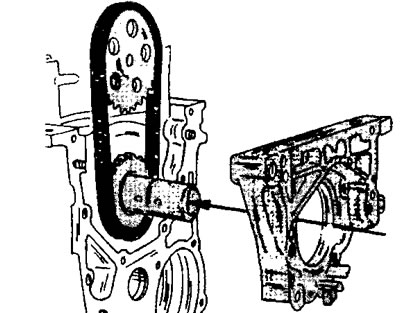
5.78 Install the bearing shield on the cylinder block
79. Drive the seal into the bearing shield hole. The outer side of the seal should be flush with the surface of the shield.
80. Place the oil pump drive chain on the pump sprocket and install gaskets between the oil pump and the cylinder block on the oil filter side (see illustration).
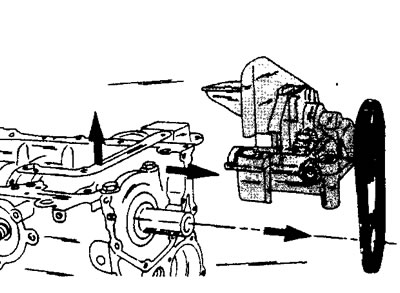
5.80 Place the oil pump drive chain on the pump sprocket and install the oil pump
Tighten the pump mounting bolts. The tightening torque for the bolts on the left side is 19 Nm, and both bolts on the right side are tightened to 13 Nm.
81. Install a new oil pan gasket and secure the oil pan.
82. Install the flywheel. Replace the flywheel mounting bolts with new ones and lubricate their threads with Loctite. Use a stop to prevent the flywheel from turning and tighten the flywheel mounting bolts to 50 Nm.
83. Install the clutch driven and pressure plates, centering the driven plate on the flywheel using the appropriate rod. Tighten the clutch mounting bolts evenly to a torque of 22 Nm.
84. Install the water pump, replacing its old gasket with a new one and secure it with five bolts with a tightening torque of 15 Nm (see illustration).
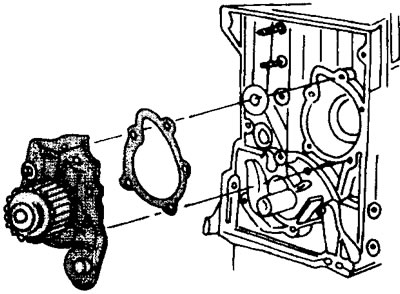
5.84 Install the water pump and secure it with five bolts
85. Install the timing belt tension roller.
86. Check the fit of both adjusting inserts in the upper part of the cylinder block.
87. Place a dry cylinder head gasket on the cylinder block. In this case, the marking applied to the left side at the rear of the gasket must face up.
88. Install the cylinder head and tighten its mounting bolts to the specified tightening torques (see the relevant chapter).
89. Adjust the valve clearance (see the relevant chapter).
90. Screw the thermal switch into the thermostat housing and tighten it to a torque of 18 Nm.
91. Install the thermostat into the housing, replacing the two old gaskets with new ones. At the same time, screw the coolant outlet pipe into the thermostat housing.
92. Secure the thermostat housing assembly to the cylinder head, replacing the old sealing gasket with a new one.
93. Remove the timing belt gear from the camshaft, which was installed to adjust the valve clearance, and fit the camshaft oil seal using a suitable mandrel. After this, put the appropriate cover back in place.
94. Install the timing belt sprocket onto the camshaft, holding the camshaft from turning.
95. Set the crankshaft and camshaft in the required position relative to each other, using the reference marks, and put on the timing belt.
96. Install the V-belt pulley on the crankshaft. When tightening the pulley mounting bolt, hold the flywheel to prevent the crankshaft from turning.
97. Perform all actions related to fastening wires, hoses and pipelines. They are installed in the reverse order of removal.