



2. Turn the cylinder block over and install the upper main bearing shells. Install the thrust washer segments onto bearing No. 2 with the grooved side facing outward (see photo) and fix them in place with grease. Please note that the recommended location of grooved (G) and regular (P) bearing shells varies depending on the model:
Early models (up to N 9 207 534)
| Bearing N | 1 | 2 | 3 | 4 | 5 |
| Upper liner | R | G | R | G | R |
| Lower liner | R | R | R | R | R |
Latest models (from N 9 207 535)
| Bearing N | 1 | 2 | 3 | 4 | 5 |
| Upper liner | G | R | R | R | G |
| Lower liner | G | R | R | G | G |
3. Lubricate the bearing shells with oil and lower the crankshaft into place, being careful not to displace the thrust washer segments (see photo). Inject some oil into the crankshaft oil passages.
4. Install the side seals on the main bearing cap No. 1. Carefully install the cap together with the bearing shell and lubricate the shell, the side surfaces of the cap and the mounting surfaces in the cylinder block. There is a risk of the side seals becoming displaced or deformed during installation of the cover, so they should be protected with feeler gauges or tin strips that can be pulled out after installation of the cover (see photos).
5. Install the liners into the remaining main caps, lubricate them with oil and install the caps in place. Install the thrust washer segments on cover No. 2 with the grooved side facing outward. When assembling, make sure to observe the installation marks made during disassembly. The protrusion on the main caps should point towards the timing gear sprockets.
6. Install the main cap nuts and bolts and tighten them to the specified torque. Lastly, tighten the side bolts on the bearing cover No. 3 (see photo).
7. Check the amount of protrusion of the side seals of cover No. 1 above the contact surface of the pallet. The seals should protrude by 2 mm (they can be trimmed if necessary).
8. Check the axial movement of the crankshaft (see Chapter 1A, Section 33, Paragraph 8).
9. Lubricate the lips of the new oil seal and install it with the lips facing inward onto the end of the crankshaft on the flywheel side. Hammer the seal into place using a tube (see photo).
10. Install the woodruff key and oil pump drive sprocket onto the crankshaft nose. Put the chain on the sprocket (see photos).
11. Check that the locating pin is in place, engage the chain with the sprocket and move the pump to its installation location on the cylinder block. Place the pump on the mounting pin and then lift it up so that you can insert a spacer piece, which looks like an angle, underneath it (see photos).
12. Insert the oil pump mounting bolts, remembering that the special centering bolt is closest to the flywheel, and tighten them to the specified torque. Lubricate the pump and chain well (see photo).
13. Install the pulley seal housing onto the contact surface of the cylinder block using silicone sealant. Install the new seal with lubricated jaws inside and hammer it into place using a tube.
14. Install the pan with a new gasket and gradually tighten its mounting bolts to the required torque. Be sure to install the three Allen head bolts correctly.
15. Install the suction drain tube with a new O-ring. Be careful not to overtighten the fastening nuts - the maximum permissible tightening torque is 0.5 kg m.
16. Install the flywheel on the crankshaft flange and secure it with new bolts, lubricating their threads with a compound for locking threaded connections. Gradually tighten the bolts to the required torque.
17. Install the driven disc and clutch basket.
20. Install the assembled cylinder head so that it rests on the pins.
21. Insert the head bolts, having first cleaned and lubricated their threads with oil. Don't forget to install the spacer sleeve under the water pump.
22. Gradually tighten the bolts in the sequence specified for step 1.
23. Loosen bolt No. 1 and then tighten it to the torque specified in step 2. Additionally tighten it to the angle specified in step 3. Repeat this operation for the remaining bolts in the correct sequence.
24. Install the camshaft sprocket support shield, insert a 10mm diameter rod into the mounting hole to lock the shield, and tighten the shield mounting bolts.
25. Install the camshaft sprocket, washer and bolt. Insert a 10mm diameter rod into the mounting hole to lock the sprocket in the correct position and tighten the bolt to the required torque. Pull out the rod.
Original can be viewed at PeugeotBook.ru
26. Install the engine support bracket and tighten its bolts (see photo).
27. Install and secure the water pump with a new gasket. Tighten the pump bolts to the specified torque.
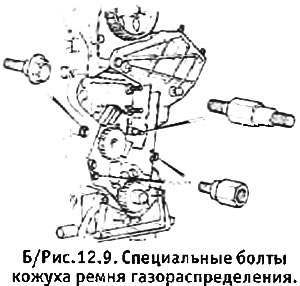
28. Install the timing case parts around the water pump, paying attention to the position of the various special bolts (see Figure 12.9).
29. Install the woodruff key and crankshaft sprocket.
30. Install the camshaft drive belt tensioner without tightening its nuts yet.
31. Temporarily install the crankshaft pulley, its washer and bolt and lightly tighten the bolt. Carefully turn the crankshaft so that a 10 mm diameter rod can pass through the installation hole in the pulley and then into a special recess. If the piston contacts the valve, immediately turn the crankshaft back and try inserting the rod again with the camshaft in a slightly different position. Do not attempt to force the crankshaft to turn if the piston is in contact with the valve.
32. Block the camshaft sprocket with a 10 mm diameter rod, remove the crankshaft pulley and install the camshaft drive belt. Be careful not to twist the belt and pay attention to the arrows indicating the correct direction of rotation. The two white stripes on the belt should align with the timing marks on the sprocket.
33. Pull out the rod and tighten the belt by turning the tensioner cam so that it points downwards. Secure the cam in this position with a lock nut. Tighten the 2 nuts at the front of the tensioner.
48. Turn the crankshaft 2 full turns in the normal direction of its rotation and then turn it further so that pistons No. 1 and 4 are in the TDC position and the valves of cylinder No. 1 are open.
34. Loosen the two nuts and the cam lock nut on the drive belt tensioner and then tighten them again.
35. Temporarily install the crankshaft pulley, turn the crankshaft and check that the rods can be inserted into the mounting holes of the crankshaft pulley and the camshaft sprocket at the same time. If this is not the case, remove the belt and try to install it again. Remove the pulley.
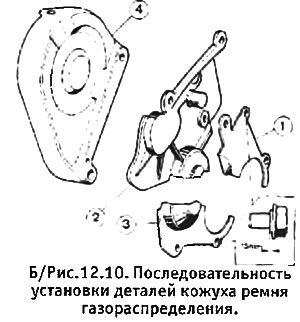
36. Install the drive belt cover in the sequence shown in the figure 12.10. (Please note that the cover will need to be removed to tension the drive belt if you have installed a new belt).
37. Install the crankshaft pulley, washer and bolt, making sure the woodruff key is still in place. Lock the starter ring gear and tighten the bolt to the required torque.
38. Install the valve cover with a new gasket, paying attention to the copper washer of the bolt on the camshaft sprocket side.
39. Install the following accessories (installation of the generator and distributor can be postponed until the engine is installed on the car):
- a. Oil filler tube/crankcase ventilation tube (see photo)
- b. Oil pressure relay
- c. Inlet pipe and inlet housing of the cooling system (see photo)
- spark plugs, distributor and high-voltage wires
- d. Generator with drive belt.
40. Install the new oil filter, thoroughly lubricate its sealing ring, and tighten the filter by hand.