English Русский
Български
Беларускі
Український
Српски
Hrvatski
Română
Polski
Slovenský
Magyar
Bookmark Articles Sitemap Contacts
Company Hyundai Company Opel Company Skoda Company Kia Company Mitsubishi Company LADA Company Audi
PeugeotBook.ru


Series 100   Series 200   Series 300   400-500   Series 600   Crossovers   Others
 
Peugeot 305 (1977-1989) Peugeot 306 (1993-2002) Peugeot 307 (2001-2008)

Pistons, connecting rods and cylinder liners — installation (Peugeot 305)

  • Main
  • 30X
  • Peugeot 305 (1977-1989)
  • Power unit
  • Gasoline engines
  • Pistons, connecting rods and cylinder liners — installation
0
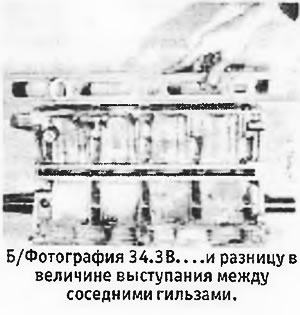
1. First of all, you need to install the liners in the cylinder block and check that they are in place and not warped, and also check the amount of protrusion of the liners above the cylinder block and the difference in the amount of protrusion between adjacent liners.

2. Turn the cylinder block over to its normal position and check that the liner seats are absolutely clean. Even the slightest trace of dirt in the sockets can eventually cause the cylinder head gasket to leak. If you have not replaced the sleeves, they should be installed in their original locations, observing the marks made during disassembly. Check that the sleeves are clean and that their lower surfaces are free of dirt, traces of old sealant, etc.

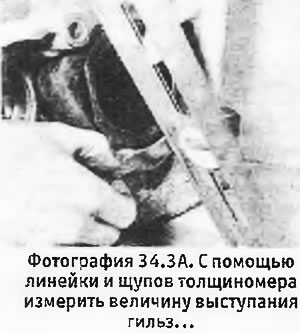
3. Insert the sleeves into the block (without pads yet) and using a dial gauge, measure the amount of their protrusion above the upper surface of the cylinder block. For each sleeve, measurements are taken at four points, spaced 90° apart. If a dial gauge is not available, a ruler and feeler gauge probes can be used (see photo).
3. Insert the sleeves into the block (without pads yet) and using a dial gauge, measure the amount…

4. All 4 numbers obtained for each sleeve must be the same: if they differ from each other by more than 0.02 mm, then the sleeve is at an angle.


5. Select a gasket of the required thickness for each sleeve, which would ensure the correct protrusion of the sleeve above the block. In this case, the difference in the amount of protrusion between adjacent sleeves should also not go beyond the specified limits. It is permitted to use no more than one gasket for each sleeve. If you have any problems, check to see if there is any dirt between the sleeve and the block and how accurately you measured. New sleeves can be swapped around in the block. If you still cannot get the desired result, the cartridges may be deformed and should be taken to a specialist for inspection.

6. After selecting gaskets for all the liners, install the liners with gaskets in the cylinder block and again check the amount of protrusion and the absence of distortions (see section 8).

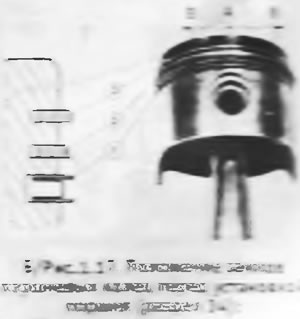
7. If you have not replaced the pistons, they should be installed in the original liners, using the marks made during disassembly. Before installing the piston into the sleeve, the piston ring locks must be correctly positioned. The lock of the lower oil scraper ring expander should be located immediately above the axis of the piston pin, and the locks of the thin rings that are part of the oil scraper ring should be offset by 20-50 mm in different directions from the lock of the expander (see B/Figure 1.17). The locks of the middle and upper compression rings must be offset by 120° in opposite directions from the lock of the expander.
7. If you have not replaced the pistons, they should be installed in the original liners, using the…


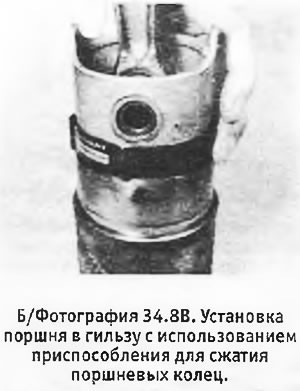
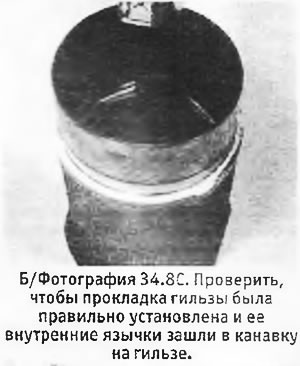
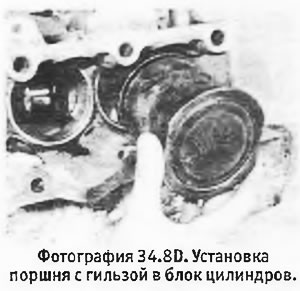
8. Clean the bearing seats in the lower connecting rod heads thoroughly and install the lower connecting rod bearing shells into them (see photo). Lubricate the inside of the cylinder liners with clean engine oil and, using a suitable piston ring compressor, insert the first piston with the connecting rod into its cylinder liners (see photo). Check that the sleeve gasket is properly seated and insert the sleeve into the block while guiding the connecting rod toward the crankpin (see photos). Check that the sleeve is correctly inserted into the block and the piston is correctly inserted into the sleeve. Old parts should have marks made on them during disassembly, and these marks should be aligned. If you are installing new sleeves, you should mark them according to their position.


Material copied from the resource [peugeotbook]
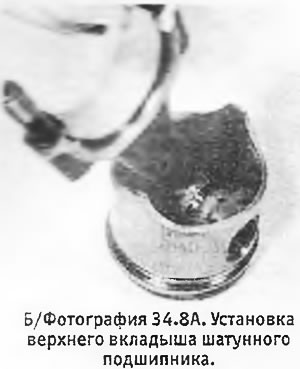
8. Clean the bearing seats in the lower connecting rod heads thoroughly and install the lower…

8. Clean the bearing seats in the lower connecting rod heads thoroughly and install the lower…

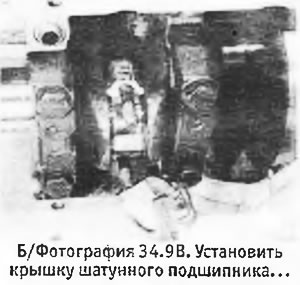
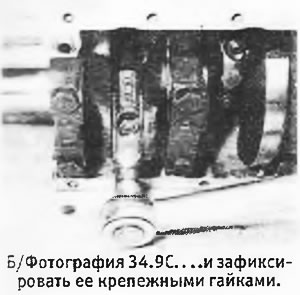
9. After installing all the sleeves with the connecting rod and piston groups, fix the sleeves with special metal strips so that they do not move during the installation of the connecting rod caps (see photo). Wipe and dry the covers thoroughly and install the lower connecting rod bearing shells into them. Lay out the caps in order and install them on the connecting rods, after thoroughly lubricating the connecting rod journals and bearing shells with clean engine oil (see photo). Check that the locating tabs on the bearing shells are mated on the same side. Install the connecting rod cap retaining nuts and tighten them to the specified torque (see photo).
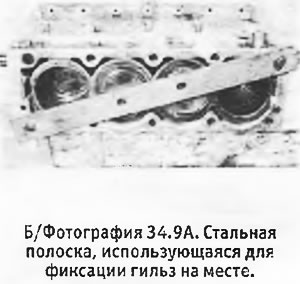


9. After installing all the sleeves with the connecting rod and piston groups, fix the sleeves with…


9. After installing all the sleeves with the connecting rod and piston groups, fix the sleeves with…


10. Check the crankshaft for free rotation.
This article is available at russian, bulgarian, belarusian, ukrainian, serbian, croatian, romanian, polish, slovak, hungarian
Article reviewed by editor: Ostrovsky Fedor
Share information:
Previous
Peugeot 305: Gasoline engines
Next

Crankshaft — installation
Installing an XU engine with a gearbox on a car
Connecting the XU engine to the gearbox
Assembly of the XU series engine
Inspection and tidying up of XU engine parts (general part)
Cylinder head — installation on an engine removed from a car
Engine and gearbox — connection to each other
Timing chain and sprocket assembly
Timing mechanism housing — assembly and installation
Valve clearances — checking and adjustment
See similar information for other Peugeot models

➨ Cylinder head cover — removal and refitting Peugeot 106 (1991-2003)
➨ Cylinder head (petrol engines 1.4 and 1.6 l, EPZ, TU5) Peugeot 207 (2006-2014)
➨ Removal pistons with connecting rods Peugeot 406 (1995-2004)
➨ Cylinder head — removal Peugeot 605 (1989-2000)
➨ Pistons and connecting rods — disassembly, inspection and… Peugeot 806 (1994-2002)
Link to this article in different formats
Comments and feedback from visitors
No comments yet


Add two numbers 31 + 19


Peugeot 307 (2001-2008) 
  • User manual
  • Keys, doors and alarm
  • Controls and instruments
  • Driving and operation
  • Maintenance
  • Power unit
  • Petrol engines TU3 and TU5
  • Petrol engines EW10
  • Diesel engines DV10
  • Diesel engines DW10
  • Transmission
  • Clutch and drive shafts
  • Mechanical gearbox
  • Automatic gearbox
  • Chassis, running gear
  • Front suspension
  • Rear suspension
  • Steering
  • Brake system
  • Body and interior
  • Exterior (external elements)
  • Interior (internal elements)
  • Doors, locks and windows
  • Heating and air conditioning
  • Electrical equipment
  • Equipment and devices
  • Power devices
  • Airbags
  • Electrical circuits
Peugeot 306 (1993-2002) 
  • General information
  • Introduction to manual
  • Specifications
  • Gasoline engine
  • Engine repair
  • Lubrication system
  • Cooling system
  • Fuel injection
  • Ignition system
  • Diesel engine
  • Engine repair
  • Lubrication system
  • Cooling system
  • Fuel injection
  • Transmission
  • Clutch
  • Gearbox
  • Drive shafts
  • Chassis, running gear
  • Steering system
  • Front suspension
  • Rear suspension
  • Brake system
  • Electrical equipment
  • Power devices
  • Electrical circuits
Peugeot 305 (1977-1989) 
  • General information
  • Maintenance
  • Power unit
  • Gasoline engines
  • Diesel engines
  • Cooling system (gasoline)
  • Cooling system (diesel)
  • Fuel system (gasoline)
  • Fuel system (diesel)
  • Ignition system
  • Transmission
  • Clutch
  • Mechanical gearbox BB8
  • Mechanical gearbox BE1
  • Automatic gearbox ZF4
  • Shafts, hubs and wheels
  • Chassis, running gear
  • Brake system
  • Car suspension
  • Steering
  • Body and interior
  • Exterior (external elements)
  • Interior (internal elements)
  • Electrical equipment
  • Equipment and devices
  • Headlights and lighting
  • Power devices
  • Electrical circuits
  • Wiring diagrams (diesel)
PeugeotBook.ru © 2018–2026 | Mobile version | Sitemap: EN BG BY UA RS HR RO PL SK HU | Write message | Site search | Add to bookmarks | Peugeot owners
106 (1991-2003) | 206 (1998-2012) | 207 (2006-2014) | 305 (1977-1989) | 306 (1993-2002) | 307 (2001-2008) | 405 (1987-1997) | 406 (1995-2004) | 605 (1989-2000) | Partner-I (1996-2008) | Eurovans-807 (2002-2014) | Eurovans-806 (1994-2002) | J5 (1981-1993) |
Cookies are used to ensure the correct display of pages on the site.