



2. Before lowering the engine, check that all hoses, wires, etc. are tucked away. Apply a few drops of thread locking compound to the hole in the gearbox cover where the vertical bolt on the gear selector lever should fit. Unscrew the stud with the lock nut on the front speedometer cable so that the tip can be inserted.
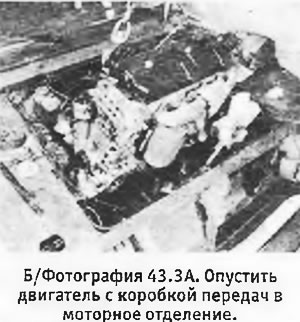
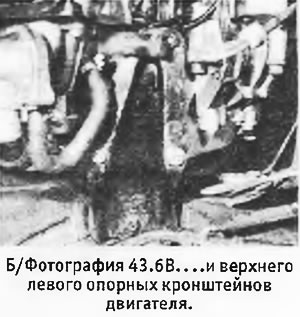
3. Carefully lower the engine and gearbox while simultaneously moving it to one edge of the engine compartment. Once the box is low enough, insert the first drive shaft, being careful not to damage the seal. Move the engine to the side of the connected drive shaft and turn it outward to create more room to work. Insert the second drive shaft, rocking the machine slightly if necessary to make this easier. In this case, be careful not to damage the main gear oil seal (see photos).
 |
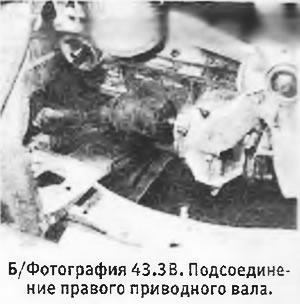 |
4. After installing both shafts, insert the speedometer cable end into the speedometer drive adapter. Install the lock screw and lock nut and tighten them both in that sequence.
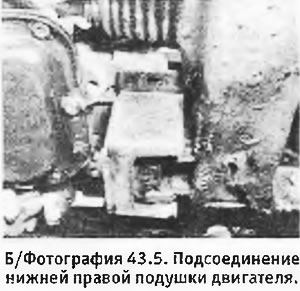
5. Move the engine with the gearbox and slowly lower them so that the rear edge of the gearbox housing is positioned under the steering gear box. Install the lower right powertrain mount (see photo).
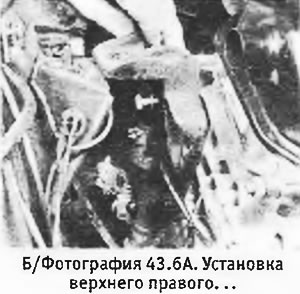
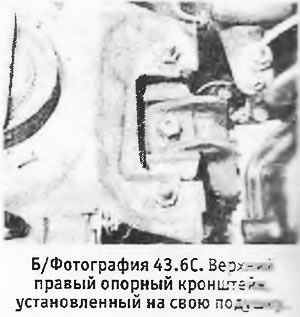
6. If not already done, install the 2 upper engine support brackets onto the engine and lower it into its final position. Install and tighten all upper mount nuts and bolts to the specified torque. Install and tighten the lower cushion bolts to the specified torque. Disconnect the hoists from the engine.
 |
 |
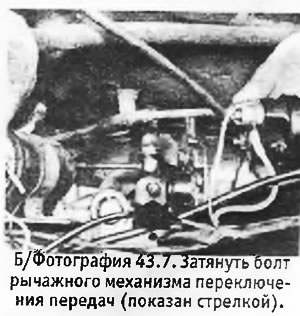
7. Clean the threads of the front gear shift rod bolt and lubricate the ball joint parts with the correct type of grease. Assemble the ball joints and install the bolt, tightening it to the required torque (see photo).
8. Install the starter if it has not already been done (see chapter 10). Connect the wires to the starter and tighten the mounting nuts.
9. Install and adjust the clutch cable (see chapter 5).
10. Connect the wires to the ignition coil and distributor.
11. Install the intake manifold and carburetor, checking that all 8 hose clamps are in good condition and securely fastened. Install the manifold support bracket by tightening the bolt to the engine/transmission mating surface to the specified torque. Connect the fuel supply line and the vacuum regulator tube to the carburetor, and the brake booster vacuum hose to the manifold.
12. Install the generator (see chapter 10) and tighten its drive belt. Install the voltage regulator in its place on the left fender.
13. Install the exhaust pipes (see chapter 3) and check that the gap between the rear subframe (behind the pallet) and the exhaust pipe was at least 35 mm.
14. Install the radiator (see chapter 2). If the radiator hoses are not in very good condition, it is better to replace them. Install the air deflectors in front of the radiator and then the front grille.
[Article republished from the website: www.peugeotbook.ru]
15. Connect the remaining water hoses and after a final check, fill the cooling system with liquid (see chapter 2).
16. Connect the wiring harness electrical connectors and the remaining unconnected single wires. Check that the distributor rotor is in place, install the distributor cap and connect the wires to the distributor. Install new spark plugs, after checking their spark gap, and connect the spark plug wires to them. Please note that on the engines in question, the spark plugs must be tightened to a certain torque (see chapter 4).
17. Connect the air and throttle cables (see chapter 3). The air filter should be installed after the engine has been run in for a test run.
18. Fill the engine with oil up to the upper mark on the dipstick.
19. Check again carefully whether everything is connected (pay special attention to ground wires, drive belt tension, and carburetor controls). Check for any obvious oil or coolant leaks, and for rags, tools, etc. left in the engine compartment.
20. Install the battery in place and secure it with the clamp plate. Connect the wires to the battery and check the operation of the electrical circuits.
21. If the suspension was disconnected to remove the engine/gearbox, reconnect it (see chapter 9).
22. The engine is ready for test running.