
English Русский
Български
Беларускі
Український
Српски
Hrvatski
Română
Polski
Slovenský
Magyar
Bookmark Articles Sitemap Contacts
Company Hyundai Company Opel Company Skoda Company Kia Company Mitsubishi Company LADA Company Audi
PeugeotBook.ru


Series 100   Series 200   Series 300   400-500   Series 600   Crossovers   Others
 
Partner I (1996-2008) Peugeot 807 (2002-2014) Peugeot 806 (1994-2002) Peugeot J5 (1981-1993)

High idle speed thermostat sensor (Peugeot Partner I)

  • Main
  • Пежо
  • Partner I (1996-2008)
  • Power unit
  • Power and exhaust (XUD diesels)
  • High idle speed thermostat sensor
0
Table of contents: Removal 🠇 Installation 🠇 Adjustment 🠇
Note: A new sealing washer must be used when installing the sensor.


Removal


1. The thermostatic sensor is located on the side of the thermostat housing/fuel filter.

2. For easier access on 1.9L models, remove the air distribution housing as described in paragraph 3. If necessary, also remove the air intake duct and disconnect the vent hose from the oil filler pipe. For more information, please refer to the relevant paragraphs in this chapter.

3. Drain the coolant from the cooling system as described in chapter 1B.

4. Loosen the clamp screw or nut (whichever is applicable) and disconnect the high idle speed cable end from the cable on the high idle speed lever of the high pressure fuel pump (figure 4.4, a, b).
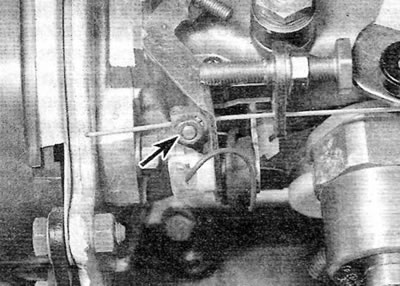
Figure 4.4, a. High idle speed cable end clamp nut (marked with an arrow) (lucas pump)
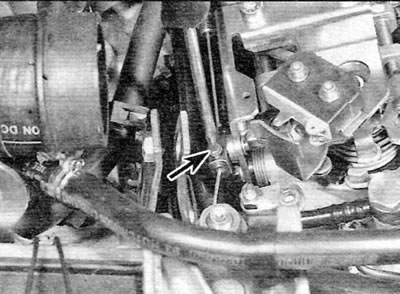
Figure 4.4, a. High idle speed cable end clamp nut (marked with an arrow) (lucas pump)


Figure 4.4, b. Loosening the high idle speed cable end clamp screw (marked with an arrow) (bosch…

Figure 4.4, b. Loosening the high idle speed cable end clamp screw (marked with an arrow) (bosch pump)


5. Remove the cable from the adjusting screw located in the bracket on the high pressure fuel pump (figure 4.5).
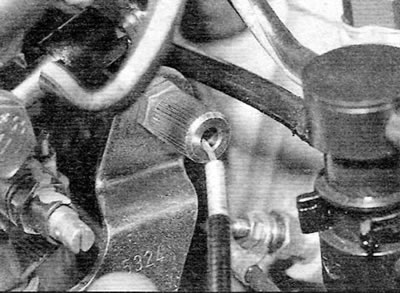
Figure 4.5. Removing the high idle speed cable from the adjusting screw (bosch pump)

Figure 4.5. Removing the high idle speed cable from the adjusting screw (bosch pump)


6. Using a suitable open-end wrench, unscrew the thermostatic sensor from the thermostat housing/fuel filter and remove the sensor together with the cable (figure 4.6). Remove the sealing washer if applicable.
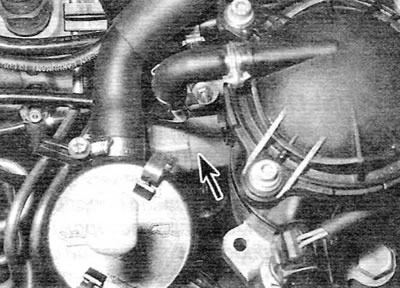
Figure 4.6. High idle speed thermostat sensor (marked with an arrow)

Figure 4.6. High idle speed thermostat sensor (marked with an arrow)


Installation


7. If sealant was used instead of a gasket for the original installation, carefully remove all traces of the "old" sealant from the sensor and housing. Make sure that no traces of sealant remain inside the coolant passages in the housing.


8. Install the sensor using suitable sealant or a new washer (whichever is applicable), and tighten it securely.

9. Insert the adjusting screw into the bracket on the high pressure fuel pump and tighten the lock nut by hand.

10. Pass the cable through the high idle speed lever and install the end cap onto the cable, but do not tighten the clamp screw or nut (whichever is applicable).

11. Adjust the cable as described in the following paragraphs.

Adjustment


12. With the engine cold, fully depress the high idle speed lever toward the flywheel end of the engine. Tighten the clamp screw or nut to hold the cable end in contact with the lever.

13. Adjust the screw so that the high idle speed lever touches the corresponding stop, and then tighten the lock nut.

(Original published on the portal: PEUGEOTBOOK.ru)

14. Measure the length of the open section of the cable.

15. Install the components removed to gain access to the sensor (see the relevant paragraphs of this chapter).

16. Fill the cooling system as described in chapter 1B, and allow the engine to run until it reaches normal operating temperature.

17. Check that the high idle speed cable has slack. If not, the sensor may be faulty.

18. With the engine warm, check the cable for approximately 0.5-1 mm of play on the Lucas pump and 5-6 mm of play on the Bosch pump. This indicates that the thermostatic sensor is working properly.

19. Make sure that the engine's crankshaft speed increases when the idling boost lever is pressed in the direction of the engine end where the flywheel is located. When the lever is moved all the way to the stop, the high idle speed should correspond to the specified value (for detailed information on adjusting the high idle speed, refer to paragraph 9).

20. Stop the engine.
This article is available at russian, bulgarian, belarusian, ukrainian, serbian, croatian, romanian, polish, slovak, hungarian
Article reviewed by editor: Nikonova Veronica
Share information:
Previous
Partner I: Power and exhaust (XUD diesels)
Next

Air filter and related components — removal and installation
Fuel system — filling and bleeding
General information and precautions
Fuel and exhaust system specifications
High-pressure fuel pump — removal and installation
Fuel injection advance — testing methods and adjustments
Fuel injection advance (Lucas high-pressure fuel pump) —…
Fuel injection advance (Bosch high-pressure fuel pump) —…
High pressure fuel pump — adjustment
See similar information for other Peugeot models

➨ Idle speed and mixture check and adjustment Peugeot 106 (1991-2003)
➨ Crankshaft speed and position sensor (TU5 petrol engine) Peugeot 207 (2006-2014)
➨ Fast idle speed cable — removal, installation and adjustment Peugeot 305 (1977-1989)
➨ Checking idle speed and mixture composition (CO) (20,000 km/12… Peugeot 405 (1987-1997)
➨ Thermostat — removal and installation Peugeot 605 (1989-2000)
Link to this article in different formats
Comments and feedback from visitors
No comments yet


Add two numbers 10 + 25


Partner I (1996-2008) 
  • General information
  • Introduction to the guide
  • Faults en route
  • Weekly checks
  • User manual
  • Maintenance (petrol)
  • Maintenance (diesel)
  • Power unit
  • Petrol engines
  • Diesel engines «XUD»
  • Diesel engines «DW»
  • Overhaul of petrol engines
  • Overhaul of diesel engines
  • Cooling and heating
  • Power and exhaust (petrol)
  • Power and exhaust (XUD diesels)
  • Power and exhaust (DW diesels)
  • Emission reduction
  • Starting and charging system
  • Transmission
  • Clutch
  • Mechanical gearbox
  • Drive shafts
  • Chassis, running gear
  • Brake system
  • Car suspension
  • Steering
  • Body and interior
  • Exterior (external elements)
  • Interior (internal elements)
  • Doors, locks and windows
  • Electrical equipment
  • Equipment and devices
  • Electrical circuits
Peugeot 807 (2002-2014) 
  • General information
  • Operating instructions
  • Maintenance
  • Troubleshooting
  • Power unit
  • Gasoline engines
  • Diesel engines
  • Cooling and heating
  • Fuel injection (petrol)
  • Fuel system (diesel)
  • Fuel system
  • Exhaust system
  • Ignition system
  • Transmission
  • Clutch
  • Manual gearbox
  • Automatic gearbox
  • Chassis, running gear
  • Brake system
  • Car suspension
  • Steering system
  • Body and interior
  • Exterior (external elements)
  • Interior (internal elements)
  • Electrical equipment
  • Power devices
  • Electrical circuits
Peugeot 806 (1994-2002) 
  • General information
  • User manual
  • Maintenance
  • Power unit
  • Petrol engines
  • Diesel engines
  • Lubrication system
  • Cooling system
  • Fuel injection (petrol)
  • Fuel system (diesel)
  • Ignition and exhaust systems
  • ECM Bosch Motronic MP 3.2
  • ECM Magneti-Marelli (MM)
  • Transmission
  • Clutch
  • Mechanical gearbox
  • Chassis, running gear
  • Brake system
  • Car suspension
  • Steering
  • Electrical equipment
  • Equipment and devices
  • Electrical circuits
Peugeot J5 (1981-1993) 
  • General information
  • Introduction to manual
  • Specifications
  • Gasoline engine
  • Engine repair
  • Lubrication system
  • Cooling system
  • Fuel system
  • Ignition system
  • Diesel engine
  • Engine repair (DB9)
  • Lubrication system (DB9)
  • Cooling system (DB9)
  • Fuel injection (DB9)
  • Engine repair (U25)
  • Lubrication system (U25)
  • Cooling system (U25)
  • Fuel injection (U25)
  • Transmission
  • Clutch
  • Gearbox
  • Drive shafts
  • Chassis, running gear
  • Steering system
  • Car suspension
  • Brake system
  • Electrical equipment
  • Power devices
  • Electrical circuits
PeugeotBook.ru © 2018–2026 | Mobile version | Sitemap: EN BG BY UA RS HR RO PL SK HU | Write message | Site search | Add to bookmarks | Peugeot owners
106 (1991-2003) | 206 (1998-2012) | 207 (2006-2014) | 305 (1977-1989) | 306 (1993-2002) | 307 (2001-2008) | 405 (1987-1997) | 406 (1995-2004) | 605 (1989-2000) | Partner-I (1996-2008) | Eurovans-807 (2002-2014) | Eurovans-806 (1994-2002) | J5 (1981-1993) |
Cookies are used to ensure the correct display of pages on the site.