
English Русский
Български
Беларускі
Український
Српски
Hrvatski
Română
Polski
Slovenský
Magyar
Bookmark Articles Sitemap Contacts
Company Hyundai Company Opel Company Skoda Company Kia Company Mitsubishi Company LADA Company Audi
PeugeotBook.ru


Series 100   Series 200   Series 300   400-500   Series 600   Crossovers   Others
 
Partner I (1996-2008) Peugeot 807 (2002-2014) Peugeot 806 (1994-2002) Peugeot J5 (1981-1993)

Fuel injectors — inspection, removal and installation (Peugeot Partner I)

  • Main
  • Пежо
  • Partner I (1996-2008)
  • Power unit
  • Power and exhaust (XUD diesels)
  • Fuel injectors — inspection, removal and installation
0
Table of contents: Examination 🠇 Removal 🠇 Installation 🠇
Caution: Take special precautions when working with fuel injectors. Never place your hands or other body parts under the fuel jet from the nozzle, as high operating pressure may cause fuel to penetrate the skin, possibly causing death. It is highly recommended that pressure injector testing be performed by a dealer or diesel fuel system specialist.


Examination


1. The condition of the injectors deteriorates with prolonged use, and it is quite possible to expect that after 100,000 km of mileage (or so) they will require repair or replacement. Accurate testing, repair and calibration of injectors should be entrusted to a specialist. A faulty injector that causes detonation or increased smoke can be identified without disassembling it by following these steps.

2. Allow the engine to idle at high speed. Loosen the connection on each injector one by one, after wrapping the connection with a rag to prevent fuel from spilling. Be careful not to let fuel come into contact with your skin. When the connection on the faulty injector is released, the detonation or smoking will stop.

Removal


3. For easier access on 1.9L models, remove the air distribution housing as described in paragraph 3. If necessary, also remove the air intake duct and disconnect the vent hose from the oil filler pipe. For more information, please refer to the relevant paragraphs in this chapter.

4. Thoroughly clean the area around the injectors and the union nuts of the injector fuel lines.


5. Disconnect the return fuel lines from the injectors (figure 10.5).
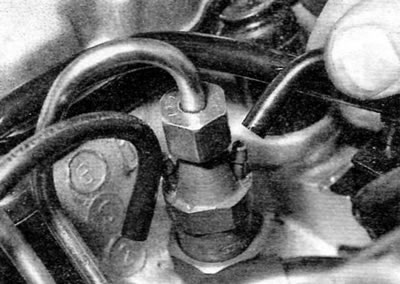
Figure 10.5. Disconnecting the return fuel line from the fuel injector

Figure 10.5. Disconnecting the return fuel line from the fuel injector


6. Unscrew the union nuts securing the fuel lines of the injectors to the high-pressure fuel pump. Hold the fittings on the pump while unscrewing the nuts. Plug open ports to prevent dirt from entering. For this you can use small plastic bags or "fingers" cut off from "old" ones (but clean!) rubber gloves.

7. Unscrew the union nuts and disconnect the fuel lines from the injectors (figure 10.7). If necessary, the fuel injector lines can be removed completely. Carefully mark the location of the fuel line clamps to facilitate installation. Cap the ports on the injectors to prevent dirt from entering.
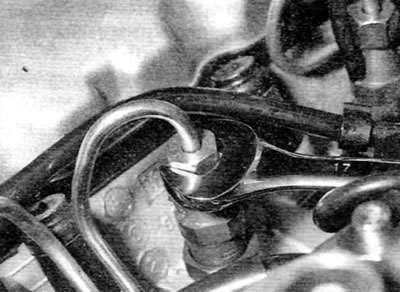
Figure 10.7. Unscrewing the union nut on the injector fuel line

Figure 10.7. Unscrewing the union nut on the injector fuel line


8. Unscrew the injectors using a long socket head or open-end wrench (for chamfers with a spanner size of 27 mm) and remove them from the cylinder head (figure 10.8).
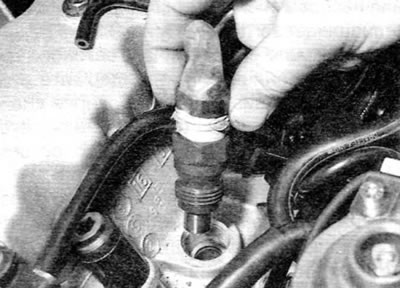
Figure 10.8. Unscrew the injectors and remove them from the cylinder head

Figure 10.8. Unscrew the injectors and remove them from the cylinder head


9. Remove the copper washers and flame deflector washers from the mounting holes in the cylinder head. Also remove the bushings if they are not secured (figure 10.9, a-c).
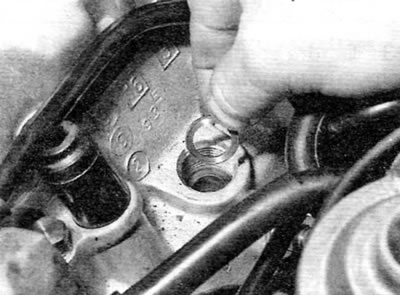
Figure 10.9, a. Removing the copper washer of the fuel injector...
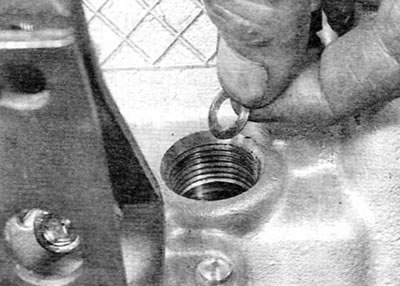
Figure 10.9, a. Removing the copper washer of the fuel injector...


Figure 10.9, b....flame-deflecting washer...
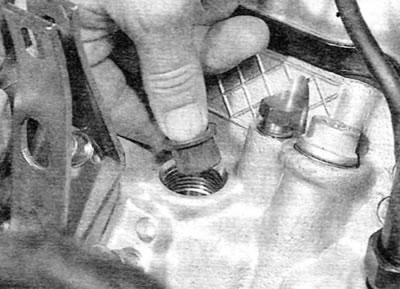
Figure 10.9, b....flame-deflecting washer...


Figure 10.9, c....and bushings

Figure 10.9, c....and bushings


Installation


10. Purchase new copper washers and flame washers. Also replace the bushings if they are damaged.

11. Do not allow the injectors to fall and be careful not to damage the injector tips. The injectors are manufactured to very precise tolerances and require careful handling. For example, never clamp them in a vice.

12. Begin installation by installing the bushings (if they were removed) into the cylinder head. Then install the flame deflector washers (convex side up) and copper washers.

13. Screw in the injectors and tighten them to the specified torque.

14. Install the fuel injector lines and tighten the union nuts. Install the fuel line clamps according to the previously marked position. If the clamps are not positioned correctly or are missing, problems may occur such as broken or cracked pipes.

15. Connect the return lines.

16. Reinstall the items removed to gain access (see the relevant paragraphs of this chapter).

17. Start the engine. If difficulties arise, bleed the fuel system as described in paragraph 2.
This article is available at russian, bulgarian, belarusian, ukrainian, serbian, croatian, romanian, polish, slovak, hungarian
Article reviewed by editor: Nikonova Veronica
Share information:
Previous
Partner I: Power and exhaust (XUD diesels)
Next

High pressure fuel pump — adjustment
Fuel injection advance (Bosch high-pressure fuel pump) —…
Fuel injection advance (Lucas high-pressure fuel pump) —…
Fuel injection advance — testing methods and adjustments
High-pressure fuel pump — removal and installation
Accelerator cable — removal, installation and adjustment
Fuel level indicator sensor — removal and installation
Collectors — removal and installation
Exhaust system — general information and replacement of…
See similar information for other Peugeot models

➨ Fuel filter renewal — carburetor models Peugeot 106 (1991-2003)
➨ Fuel injectors Peugeot 207 (2006-2014)
➨ Fuel injectors — removal, inspection and installation Peugeot 305 (1977-1989)
➨ Fuel injectors — removal, inspection and installation Peugeot 406 (1995-2004)
➨ Replacing the fuel filter Peugeot 605 (1989-2000)
Link to this article in different formats
Comments and feedback from visitors
No comments yet


Add two numbers 50 + 30


Partner I (1996-2008) 
  • General information
  • Introduction to the guide
  • Faults en route
  • Weekly checks
  • User manual
  • Maintenance (petrol)
  • Maintenance (diesel)
  • Power unit
  • Petrol engines
  • Diesel engines «XUD»
  • Diesel engines «DW»
  • Overhaul of petrol engines
  • Overhaul of diesel engines
  • Cooling and heating
  • Power and exhaust (petrol)
  • Power and exhaust (XUD diesels)
  • Power and exhaust (DW diesels)
  • Emission reduction
  • Starting and charging system
  • Transmission
  • Clutch
  • Mechanical gearbox
  • Drive shafts
  • Chassis, running gear
  • Brake system
  • Car suspension
  • Steering
  • Body and interior
  • Exterior (external elements)
  • Interior (internal elements)
  • Doors, locks and windows
  • Electrical equipment
  • Equipment and devices
  • Electrical circuits
Peugeot 807 (2002-2014) 
  • General information
  • Operating instructions
  • Maintenance
  • Troubleshooting
  • Power unit
  • Gasoline engines
  • Diesel engines
  • Cooling and heating
  • Fuel injection (petrol)
  • Fuel system (diesel)
  • Fuel system
  • Exhaust system
  • Ignition system
  • Transmission
  • Clutch
  • Manual gearbox
  • Automatic gearbox
  • Chassis, running gear
  • Brake system
  • Car suspension
  • Steering system
  • Body and interior
  • Exterior (external elements)
  • Interior (internal elements)
  • Electrical equipment
  • Power devices
  • Electrical circuits
Peugeot 806 (1994-2002) 
  • General information
  • User manual
  • Maintenance
  • Power unit
  • Petrol engines
  • Diesel engines
  • Lubrication system
  • Cooling system
  • Fuel injection (petrol)
  • Fuel system (diesel)
  • Ignition and exhaust systems
  • ECM Bosch Motronic MP 3.2
  • ECM Magneti-Marelli (MM)
  • Transmission
  • Clutch
  • Mechanical gearbox
  • Chassis, running gear
  • Brake system
  • Car suspension
  • Steering
  • Electrical equipment
  • Equipment and devices
  • Electrical circuits
Peugeot J5 (1981-1993) 
  • General information
  • Introduction to manual
  • Specifications
  • Gasoline engine
  • Engine repair
  • Lubrication system
  • Cooling system
  • Fuel system
  • Ignition system
  • Diesel engine
  • Engine repair (DB9)
  • Lubrication system (DB9)
  • Cooling system (DB9)
  • Fuel injection (DB9)
  • Engine repair (U25)
  • Lubrication system (U25)
  • Cooling system (U25)
  • Fuel injection (U25)
  • Transmission
  • Clutch
  • Gearbox
  • Drive shafts
  • Chassis, running gear
  • Steering system
  • Car suspension
  • Brake system
  • Electrical equipment
  • Power devices
  • Electrical circuits
PeugeotBook.ru © 2018–2026 | Mobile version | Sitemap: EN BG BY UA RS HR RO PL SK HU | Write message | Site search | Add to bookmarks | Peugeot owners
106 (1991-2003) | 206 (1998-2012) | 207 (2006-2014) | 305 (1977-1989) | 306 (1993-2002) | 307 (2001-2008) | 405 (1987-1997) | 406 (1995-2004) | 605 (1989-2000) | Partner-I (1996-2008) | Eurovans-807 (2002-2014) | Eurovans-806 (1994-2002) | J5 (1981-1993) |
Cookies are used to ensure the correct display of pages on the site.