
English Русский
Български
Беларускі
Український
Српски
Hrvatski
Română
Polski
Slovenský
Magyar
Bookmark Articles Sitemap Contacts
Company Hyundai Company Opel Company Skoda Company Kia Company Mitsubishi Company LADA Company Audi
PeugeotBook.ru


Series 100   Series 200   Series 300   400-500   Series 600   Crossovers   Others
 
Partner I (1996-2008) Peugeot 807 (2002-2014) Peugeot 806 (1994-2002) Peugeot J5 (1981-1993)

Fuel injection advance (Lucas high-pressure fuel pump) — checking and adjusting (Peugeot Partner I)

  • Main
  • Пежо
  • Partner I (1996-2008)
  • Power unit
  • Power and exhaust (XUD diesels)
  • Fuel injection advance (Lucas high-pressure fuel pump) — checking and adjusting
0
Warning. Do not attempt to perform injection advance adjustment procedures without accurate instruments. The appropriate special tools for adjusting the injection pump timing can be purchased at major auto parts stores or from your Peugeot/Citroen dealer. Before starting work, please read the safety precautions described in paragraph 1 this chapter.


Note: To check the injection advance of the high pressure fuel pump, a dial indicator (Peugeot/Citroen special tool no. 2437-T) is required together with a special installation gauge and support bracket (Peugeot/Citroen special tool no. 4O93-TJ) (figure 7.4). Without this equipment (or an appropriate alternative) the procedure for checking and adjusting the injection advance of the high-pressure fuel pump should be entrusted to a Peugeot/Citroen dealer or other specialist who has the appropriate equipment.


1. If the fuel injection advance is being checked without removing the pump from the engine, rather than during the pump installation procedure, disconnect the battery ground cable (see "Disconnecting the battery") and cover the generator rotor with a clean cloth or plastic bag to protect it from possible fuel spillage. Remove the fuel injector lines as described in paragraph 5.

2. Set the engine assembly/camshaft timing marks (see chapter 2B) to lock the crankshaft. Remove the crankshaft locking tool and then turn the crankshaft backwards (counterclockwise) approximately a quarter turn.

3. Unscrew the process plug from the guide on the top of the pump body and remove the sealing washer (figure 7.3). Insert the special installation probe into the guide, making sure that it fits correctly onto the surface of the sealing washer on the guide.
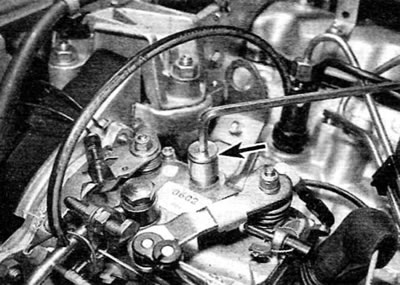


Figure 7.3. Removing the technological plug from the hole for adjusting the injection advance of…

Figure 7.3. Removing the technological plug from the hole for adjusting the injection advance of the high-pressure fuel pump (lucas pump)


Note: To ensure accurate measurement, the feeler gauge must fit against the surface of the guide sealing washer, not the top edge of the guide.

4. Attach the bracket to the pump guide and securely attach the dial indicator to the bracket so that its tip comes into contact with the lever mechanism of the bracket (figure 7.4). Position the indicator so that its plunger is in the middle of its stroke, and then reset the reading to zero.
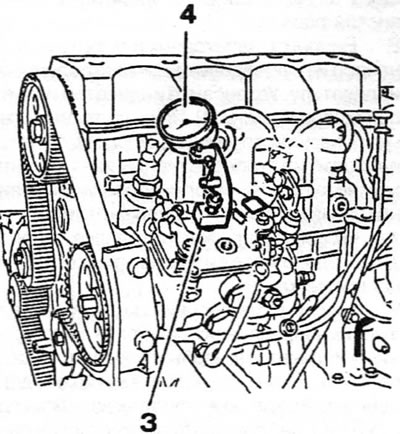

Figure 7.4. Pointer indicator for adjusting the injection advance of the high-pressure fuel pump…

Figure 7.4. Pointer indicator for adjusting the injection advance of the high-pressure fuel pump (4) and the corresponding support bracket (3), secured to the high-pressure fuel pump


5. Slowly turn the crankshaft in the correct direction of rotation (along the nasal arrow) enough to allow the crankshaft locking tool to be reinstalled.

6. With the crankshaft locked, read the indicator; the reading should match the value indicated on the pump (there is a tolerance of +0.04 mm). The injection advance value can be indicated on a plastic disc attached to the front of the pump, or alternatively on a tag attached to the pump control handle (figure 7.6).
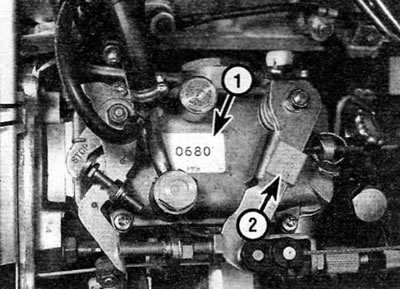
Figure 7.6. High-pressure fuel pump injection advance values indicated on the plate (1) and tag (2)…

Figure 7.6. High-pressure fuel pump injection advance values indicated on the plate (1) and tag (2) (lucas pump)


7. If adjustment is required, loosen the front nuts and rear pump mounting bolt, then slowly rotate the pump body until the point where the dial indicator reads the specified value is reached. Once the pump is positioned correctly, tighten the front nuts and rear bolt to the specified torque.

8. Slightly pull out the feeler gauge so that it is positioned away from the pump rotor dowel pin and remove the crankshaft locking rod. Turn the crankshaft 1% of a revolution in the normal direction of rotation.

9. Reinsert the feeler gauge, making sure it is properly seated on the sealing washer surface of the guide and not on the top edge, then zero the indicator.


10. Slowly turn the crankshaft in the correct direction of rotation until the crankshaft locking tool can be reinstalled. Check the injection advance again.

11. If adjustment is required, loosen the nuts and pump mounting bolt and repeat steps 11. p. 7-10.

12. When the pump injection advance is set correctly, remove the dial indicator and support bracket and take out the dipstick.

13. Screw in the screw (with a sealing washer) into the guide and tighten it securely.

14. If this procedure is performed as part of the pump installation sequence, proceed as described in paragraph 5.

15. If the procedure is performed without removing the pump from the engine, connect the fuel lines of the injectors, tightening their union nuts to the specified torque. Connect the battery and then bleed the fuel system (see paragraph 2). Start the engine and adjust the idle speed and stall prevention speed as described in paragraph 9.
This article is available at russian, bulgarian, belarusian, ukrainian, serbian, croatian, romanian, polish, slovak, hungarian
Article reviewed by editor: Nikonova Veronica
Share information:
Previous
Partner I: Power and exhaust (XUD diesels)
Next

Fuel injection advance — testing methods and adjustments
High-pressure fuel pump — removal and installation
High idle speed thermostat sensor
Air filter and related components — removal and installation
Fuel system — filling and bleeding
Fuel injection advance (Bosch high-pressure fuel pump) —…
High pressure fuel pump — adjustment
Fuel injectors — inspection, removal and installation
Accelerator cable — removal, installation and adjustment
Fuel level indicator sensor — removal and installation
See similar information for other Peugeot models

➨ Fuel injection systems — general information Peugeot 106 (1991-2003)
➨ Checking and adjusting the fuel injection pump Peugeot 206 (1998-2012)
➨ Fuel injection pump (Lucas CAV/Roto-Diesel) — checking and… Peugeot 305 (1977-1989)
➨ Adjusting the high pressure fuel pump Peugeot 406 (1995-2004)
➨ High pressure fuel pump — removal, installation and adjustment Peugeot 605 (1989-2000)
Link to this article in different formats
Comments and feedback from visitors
No comments yet


Add two numbers 12 + 16


Partner I (1996-2008) 
  • General information
  • Introduction to the guide
  • Faults en route
  • Weekly checks
  • User manual
  • Maintenance (petrol)
  • Maintenance (diesel)
  • Power unit
  • Petrol engines
  • Diesel engines «XUD»
  • Diesel engines «DW»
  • Overhaul of petrol engines
  • Overhaul of diesel engines
  • Cooling and heating
  • Power and exhaust (petrol)
  • Power and exhaust (XUD diesels)
  • Power and exhaust (DW diesels)
  • Emission reduction
  • Starting and charging system
  • Transmission
  • Clutch
  • Mechanical gearbox
  • Drive shafts
  • Chassis, running gear
  • Brake system
  • Car suspension
  • Steering
  • Body and interior
  • Exterior (external elements)
  • Interior (internal elements)
  • Doors, locks and windows
  • Electrical equipment
  • Equipment and devices
  • Electrical circuits
Peugeot 807 (2002-2014) 
  • General information
  • Operating instructions
  • Maintenance
  • Troubleshooting
  • Power unit
  • Gasoline engines
  • Diesel engines
  • Cooling and heating
  • Fuel injection (petrol)
  • Fuel system (diesel)
  • Fuel system
  • Exhaust system
  • Ignition system
  • Transmission
  • Clutch
  • Manual gearbox
  • Automatic gearbox
  • Chassis, running gear
  • Brake system
  • Car suspension
  • Steering system
  • Body and interior
  • Exterior (external elements)
  • Interior (internal elements)
  • Electrical equipment
  • Power devices
  • Electrical circuits
Peugeot 806 (1994-2002) 
  • General information
  • User manual
  • Maintenance
  • Power unit
  • Petrol engines
  • Diesel engines
  • Lubrication system
  • Cooling system
  • Fuel injection (petrol)
  • Fuel system (diesel)
  • Ignition and exhaust systems
  • ECM Bosch Motronic MP 3.2
  • ECM Magneti-Marelli (MM)
  • Transmission
  • Clutch
  • Mechanical gearbox
  • Chassis, running gear
  • Brake system
  • Car suspension
  • Steering
  • Electrical equipment
  • Equipment and devices
  • Electrical circuits
Peugeot J5 (1981-1993) 
  • General information
  • Introduction to manual
  • Specifications
  • Gasoline engine
  • Engine repair
  • Lubrication system
  • Cooling system
  • Fuel system
  • Ignition system
  • Diesel engine
  • Engine repair (DB9)
  • Lubrication system (DB9)
  • Cooling system (DB9)
  • Fuel injection (DB9)
  • Engine repair (U25)
  • Lubrication system (U25)
  • Cooling system (U25)
  • Fuel injection (U25)
  • Transmission
  • Clutch
  • Gearbox
  • Drive shafts
  • Chassis, running gear
  • Steering system
  • Car suspension
  • Brake system
  • Electrical equipment
  • Power devices
  • Electrical circuits
PeugeotBook.ru © 2018–2026 | Mobile version | Sitemap: EN BG BY UA RS HR RO PL SK HU | Write message | Site search | Add to bookmarks | Peugeot owners
106 (1991-2003) | 206 (1998-2012) | 207 (2006-2014) | 305 (1977-1989) | 306 (1993-2002) | 307 (2001-2008) | 405 (1987-1997) | 406 (1995-2004) | 605 (1989-2000) | Partner-I (1996-2008) | Eurovans-807 (2002-2014) | Eurovans-806 (1994-2002) | J5 (1981-1993) |
Cookies are used to ensure the correct display of pages on the site.