
English Русский
Български
Беларускі
Український
Српски
Hrvatski
Română
Polski
Slovenský
Magyar
Bookmark Articles Sitemap Contacts
Company Hyundai Company Opel Company Skoda Company Kia Company Mitsubishi Company LADA Company Audi
PeugeotBook.ru


Series 100   Series 200   Series 300   400-500   Series 600   Crossovers   Others
 
Peugeot 206 (1998-2012) Peugeot 207 (2006-2014)

Camshafts (diesel engines) (Peugeot 207)

  • Main
  • 20X
  • Peugeot 207 (2006-2014)
  • Power unit
  • Engine characteristics
  • Camshafts (diesel engines)
0

Characteristics


The intake camshaft (1) drives the vacuum pump.

The exhaust camshaft (2) drives the high pressure fuel pump.

Main bearing side clearance (DW10BTED4): 0.04-0.168 mm.
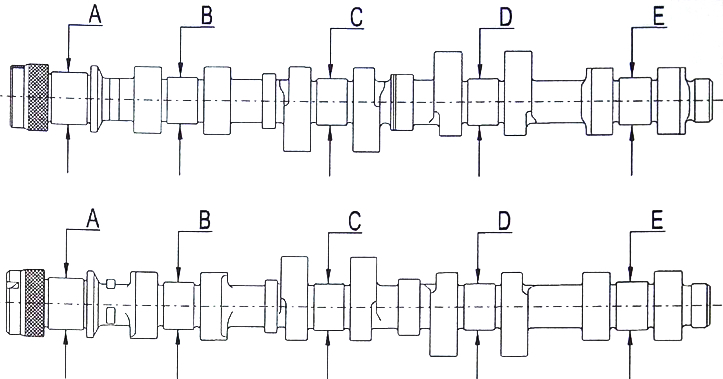
Main bearing side clearance (DW10BTED4): 0.04-0.168 mm.
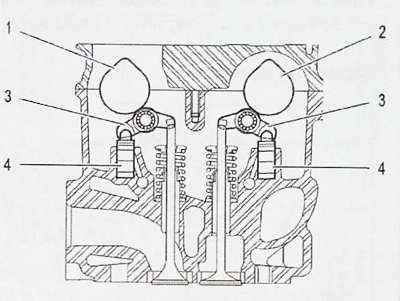

Roller Levers and Pushers:

Roller Levers and Pushers:
1 - intake camshaft;
2 - exhaust camshaft;
3 - roller pusher levers;
4 - hydraulic tappets.
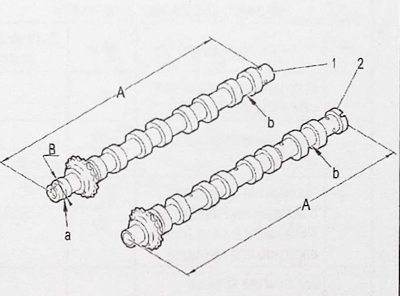

Camshaft markings:

Camshaft markings:
1 - intake camshaft;
2 - exhaust camshaft;
a - neck for sealing;
b - camshaft marking.
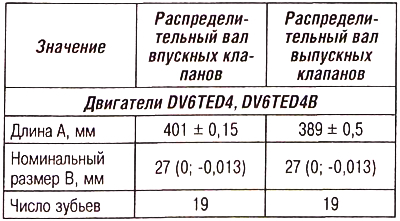
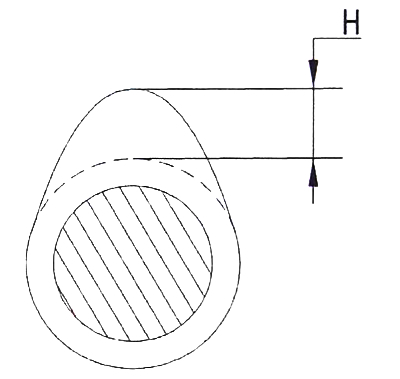
b - camshaft marking.

b - camshaft marking.
This article is available at russian, bulgarian, belarusian, ukrainian, serbian, croatian, romanian, polish, slovak, hungarian
Article reviewed by editor: Matveev Demid
Share information:
Previous
Peugeot 207: Engine characteristics
Next

Camshafts (petrol engines 1.4 and 1.6 l, EP3, TU5)
Timing belt characteristics (1.6L diesel engines)
Timing belt characteristics (petrol engines 1.4 and 1.6 l, EP3,…
Cylinder head (1.6L diesel engines)
Cylinder head (petrol engines 1.4 and 1.6 l, EPZ, TU5)
Characteristics of the cylinder block (petrol engines 1.4 l, EPZ)
Cylinder Block Specifications (1.6L Petrol Engine, TU5)
Cylinder Block Characteristics (1.6L Diesel Engines)
Valve mechanism characteristics (petrol engines 1.4 and 1.6 l,…
Valve train characteristics (1.6L diesel engines)
See similar information for other Peugeot models

➨ Servicing specifications — diesel models Peugeot 106 (1991-2003)
➨ Diesel engines — general description Peugeot 306 (1993-2002)
➨ Technical characteristics of diesel engines Peugeot 405 (1987-1997)
➨ Specification of cars with diesel engines Peugeot 605 (1989-2000)
➨ Cars with 1.9-liter diesel engines Peugeot 806 (1994-2002)
Link to this article in different formats
Comments and feedback from visitors
No comments yet


Add two numbers 32 + 31


Peugeot 207 (2006-2014) 
  • General information
  • Car care
  • Governing bodies
  • Driving and operation
  • Power unit
  • Engine characteristics
  • Engine repair
  • Cooling system
  • Lubrication system
  • Ignition system
  • Control system (gasoline)
  • Fuel system (gasoline)
  • Control system (diesel)
  • Transmission
  • Clutch
  • Mechanical gearbox
  • Automatic gearbox
  • Drive shafts
  • Chassis, running gear
  • Car suspension
  • Steering
  • Brake system
  • Body and interior
  • Exterior (external elements)
  • Interior (internal elements)
  • Heating and air conditioning
  • Electrical equipment
  • Equipment and devices
  • Headlights and lighting
  • Power devices
  • Electrical circuits
Peugeot 206 (1998-2012) 
  • General information
  • User manual
  • Maintenance
  • Power unit
  • Gasoline engines
  • Diesel engines
  • Diesel power system
  • Engine management system
  • Transmission
  • Clutch
  • Mechanical gearbox
  • Automatic gearbox
  • Drive shafts
  • Chassis, running gear
  • Front suspension
  • Rear suspension
  • Steering
  • Brake system
  • Body and interior
  • Body elements
  • Doors, locks and windows
  • Electrical equipment
  • Equipment and devices
  • Electrical circuits
PeugeotBook.ru © 2018–2026 | Mobile version | Sitemap: EN BG BY UA RS HR RO PL SK HU | Write message | Site search | Add to bookmarks | Peugeot owners
106 (1991-2003) | 206 (1998-2012) | 207 (2006-2014) | 305 (1977-1989) | 306 (1993-2002) | 307 (2001-2008) | 405 (1987-1997) | 406 (1995-2004) | 605 (1989-2000) | Partner-I (1996-2008) | Eurovans-807 (2002-2014) | Eurovans-806 (1994-2002) | J5 (1981-1993) |
Cookies are used to ensure the correct display of pages on the site.
