



Table of contents: Cylinder block 🠇 Moving parts of the engine 🠇 Tightening torques (main bearing cap…🠇 Tightening torques (flywheel) 🠇
Cylinder block
Marking "a":
- engraving of crankshaft bearing diameter class;
- orientation of bearings to the clutch and timing drive.
Marking "b":
- manufacturer's marking;
- iCE type;
- node label;
- serial number.
Marking "c":
- processing marking;
- year of manufacture.
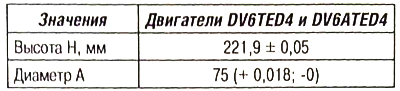
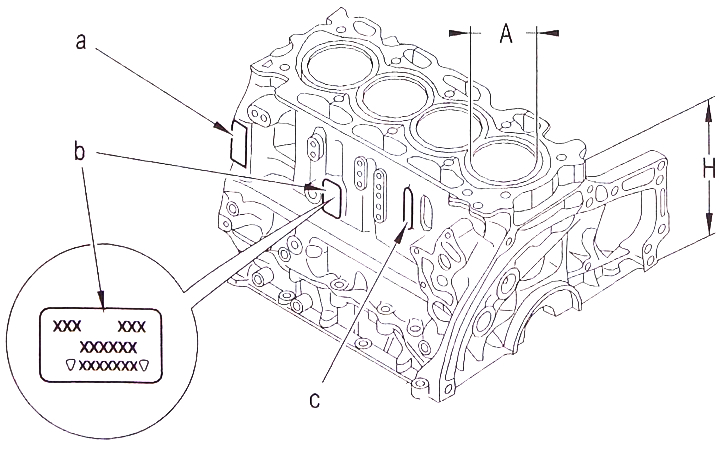
Attention. It is prohibited to grind the plane of the block that is joined to the cylinder head gasket. It is also prohibited to bore the cylinder holes.
The cylinder block is made of aluminum alloy, cast under pressure together with cast iron liners. The main bearing caps are made of cast iron, integrated into the main bearing cap crankcase during casting.
The crankshaft main bearing housing is secured with 10 M9 bolts on each side of the bearing housing, the cut line is closed with 14 M6 bolts.
Moving parts of the engine
The crankshaft is steel, stamped, with main and connecting rod journals having fillets reinforced by ball knurling, and integrated counterweights.
The tightness of the crankshaft ends is ensured by means of seals in the cylinder block on the flywheel side and in the oil pump housing on the timing drive side. The connecting rods are steel, stamped, with a cover secured with bolts, and a breakable lower head with smooth liners.
The liners on the side of the main bearing beds have no locking protrusions, the liners on the side of the cylinder block have locking protrusions.
Piston - aluminum alloy with oil cooling chamber. Piston ring - with a cross-section in the form of a double trapezoid of the clamped type (No. 1).
Oil scraper ring - with scraping edges (No. 2).
Piston ring - I-section, with conical, chrome-plated edges (No. 3).
Note: When installing, ensure that the installed parts are oriented correctly.
Tightening torques (main bearing cap housing)
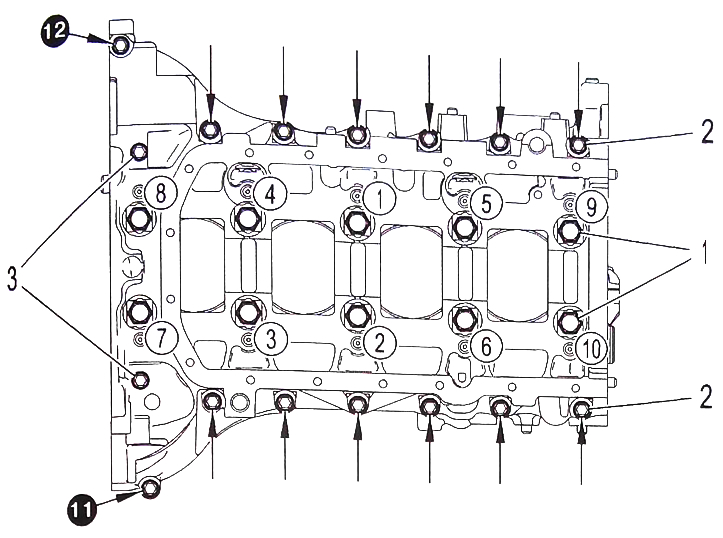
Attention: Tightening must be carried out in the specified sequence.
Reuse of main bearing cap bolts (1) is prohibited.
Maximum bolt length 116.5 mm. Step 1:
- pre-tighten new main journal cap bolts (1) to 10 Nm (from 1 to 10);
- pre-tighten the 14 bolts (2) securing the crankshaft main bearing cap housing to 6 Nm (from 1 to 14);
- tighten the two bolts (3) to 8 Nm (from inside the flywheel cap);
- tighten the two bolts (7) securing the crankshaft main bearing cap housing to a torque of 8 Nm.
Step 2: Loosen the bolts (1) by 180°.
Step 3: Tighten the journal cover housing bolts (1) to 30 Nm (from 1 to 10).
Step 4:
- tighten the bolts (1) at an angle of 140° (from 1 to 10);
- tighten the bolts (2) to 0 Nm (from 1 to 14).
Attention: Tightening must be carried out in the specified sequence.
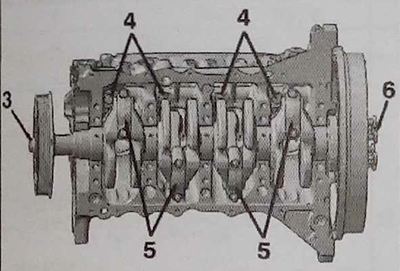
Re-use of connecting rod cap bolts (5) is prohibited.
Maximum bolt length under head 41 mm.
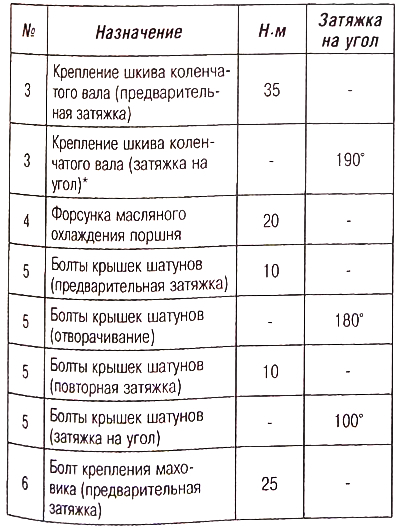
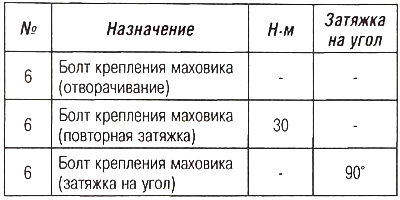
* When the required angle is reached, the tightening torque should be between 8 and 16 Nm.
Tightening torques (flywheel)
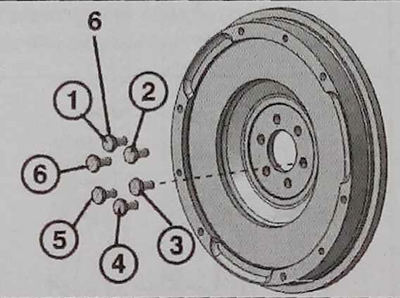
Attention: Tightening must be carried out in the specified sequence.
Re-use of the flywheel mounting bolts (6) is prohibited. Maximum bolt length 16.2 mm.
Note: When installing, adjust the position of the engine flywheel on the crankshaft.
Tightening sequence:
- pre-tightening of bolts with a torque of 25 Nm (order 1-5-32-6-4);
- loosen bolts in order 1-5-3-2-6-4;
- pre-tightening of bolts with a torque of 8 Nm (order 1-5-32-6-4);
- tightening torque 30 Nm (order 1-5-3-2-6-4);
- additional tightening at 90° (order 1-5-3-2-6-4).