



Note: Two lower gaskets should be included with your new windshield.
To remove the windshield:
- remove the interior rearview mirror;
- remove the front pillar trim;
- remove the sun visors;
- remove the ceiling handles;
- remove the ceiling console;
- remove the decorative ceiling trim elements;
- place two spacers between the ceiling and the roof to lower the front of the headliner slightly;
- remove the wiper blades and arms;
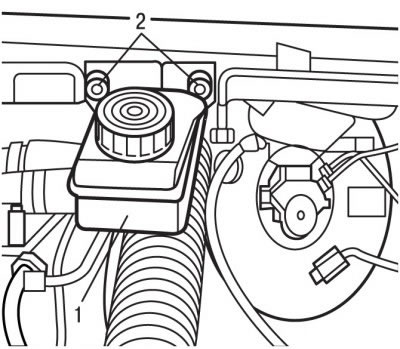
Figure 8.2. Location of bolts (2) for fastening the expansion tank (1)
- unscrew two bolts 2 (see Figure 8.2) fasteners and move aside the expansion tank with brake fluid;
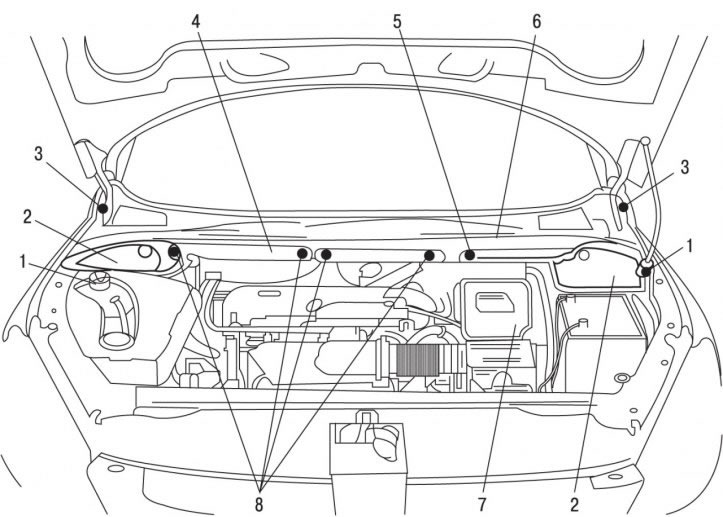
Figure 9.32. Panel grille in front of the windshield: 1 - bolts; 2 - side soundproofing coverings; 3 - clamps; 4 - soundproofing coating; 5 - crossbar; 6 - grille; 7 - battery support; 8 - clamps
- unscrew bolts 1 (see Figure 9.32) and remove crossbar 5 from the lower part of the windshield opening;
- remove the 3 fasteners securing the grille of the panel in front of the windshield;
- remove the 6 panel grille in front of the windshield;
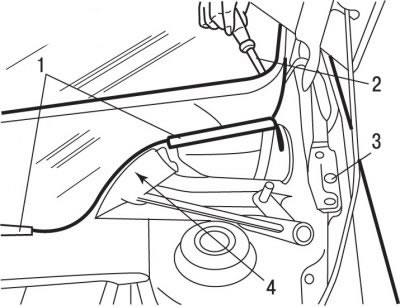
Figure 10.52. Removing the windshield profiles: 1 - profiles; 2 - an awl when piercing the glue layer; 3 - bolt for fastening the string; 4 - adhesive tape for glass protection
- remove profiles 1 (figure 10.52) at the bottom of the windshield;
- secure one end of the cutting string to bolt 3;
- apply adhesive tape 4 on both sides of the windshield to protect the glass;
- from the inside of the car, in the lower corner of the windshield, use an awl 2 to pierce the layer of glue that holds the glass in place;
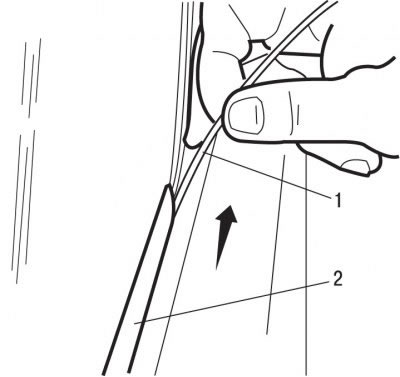
Figure 10.53. Passing the split string (1) under the windshield seal (2)
- pass the split string 1 (figure 10.53) under the seal 2 of the windshield, starting from the lower left corner and then around the perimeter in a counterclockwise direction;
- insert the second end of the split string into the awl and pull it inside, about 50 cm;
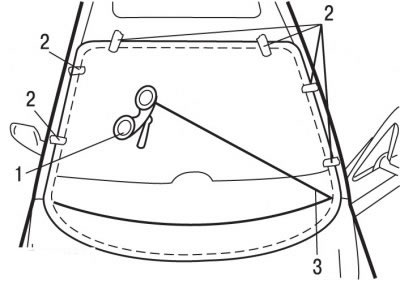
Figure 10.54. Installing adhesive tapes: 1 - special device (1) with a coil; 2 - adhesive tapes; 3 - split string
- when reusing the windshield, apply adhesive tapes 2 (figure 10.54), which serve as marks when reinstalled. Cut the adhesive strips along the edge of the windshield;
- when tightening the split string, make sure the string is properly positioned under the windshield seal and under the windshield;
- secure the second end of the split string 3 in a special device 1 with a reel;
- place a jig or flat wooden wedge between the split wire and the instrument panel to protect it while cutting away the adhesive at the bottom of the windshield;
- start cutting away the adhesive from the bottom of the windshield. If you don't have a special device with a reel, you can pull the split string through manually, after first protecting your hands from being cut by the string;
- once the string stops moving, move the spool attachments to ensure that the adhesive is cut in a consistent and clockwise direction when looking at the windshield from the outside of the vehicle;
Caution: Cutting the adhesive in this area requires special care, as the lower portion of the windshield is held in place by two layers of adhesive. Therefore, special care must be taken not to break the split string.
- continue cutting until the entire layer of glue is cut off;
- use suction cups to remove the windshield from the car.
Important! If you replace the windshield, install a new rain sensor. Protect your dashboard and interior. If you are reusing undamaged glass, use an electric knife to cut away any remaining adhesive and sealant from the glass and the edge of the opening in the body. Do not completely remove any remaining adhesive or sealant. These residues serve as a soft support during installation and also improve the adhesion of the new adhesive and sealant to the surfaces.
To install the windshield:
- clean the adhesive application area around the entire perimeter of the glass using the glass cleaner supplied in the bonding kit;
- apply the first coat of glass adhesive chosen from the glass bonding kit to the glass. Drying time is 10 minutes;
- if the glass opening was coated with an anti-corrosion compound or replaced, restore the paintwork and, if necessary, perform anti-corrosion treatment operations;
- first of all, clean the area of the glass opening covered with the anti-corrosion compound with the cleaning solvent selected from the bonding kit, and then apply the primary metal adhesive to it. Drying time is 10 minutes;
- apply the primary components of the adhesive to the glass, choosing them from the gluing kit;
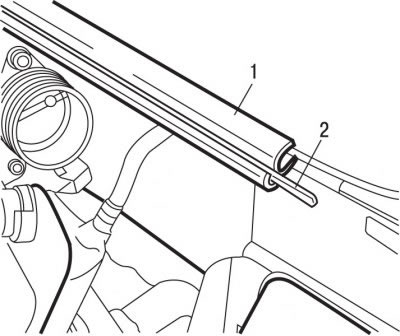
Figure 10.55. Location of plastic molding (2) in windshield profile (1)
- if the windshield has been removed, reinstall the profiles at the bottom of the glass, ensuring that the marks on the windshield are correctly positioned. Raise plastic moldings 2 profiles 1 (figure 10.55);
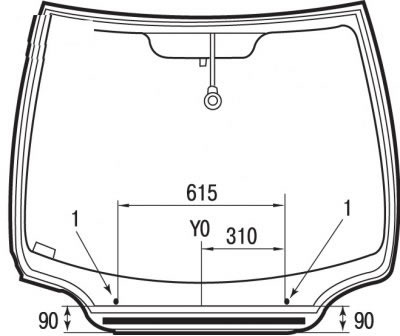
Figure 10.56. Dimensions for installing gaskets (1) on the windshield: Y0 - axis of symmetry of the windshield
- install two gaskets 1 (figure 10.56) at a distance of 90 mm from the lower central profile and at a distance of 310 mm on both sides from the Y0 axis of symmetry of the windshield;
- fill the extrusion gun with a two-component mastic kit;
- install the nozzle tip that comes in the gluing kit;
- cut the tip of the tapered tip at 8mm diameter and 12mm height using a special clamp for cutting tapered tips;
Caution! The adhesive layer must not touch the windshield seal under any circumstances.
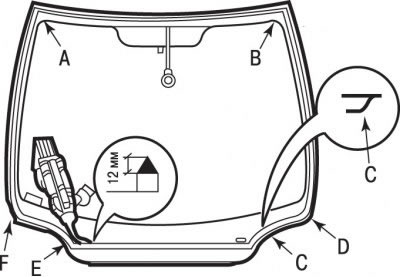
Figure 10.57. Control points (A, B, C, D, E, F) for applying glue to the windshield
- apply a layer of glue as follows (figure 10.57):
- from point A to point B at a distance of 14 mm from the edge of the windshield;
- from point B to point D at a distance of 14 mm from the edge of the windshield;
- from point D to point C at a distance of 2 mm from the lower profile of the windshield;
- from point C to point E at a distance of 77 mm from the lower profile of the windshield;
- from point E to point F at a distance of 2 mm from the lower profile of the windshield;
- from point F to point A at a distance of 14 mm from the edge of the windshield;
- apply a second layer of adhesive from point C to point E at a distance of 56 mm from the lower profile of the windshield;
- position the windshield correctly in relation to the adhesive strips, lifting the bottom part above the hood to avoid rubbing the adhesive off the front panel;
Important! To ensure soundproofing of the interior, the two layers of adhesive must be sealed when applied. Do not apply excess glue at points (C - E) and place the glue layers parallel. The time interval between applying the mastic to the glass and installing it on the car should not exceed 8 minutes (for quick-setting mastics).
Original published on the portal www.PeugeotBook.ru
- constantly press the glass with suction cups;
- wait for the glue to polymerize for 30 minutes before continuing work;
- install the wiper arms together with the blades onto the marks on the windshield;
- further installation is carried out in the reverse order of removal, taking into account the following:
- check the functionality of electrical equipment;
- check the windshield seal for leaks;
- wipe the glass.