



- turn off the ignition and disconnect the ground wire from the battery;
- remove the air filter housing;
- remove the air intake pipe;
- remove the decorative battery cover;
- remove the battery;
- remove the battery support;
- disconnect, release from the fasteners and move aside the wiring harnesses going to the gearbox;
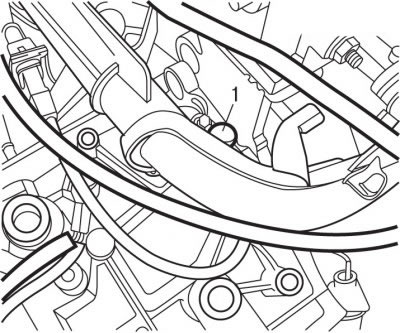
Figure 5.10. Location of the engine speed sensor (1)
- remove sensor 1 (figure 5.10) engine speed;
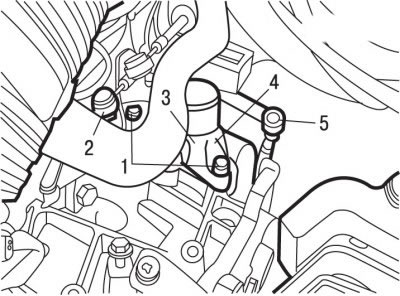
Figure 5.11. Location of components on the gearbox: 1 - bolts; 2 - transition rod; 3 - gear shift rod support; 4 - reaction rod; 5 - nut
- using the 0216-G1 ball joint removal tool with a diameter of 10 mm, disconnect the transition rod 2 (figure 5.11);
- using the 0216-G2 ball joint remover with a diameter of 13 mm, disconnect the reaction rod 4;
- unscrew bolts 1 and nut 4 and remove support 3 of gear shift rods;
- remove the windshield wiper arms;
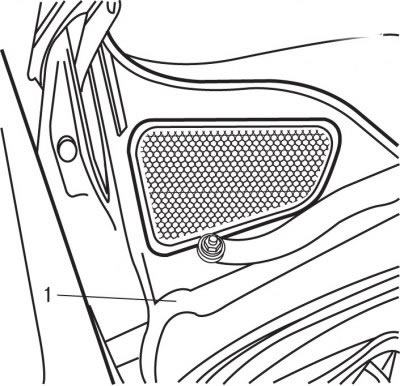
Figure 5.12. Location of the grille (1) of the panel in front of the windshield
- remove grille 1 (figure 5.12) panels in front of the windshield;
- install a support crossmember to support the power unit;
- hook the crossmember support clamp onto the engine lifting bracket;
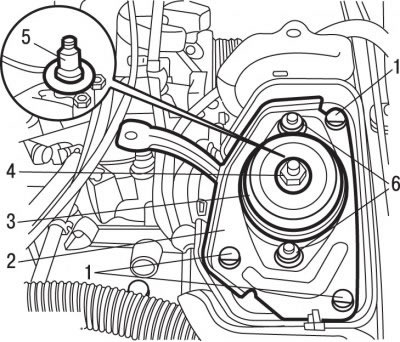
Figure 5.13. Fastening the elastic support: 1 - bolts; 2 - bracket; 3 - elastic support; 4 - nut, 65 Nm; 5 - gearbox axis; 6 - bolts, 30 Nm
- unscrew nut 4 (figure 5.13) fasteners from the gearbox support axle and remove it together with the washer;
- unscrew the 6 bolts securing the cushion;
- remove elastic support 3;
- unscrew bolts 1 and remove bracket 2 of the gearbox axle;
- using a special bushing 0317-AB, remove the gearbox suspension axle 5;
- raise the car by lifting the front wheels;
- remove the front wheels;
- remove the lower engine compartment protection;
- remove the left front wheel arch mudguard;
- place a collecting pan under the engine to collect any leaking oil;
- drain the oil from the gearbox;
- remove the drive shafts;
- disconnect the exhaust outlet pipe. It is necessary to protect the connecting element in the front exhaust pipe from any mechanical damage;
Caution! The connecting element in the front exhaust pipe must not be bent more than 20° in the rotation angle or displaced by 20 mm in the axial direction and 25 mm in the radial direction, otherwise it will be damaged.
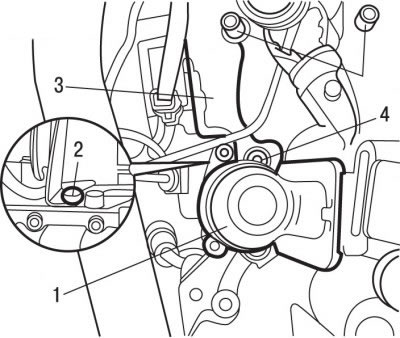
Figure 5.14. Location of starter mounting elements: 1 - clutch slave cylinder; 2 - starter; 3 - wiring harness; 4 - mounting bolts
- unscrew bolts 4 (figure 5.14), remove the clutch slave cylinder 1 and attach it to the body with soft wire;
- unscrew the starter mounting bolts 2 and the wiring harness support 3;
- move the starter to the side without removing it;
Caution! Do not disconnect the hydraulic hose from the clutch slave cylinder or press the clutch pedal.
- remove the engine mount jet bracket;
- remove the bump stop and the underframe shock absorber;
- using the threaded rod of the support crossmember, slightly lower the power unit;
- hook the lifting cable clamps to the gearbox;
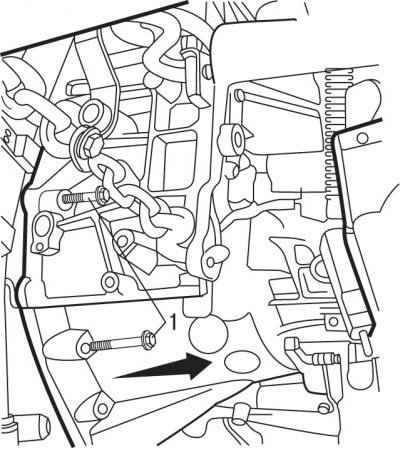
Figure 5.15. Location of the bolts (1) for the upper gearbox mount
- unscrew bolts 1 (figure 5.15) upper gearbox mount;
- protect the inside of the cooling system radiator with a sheet of cardboard cut to the size of the radiator;
- remove the gearbox;
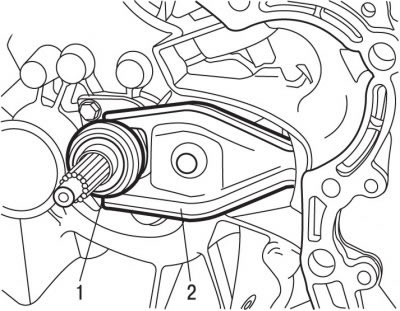
Figure 5.16. Location of the clutch release bearing (1) and fork (2)
- if necessary, remove the clutch release bearing 1 (figure 5.16) and fork 2.
To install the gearbox:
- check the condition of the clutch;
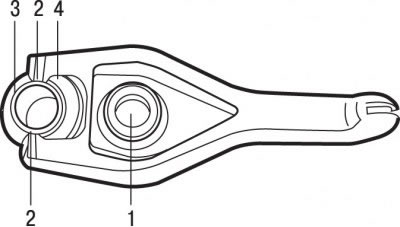
Figure 5.17. Clutch release fork: 1 - clutch release bearing; 2 - protrusions; 3 - fork tips; 4 - ball joint insert
- check the condition of the ball joint liner 4 (figure 5.17). If the ball joint bushing condition is unsatisfactory, replace the clutch release fork;
- lubricate the 3 sections of the clutch release fork where the clutch release bearing is mounted with a thin layer of special G12 grease;
- install the clutch release bearing 1 so that the protrusions 2 enter the fork tips 3;
- clean the splined portion of the gearbox input shaft;
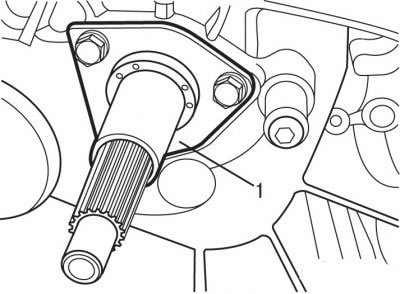
Figure 5.18. Location of the guide sleeve (1) of the clutch release bearing
- lubricate the guide bushing 1 with a thin layer of special G12 grease (figure 5.18) clutch release bearing. The lubricant layer must be thin and uniform, otherwise, when the clutch is operating, excess lubricant will be thrown onto the working surfaces of the clutch, which may impair its operation;
Caution! Do not apply grease to the gearbox input shaft splines.
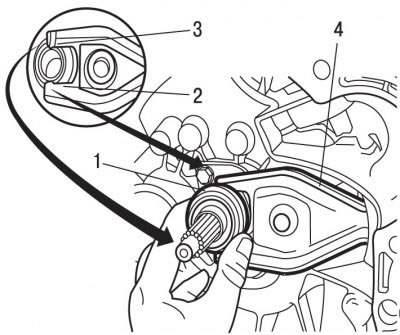
Figure 5.19. Installing the clutch fork: 1 - clutch release bearing; 2 - protrusions; 3 - tips; 4 - fork
- install the clutch release fork with bearing back into place. Move the clutch release bearing 1 (figure 5.19) until the projections 2 are installed in place of the tips 3 of the clutch release fork 4. Check that the clutch release bearing moves with the fork;
- replace the differential sealing rings, after lubricating the working edges of the rings;
- replace with new self-locking nuts and bolts, as well as lock washers and sealing gaskets;
Caution: Make sure that the engine block is fitted with guide bushings to centre the gearbox.
- lift the gearbox and attach it to the engine;
- move the gearbox towards the engine so that the input shaft of the gearbox enters the splines of the driven disk of the clutch. To align the splines of the transmission input shaft with the splines of the clutch driven disc, it may be necessary to rotate the engine crankshaft slightly. When installing the gearbox, the input shaft should not hang on the clutch disc;
- having moved the gearbox forward, install the clutch housing on the guide bushings of the cylinder block;
- install the upper gearbox mounting bolts and tighten them to 55 Nm;
- clean the gearbox suspension axle threads from dirt and apply a thin layer of E3 grease to them;
- install support 3 in place (see Figure 5.11) gear shift rods and connect the transition rod 2 and the reaction rod 4. Tighten the nut 4 to a torque of 19 N·m, and the bolts 1 to a torque of 13 N·m;
- install the starter and secure it with bolts;
- install the wiring harness bracket and secure it with bolts;
- install clutch slave cylinder 1 (see Figure 5.14) and secure it with 4 bolts;
- install the engine subframe shock absorber back into place;
- tilt the power unit forward and install the bump stop;
- secure the subframe reinforcement with bolts, tightening them to a torque of 40 Nm;
- tighten the lower gearbox mount and bump stop bolts to 60 Nm;
- tighten the gearbox mounting nuts to a torque of 40 N·m;
- install the engine mount torque bracket and tighten the bracket mounting bolt to 55 N·m, and bolt 3 to 40 N·m;
- using the special sleeve 0317-AB, install the axis 5 (see Figure 5.13) together with the washer.
- install bracket 2 and secure it with bolts 1;
- install elastic support 3;
- screw in bolts 6, tightening them by hand at this stage;
- install the washer and tighten the nut 4 securing the gearbox suspension axle;
Caution! Before tightening the elastic mount mounting bolts, center the power unit.
- tighten bolts 6 to 30 Nm and nut 4 to 65 Nm;
- further installation is carried out in the reverse order of removal, taking into account the following;
- install the drive shafts;
- fill the gearbox with oil;
- connect the ground wire to the battery;
- initialize all computers.