



Table of contents: Regulator block 🠇 Electronic control unit (ecu) 🠇 Front wheel sensor (wheel rotation…🠇 Rear wheel sensor (wheel rotation…🠇
The anti-lock braking system prevents the wheels from locking during sudden braking. Thanks to this, the car remains controllable during full braking.
The system consists of a hydraulic regulator unit and 4 wheel sensors.
The regulator unit contains an electronic control unit (ECU), 8 hydraulic solenoid valves (2 for each brake) and an electric driven pump.
The solenoid valves are controlled by the ECU, which receives signals from four sensors mounted on each wheel of the vehicle (the front sensors are mounted on the hubs, and the rear ones are attached to the caliper mounting bracket), which monitor the rotation speed of each wheel. By comparing these signals, the ECU can determine the speed of the car. By comparing the speed of an individual wheel with the average speed of the car, the control unit determines the state of wheel locking. When a wheel approaches locking, the brake fluid pressure is too high, so the pressure in the caliper is reduced by a signal from the control unit. This continues until the wheel begins to accelerate again. Then the valves close again and the pressure created by the brake pedal begins to act again. However, the pressure value in the brake circuit of this wheel is not higher than the total pressure in the system. The operation of ABS during sharp braking is repeated on each wheel until force is applied to the pedal or the car stops.
If there is any malfunction in the ABS system, it is switched off. In this case, the ABS indicator light on the instrument panel lights up, and the brake system operates in normal mode.
Regulator block
Removal
1. Remove the negative terminal from the battery.
2. Release the clamp and disconnect the main electrical connector from the regulator unit. Unscrew the nut and disconnect the ground bus from the unit.
3. Mark the brake pipes, unscrew the union nuts and disconnect the pipes from the regulator unit.
4. Unscrew the regulator mounting nuts and remove it from the engine compartment.
Installation
1. Install the regulator in place and secure with nuts.
2. Connect the brake pipes and tighten the mounting nuts to the specified torque.
3. Connect the electrical connector and ground bus to the controller unit.
4. Bleed the brake system.
Electronic control unit (ecu)
Removal
1. The ECU can be removed from the regulator while the regulator remains on the vehicle. Remove the battery and its support.
2. Release the bracket and disconnect the electrical connector from the ECU.
3. Unscrew the mounting bolts and remove the ECU unit from the engine compartment.
Installation
1. Install the ECU unit onto the regulator and secure with bolts.
2. Connect the electrical connector to the unit and install the battery.
Front wheel sensor (wheel rotation sensor)
Removal
1. Remove the negative terminal from the battery.
2. Raise the front of the car and secure it on stands. Remove the wheel.
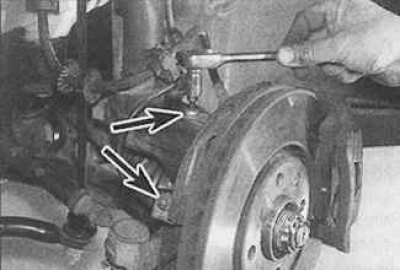
3. Unscrew the nut and bolt (indicated by arrows).
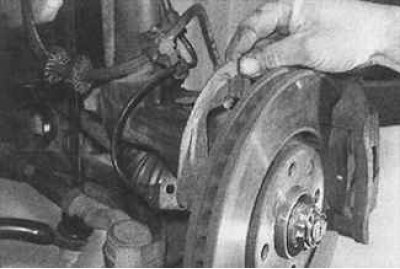
4. Remove the protective shield from the sensor.
5. Disconnect the electrical connector located on the wheel speed sensor wire.
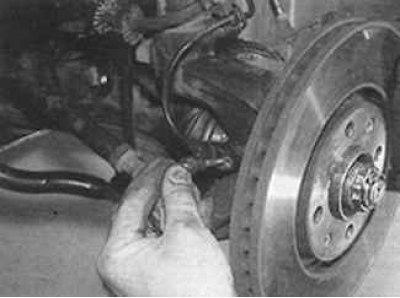
6. Unscrew the wheel speed sensor mounting bolt.
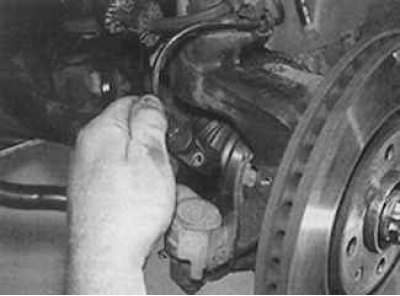
7. Remove the sensor from the steering knuckle.
Installation
1. Make sure the mating surfaces of the sensor and steering knuckle are clean and apply a light coat of grease to the sensor mounting hole in the steering knuckle.
2. Check that the tip of the sensor is clean and fits freely into the steering knuckle.
3. Lubricate the threads of the sensor mounting bolt with an anti-loosening agent (Loctite Frenetanch). Install the sensor into the steering knuckle and secure with a bolt.
4. Connect the electrical connector to the sensor.
5. Install the protective shield to the sensor and secure with a nut and bolt.
Rear wheel sensor (wheel rotation sensor)
Removal
1. Raise the rear of the vehicle and secure it on stands. Remove the corresponding rear wheel.
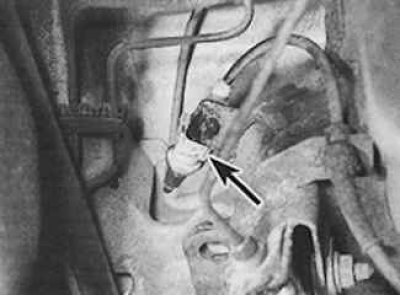
2. Disconnect the electrical connector (indicated by an arrow) from the sensor.
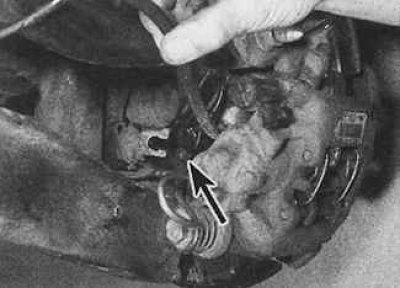
3. Unscrew the bolt and remove the sensor (indicated by the arrow) from the nest.
Installation
1. Make sure the mating surfaces of the sensor and hub are clean. Apply a thin layer of grease to the sensor mounting hole.
2. Make sure the tip of the sensor is clean and fits easily into the hub.
3. Lubricate the threads of the sensor mounting bolt with an anti-loosening agent (Loctite Frenetanch). Install the sensor into the socket and secure with a bolt.
4. Connect the sensor electrical connector.