



Table of contents: Cars with 2.1L XUD series engines 🠇 Cars with 2.5L DK5ATE engine 🠇
Cars with 2.1L XUD series engines
23. Check the condition of the timing belt for wear and mechanical damage
24. Check the ease of rotation of the rollers, make sure that they rotate smoothly, without jamming or noise.
25. Check for any signs of oil leakage on the crankshaft and camshaft seals. Replace any damaged parts with new ones.
26. Lay the toothed belt, preventing it from loosening in the sections between the gears, acting in the following order: (see illustration):
- pinion gear 1 on crankshaft;
- guide roller 2;
- gear 3 high pressure fuel pump;
- camshaft gear 4;
- gear 5 of the water pump:
- tension roller 6.
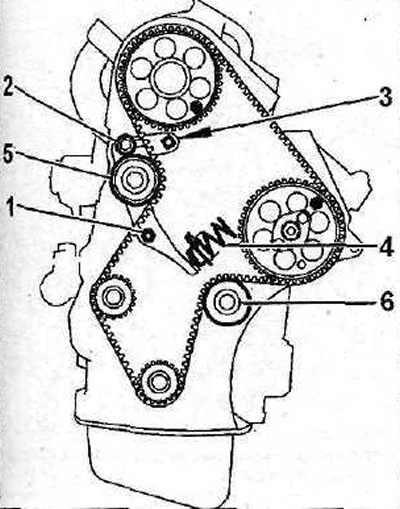
2.26 Place the toothed belt, preventing it from becoming loose in the sections between the gears
27. Loosen the timing belt tensioner bolt, turn the tensioner eccentric counterclockwise until it stops and, holding the eccentric in this position, tighten the bolt, thereby tensioning the belt (see illustration).
28. Tighten the tension roller mounting nut to 10 Nm (see illustration 2.27).
29. Remove the stop bolts that secured the crankshaft and camshaft, as well as the stop that secured the flywheel, and turn the crankshaft two revolutions in the direction of engine rotation.
30. Loosen the tension roller mounting nut, then tighten the nut again to 10 Nm.
31. Check the correct adjustment of the valve timing mechanism by installing the thrust rollers or bolts to lock the crankshaft and camshaft into the corresponding holes. If the mechanism is adjusted correctly, the rollers will enter the holes without any obstacles and fix the crankshaft and camshaft.
32. Next, the installation of the dismantled components is carried out in the reverse order of removal.
Cars with 2.5L DK5ATE engine
33. Check the ease of movement of the tension roller 12 (see illustration).
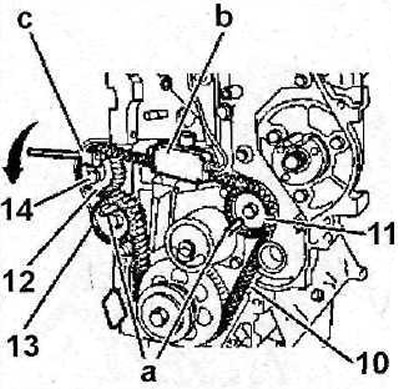
2.33 Check the ease of movement of the tension roller 12
34. Lock the balance shafts with suitable thrust rollers "a" (see illustration 2.33).
35. Place the balance shaft belt first on the crankshaft gear, then on gear 11 of the balance shaft, on tension roller 12 and gear 13 of the second balance shaft. In this case, section 10 of the belt should be tensioned (see illustration 2.33).
36. Remove the thrust rollers "a" that were used to lock the balancing shafts (see illustration 2.33).
37. Attach the sensor "b" of the belt tension measuring device (see illustration 2.33).
38. Install the lever "c" on the tension roller, turn the roller in the direction indicated by the arrow in Illustration 2.33, and read the instrument readings.
The new belt should be tensioned to 70 SEEM. If the old belt is being installed, it should be tensioned to 51 SEEM
39. Tighten bolt 14 of the tension roller with a force of 45 Nm (see illustration 2.33).
40. Remove the belt tension measuring device sensor.
41. Install the timing belt tension roller 15, tighten its mounting bolt 16 with a force of 45 Nm (see illustration).
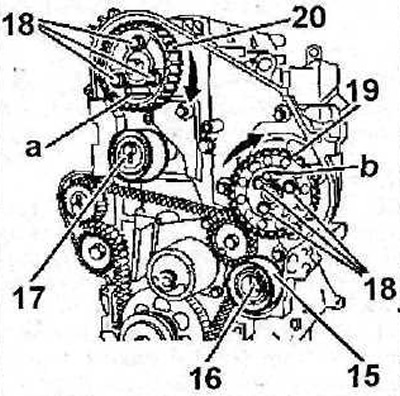
2.41 Install the timing belt tension roller 15, tighten its mounting bolt 16 with a force of 45 Nm
42. Check the ease of movement of tension rollers 15 and 17 (see illustration 2.41).
43. Lock the camshaft gear and the fuel injection pump gear with thrust rollers "a" 0178-A and "b" 0178-B (see illustration 2.41).
44. Loosen the six bolts 18 securing the gears (see illustration 2.41).
45. Check the ease of movement of gear 19 of the camshaft and gear 20 of the high-pressure fuel pump on the hubs (see illustration 2.41).
46. Tighten the gear mounting bolts 18 by hand, then loosen them by 1/6 of a turn (see illustration 2.41).
47. Turn gears 19 and 20 in the direction of engine rotation (see arrows in illustration 2.41) and make sure the gear mounting bolts are centered in the elongated holes and not resting against their ends.
48. Place the toothed belt on the crankshaft gear, then on the tension roller 15 and gear 19 of the fuel injection pump, preventing the section 21 of the belt between the drive gear and the fuel injection pump gear from loosening (see illustration).
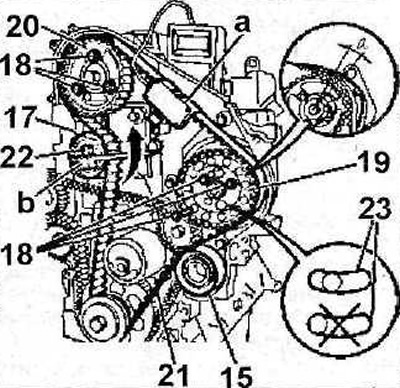
2.48 Place the toothed belt on the crankshaft gear, then on the tension roller 15 and gear 19 of the fuel injection pump
Caution! If necessary, turn the fuel injection pump gear against the direction of engine rotation to align the belt teeth with the gear slots. Only one tooth of misalignment of the gear relative to the belt is allowed.
49. Similarly, place the toothed belt on the camshaft gear 20, then on the tension roller 17 (see illustration 2.48).
50. Secure the sensor "a" of the timing belt tension measuring device (see illustration 2.48).
51. Turn tension roller 17 counterclockwise using key "b" 0178-E (see arrow in illustration 2.48) and read the instrument readings.
The new belt should be tensioned to 107 SEEM. If the old belt is being installed, it should be tensioned to 80 SEEM.
52. Tighten nut 22 of the tension roller fastening with a force of 45 Nm (see illustration 2.48) and remove the measuring instrument sensor.
53. Make sure that bolts 18 for fastening the camshaft gears and the high-pressure fuel pump are located in the center of the elongated holes 23 and do not rest against their ends (see illustration 2.48). To check, you can unscrew one of the bolts. If the bolts are not centered, then the procedure for laying the toothed belt should be repeated.
54. Tighten the gear mounting bolts first to 10 Nm, then tighten them finally to 25 Nm.
55. Remove the thrust rollers that were used to lock the camshaft and fuel injection pump gears.
56. Turn the crankshaft 10 revolutions in the direction of engine rotation.
Caution! Turning the engine in the direction opposite to its rotation is not allowed.
57. Loosen the tension of the toothed belt by turning the tension roller 17 (see illustration).
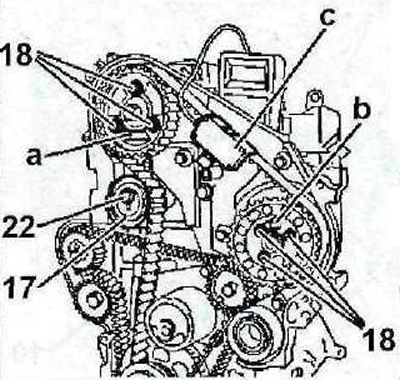
2.57 Loosen the tension of the toothed belt by turning the tension roller 17
58. Loosen the six bolts 18 securing the camshaft gears and the high-pressure fuel pump, then tighten the bolts by hand and loosen them again by 1/6 of a turn (see illustration 2.57).
59. Lock the camshaft and fuel injection pump gears by installing suitable stops "a" and "b" in the corresponding holes (see illustration 2.57).
60. Reinstall the "C" sensor of the timing belt tension measuring device (see illustration 2.57).
61. Turn the tension roller 17 (see illustration 2.57) counterclockwise using a special key 0178-E and read the instrument readings.
The new belt should be tensioned to 58 SEEM. If the old belt is being installed, it should be tensioned to 51 SEEM.
62. Tighten nut 22 securing tension roller 17 (see illustration 2.57) with a force of 45 Nm.
63. Remove and then reinstall the timing belt tension gauge sensor.
64. Make sure that the tension of the new belt is 58±3 SEEM units. If the old belt is installed, its tension should be 51±3 SEEM units.
65. Tighten the gear mounting bolts first to 10 Nm, then tighten them finally to 25 Nm.
66. Remove all stops and special devices.
67. Adjust the tension of the balance shaft drive belt by loosening the tightening of bolt 14 securing the tension roller (see illustration).
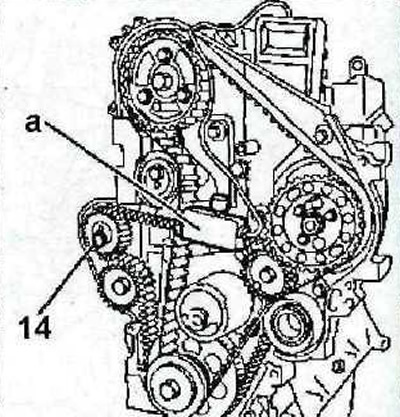
2.67 Loosen the tightening of bolt 14 securing the tension roller
68. Install the sensor "a" of the belt tension measuring device (see illustration 2.67).
69. Turn the tension roller using a suitable key and read the instrument readings.
The new belt should be tensioned to 31 SEEM. If the old belt is being installed, it should be tensioned to 26 SEEM
70. Tighten bolt 14 (see illustration 2.67) with a force of 45 Nm.
71. Remove and then reinstall sensor "a" as shown in Illustration 2.67 and read the instrument readings. The tension of the new belt should be 31±1 SEEM. If the old balance shaft drive belt is installed, its tension should be 26±1 SEEM.
72. Remove all thrust rollers and stops, as well as special devices.
73. Turn the crankshaft two revolutions in the direction of engine rotation.
74. Install new sealing gaskets on the timing drive protective covers.
75. Install protective covers 4 and 6 of the timing gear drive into their seats. Make sure that sealing gasket 25 is installed as shown in the illustration.
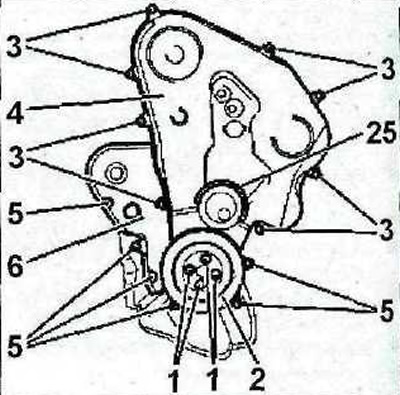
2.75 Install protective covers 4 and 6 of the timing gear drive into their seats. Make sure that sealing gasket 25 is installed correctly
76. Tighten bolts 3 and 5 securing the protective covers to 10 Nm (see illustration 2.75).
77. Install the belt pulley 2 on its seat on the crankshaft and tighten the bolts 1 of its fastening with a force of 20 Nm (see illustration 2.75).
78. Install engine protection.
79. Connect and then turn the cooling hose 26 in the direction of the arrow (see illustration).
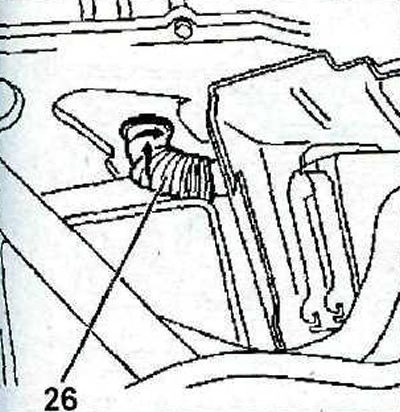
2.79 Connect and then turn the cooling hose 26 in the direction of the arrow
80. Further installation of the dismantled components is carried out in the reverse order of removal.