



Cars with gasoline engines are equipped with a regulated catalytic converter. The term "adjustable" indicates that the reduction of harmful substances in the exhaust gases is achieved by adjusting the composition of the air-fuel mixture. For this purpose, an oxygen sensor is installed in the downpipe before the catalytic converter (lambda probe), which constantly monitors the oxygen level in the exhaust gas. Based on the data received from the lambda probe, the electronic control unit alters the air-fuel mixture, making it richer or leaner. This change in the air-fuel mixture occurs quite quickly and in the following sequence: increasing the air supply for hydrocarbon combustion, decreasing the air supply (lack of air) to reduce nitrogen oxide emissions. The gases produced during combustion of the air-fuel mixture enter the catalyst, which almost completely converts them into carbon dioxide (carbon dioxide), steam and nitrogen.
Some models are not equipped with a catalytic converter.
The exhaust system of vehicles with a diesel engine is equipped with an oxidation catalyst(unregulated catalyst). In this case, the catalytic converter reduces hydrocarbon and carbon monoxide emissions by almost 50%. While the catalytic converter is not a filter that traps carbon deposits and other particles, it does help reduce their content in the exhaust gas. Gaseous hydrocarbons adhere to the solid particles that form carbon deposits and, as a rule, release them into the atmosphere. However, due to the fact that hydrocarbons are oxidized in the catalyst, they are unable to settle and combine with carbon particles.
We do not recommend repairing a heavily rusted exhaust pipe by welding it. The results of this type of repair are quite meager, as the pipe will need to be welded again after a while. Putty and clamps are more effective in this case, but after a while, the pipe will also begin to crumble. As for exhaust pipes with multiple mufflers, it often happens that immediately after replacing one muffler, another one fails. For this reason, it is recommended to change both mufflers at once.
That's why workshops change the entire exhaust system, which isn't always justified. In each specific case, the condition of the exhaust system should be checked and a decision should be made on whether to replace it completely or only its individual parts.
When working on the exhaust system, the vehicle must be lifted and placed on jack stands. Make sure the vehicle is securely supported on jack stands and will not move when removing the exhaust pipes.
If any connection does not come loose when removing the exhaust system, it can be broken. When installing the exhaust system, be sure to replace all mounting bolts and nuts with new ones.
The pipes of the system are separated by twisting at the joints or knocked down with a hammer. If necessary, the pipe can be cut, leaving approximately 10 cm from the connection point. The remaining part of the pipe is cut lengthwise and disconnected with a large screwdriver.
All exhaust system mounting bolts are easier to remove if the bolt threads were lubricated with copper grease during installation of the system. The same applies to the joints of the system pipes.
The exhaust system can be routed differently depending on the type of vehicle.
In vehicles with a gasoline engine, the exhaust system consists of three components: the exhaust pipe, the middle link with an additional muffler, and the main muffler (see illustration 1.0).
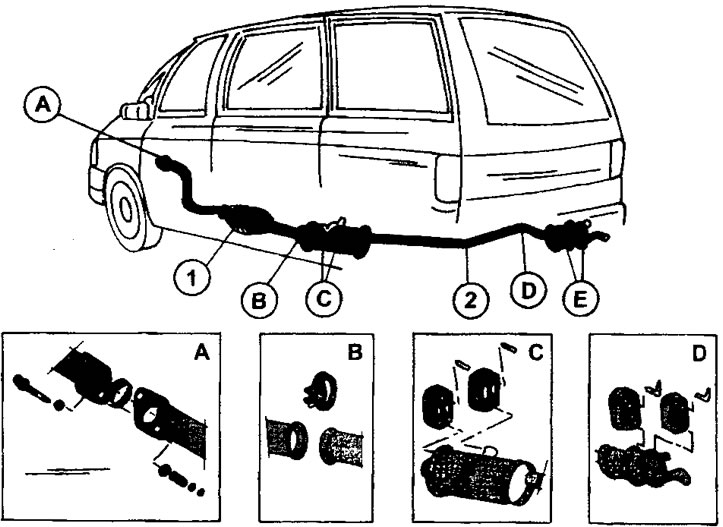
1.0 Exhaust system with catalytic converter
1 - catalyst
2 - front muffler pipe
A - catalytic converter mounting parts
B - fastening the catalyst to the connecting pipe
C - front muffler mount
D - rear muffler mount
E - muffler connection
Please note: Not all vehicles are equipped with a catalytic converter.
Heat-insulating shields are installed above the main and additional mufflers, under the fuel tank and steering gear.
Exhaust systems typically differ in the design of the downpipe (see illustrations 1.0a, 1.0b, 1.0c and 1.0d).
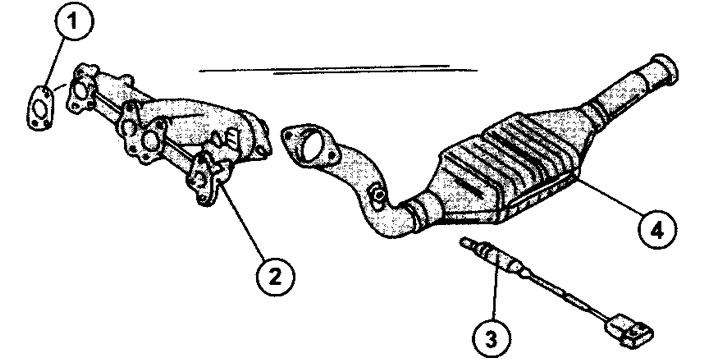
1.0a Downpipe for 1.8 and 2.0 liter XU engines without turbocharger.
1 - pipe sealing gasket
2 - exhaust manifold
3 - lambda probe with wire and exhaust manifold plug
4 - catalyst
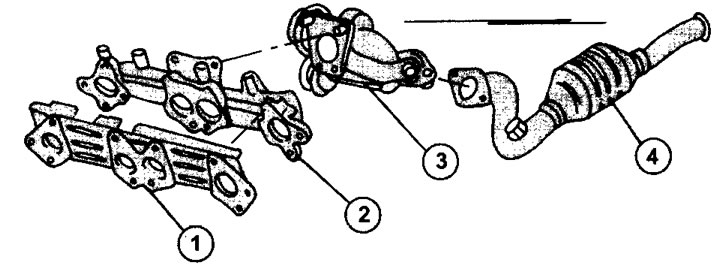
1.0b Downpipe for the 2.0L XU turbocharged engine.
1 - pipe sealing gasket
2 - exhaust manifold
3 - gas turbine supercharger of the exhaust manifold
4 - catalyst
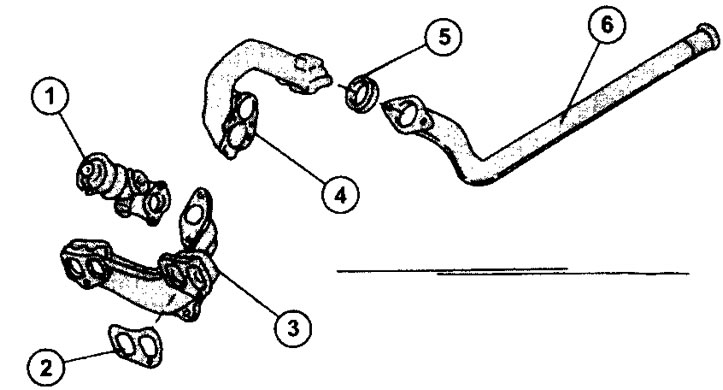
1.0v Diesel Engine Downpipe for XUD9 1.9L
1 - EGR valve
2 - exhaust manifold pipe sealing gasket
3 - exhaust manifold
4 - elbow of the inlet pipe, attached to the turbocharger
5 - gasket
6 - front muffler pipe
The catalytic converter is not shown in this illustration because it is installed in an additional muffler or is attached to the front muffler pipe.
(You can find the original on the page peugeotbook.ru)
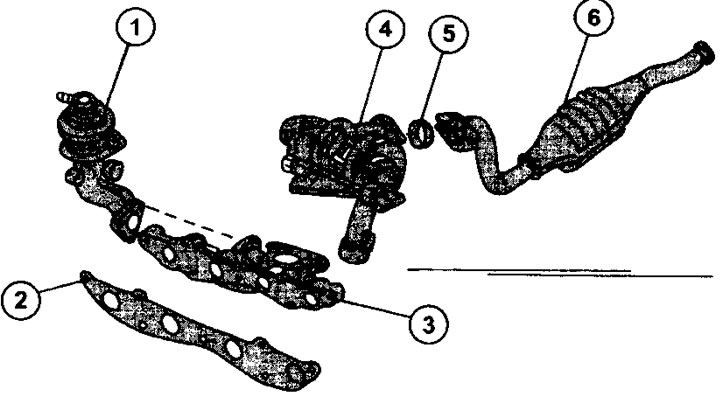
1.0g Diesel engine exhaust pipe XUD11 2.1 liter capacity
1 - EGR valve
2 - pipe sealing gasket
3 - exhaust manifold
4 - gas turbine supercharger
5 - exhaust manifold gasket
6 - oxidation type catalyst