



Table of contents: Electronic control unit 🠇 Engine speed sensor 🠇 Throttle position potentiometer 🠇 Coolant temperature sensor 🠇 Intake air temperature sensor 🠇 Lambda probe 🠇 Knock sensor 🠇 Vehicle speed sensor 🠇 Step relay (double) injection 🠇
The main components of the ignition system are shown in Figure 3.0.
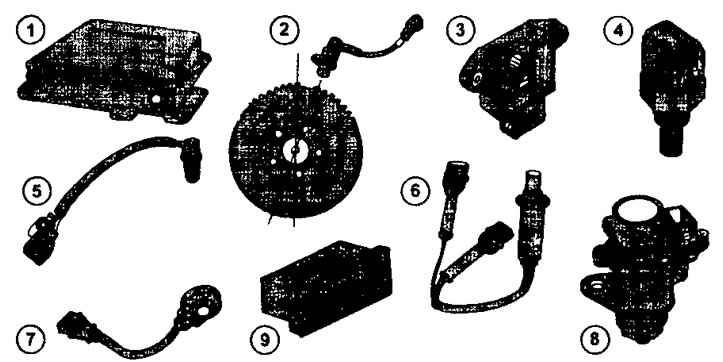
3.0 Ignition System Components
1 - Electronic control unit
2 - Engine speed sensor
3 - Throttle position potentiometer
4 - Coolant temperature sensor
5 - Intake air temperature sensor
6 - Lambda probe
7 - Knock sensor
8 - Speed sensor
9 - Step relay (double) injection
Some of them are also parts of the fuel injection system. Depending on the engine type, some changes in the system configuration are possible.
Electronic control unit
The electronic control unit is equipped with a multi-pin plug connector, which allows it to supply power to the components of the fuel injection and ignition systems, as well as receive information from the elements of these systems.
Engine speed sensor
The engine speed sensor consists of a coil with a winding and a magnetic core. This sensor sends information about the engine speed and the current position of the crankshaft to the electronic control unit. The sensor monitors the flywheel's speed, which is determined by the 60-tooth ring gear. Two teeth are missing from the ring gear, which the sensor registers. The moment of registration corresponds to the TDC of the engine.
Throttle position potentiometer
The Bosch throttle position potentiometer informs the electronic control unit of the position of the throttle valve, which can close the inlet, open it partially or open it completely. Based on the received information, the electronic control unit determines the acceleration and speed increase mode, braking or forced idle. The electronic control unit supplies the potentiometer with 5 V power. Depending on the throttle position, the potentiometer sends signals to the unit with a current of 0 to 5 V.
Coolant temperature sensor
The coolant temperature sensor is located in the outlet pipe and informs the control unit about the current coolant (engine) temperature. The signal about the coolant temperature is sent to the control unit as an electrical resistance, the strength of which depends on the temperature.
Intake air temperature sensor
The intake air temperature sensor is mounted on the throttle body and informs the control unit of the temperature of the air entering the combustion chambers. Like the coolant temperature sensor, this sensor also sends its signals in the form of current of varying strength.
Ignition timing sensor (TDC, cylinder #1). This sensor is not shown in Figure 3.0. This sensor is installed on the cylinder head of an engine with 16 valves. It recognizes the position of the piston of cylinder No. 1 and, based on this information, the ignition timing is adjusted.
Lambda probe
The lambda probe is located in the exhaust pipe before the catalytic converter. It is designed to inform the electronic control unit about the oxygen content in the exhaust system. The lambda probe is heated, ensuring it quickly reaches operating temperature.
Knock sensor
The knock sensor is screwed into the cylinder block under the intake manifold. Its information allows the control unit to adjust the ignition timing of the air-fuel mixture in the chamber of the corresponding cylinder.
Vehicle speed sensor
The vehicle speed sensor informs the control unit about the current vehicle speed.
Step relay (double) injection
Step relay (double) the injection is mounted on the control unit holder and is connected to the following parts:
- a) fuel pump;
- b) throttle valve angular displacement potentiometer;
- c) idle speed controller;
- d) fuel injectors;
- d) control unit;
- g) ignition coil;
- c) lambda probe heating element;
- e) electromagnetic valve of the adsorber;
- k) a valve for changing the configuration of the cavity of the intake manifold pipes on an engine with 16 valves.